Repairing a Blower Motor vs. Replacing the Entire Air Handler
Facing a Failed Blower Motor in the Late-Summer Heat?
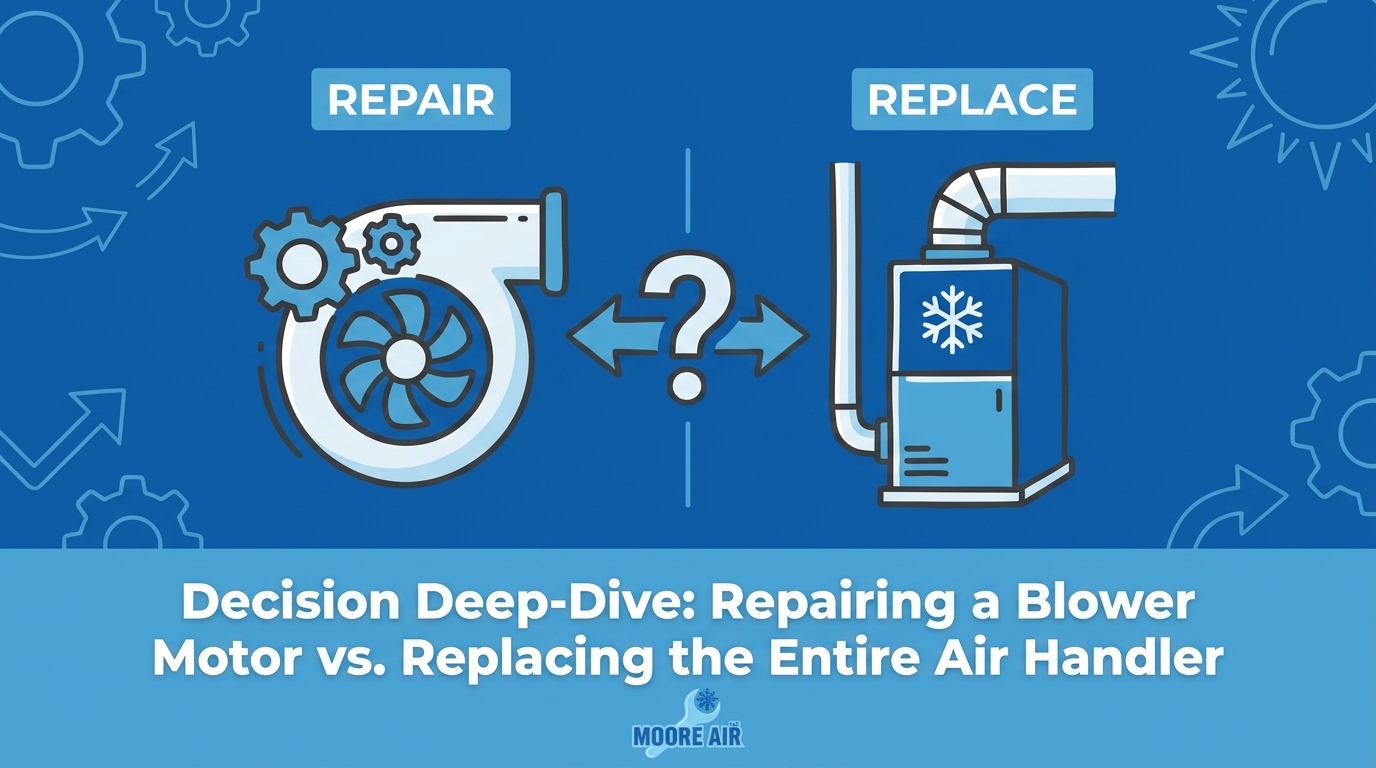
Is your air conditioning system running nonstop, yet the vents are barely pushing out any air? Finding out you are facing the decision of repairing a blower motor vs. replacing the entire air handler is one of the most stressful moments a homeowner can experience, especially during peak August late-summer cooling demand as families transition back to school. The house gets warm quickly, the air feels stagnant, and you are suddenly forced to make a major choice about your home comfort system. Our team at Moore Air has walked countless Litchfield Park homeowners through this exact scenario, and we know how overwhelming it can feel.
When the indoor fan stops spinning, the immediate discomfort makes it tempting to choose whichever option gets the cold air flowing fastest. However, treating this merely as a quick-fix situation often leads to recurring breakdowns. You are standing at a critical decision point: do you invest in a component-level repair to keep your current setup limping along, or is it time to upgrade the entire indoor unit for long-term reliability?
To make the smartest choice for your home, you need a transparent, non-price-dependent evaluation framework. By looking closely at the age of your equipment, the status of your manufacturer warranty, and the hidden wear and tear caused by extreme weather, you can determine exactly which path makes the most sense for your specific situation.
Understanding the Blower Motor’s Role in Your HVAC System
Before making any major decisions, it helps to understand exactly what has stopped working and how it fits into the larger picture of your home cooling system. The blower motor is the beating heart of your indoor climate control. Its primary function is to pull warm, unconditioned air from your home through the return ducts, push it across the chilled evaporator coil, and circulate the newly cooled air back into your living spaces.
Many homeowners confuse the blower motor with the air handler itself. Here is the distinction:
- The Blower Motor: This is a single electrical component. It consists of the motor itself, internal bearings, and a drive shaft that spins the fan blades.
- The Air Handler: This is the large metal cabinet located inside your home (often in a closet, attic, or garage). It houses the blower motor, the blower wheel (the fan), the evaporator coil, the drain pan, and various electrical control boards.
When you live in an environment like Litchfield Park AZ, our technicians know firsthand that your HVAC system rarely gets a break. Continuous high-load operation in this local climate forces the blower motor to run almost non-stop for months on end. This relentless workload accelerates wear on the motor’s internal bearings and electrical windings. Friction builds up, heat accumulates inside the motor housing, and eventually, the component simply burns out from exhaustion.
Understanding this heavy workload is key because a pattern we see often is that a failed motor is rarely an isolated event. If the environment has been harsh enough to destroy the heavy-duty blower motor, that same environment has been punishing the rest of the components inside the air handler cabinet as well.
Evaluating a Blower Motor Repair on an Aging System
If your system is relatively young, swapping out a dead motor is usually a straightforward decision. But if your equipment has been working hard for over a decade, you need a logical framework to decide if a component repair still makes sense. The goal is to avoid throwing good money at a machine that is fundamentally failing.
The 50% Rule for HVAC Repairs
A standard guideline we rely on in the industry is the 50% rule. If the cost of the repair approaches or exceeds half the value of the unit’s remaining viable life, you should seriously reconsider the investment. Instead of looking purely at the immediate invoice, consider how many more years of reliable service that repair will actually buy you.
Manufacturer Warranty Status
Always check your warranty status before authorizing a major repair. If your system was registered properly after installation, the blower motor might still be covered under a parts warranty. In that scenario, the manufacturer provides the replacement part, and you only cover the labor. If the warranty has expired, you bear the full burden of both the part and the extensive labor required to calibrate it.
The Risk of Mismatched Systems
Sometimes homeowners try to replace just the indoor air handler while leaving an old, failing outdoor condenser in place. This creates a mismatched system. Modern indoor units are designed to communicate with specific outdoor units to achieve their rated efficiency. Pairing new indoor technology with old outdoor technology forces the new blower motor to work against an inefficient compressor, often leading to premature failure. If you are weighing repairing an older AC vs. installing a new split system, we strongly recommend keeping the indoor and outdoor components matched.
That being said, a well-maintained, slightly older unit can sometimes be kept running reliably with the right repair. One Litchfield Park homeowner reached out in the spring regarding an aging unit that was originally installed over three decades ago. Our technicians arrived quickly, diagnosed the issue, and successfully performed the necessary repairs, keeping that 31-year-old unit running reliably for another ten years with only two major service calls. At Moore Air, we are committed to honest diagnostics—if a repair makes sense and extends the unit’s life safely, we will recommend it without upselling.
Hidden Risks: Cascading Failures in Older Air Handlers
A common trap our team sees homeowners fall into is assuming that a new blower motor makes the whole indoor unit “like new” again. In reality, replacing a blower motor does not reset the clock on the rest of the air handler. This oversight leads to the dreaded “band-aid” approach, where you end up paying for multiple major service calls in a single season.
The Problem: The Band-Aid Approach
When you replace the motor in a heavily aged cabinet, you are putting a strong, high-torque component into a weakened environment. The new motor will immediately start pulling air at maximum capacity. If the surrounding ductwork, blower wheel, or control boards are brittle from years of heat exposure, the increased performance from the new motor can actually strain those older parts to the breaking point.
The Cause: Accelerated Wear in Extreme Climates
National HVAC lifespan averages usually suggest a system should last 15 to 20 years. However, in our years servicing Litchfield Park AZ, we know those numbers include mild climates where systems sit idle for half the year. Extreme local late-summer heatwaves mean your system is running constantly. Under this August late-summer cooling demand, the realistic reliable lifespan drops to 10-12 years. By year 11, the wiring insulation is degrading, and the metal components have expanded and contracted thousands of times.
The Solution: Looking at the Whole Picture
The most significant hidden risk is the evaporator coil, which sits right next to the blower motor. Over a decade of use, the copper or aluminum tubing in the coil weakens. It is incredibly common for a homeowner to replace a blower motor in July, only to have the evaporator coil develop a massive refrigerant leak in August. By looking at the overall health of the entire air handler—including the coil, the drain pan, and the electrical relays—you can avoid the frustration of cascading failures.
Key Factors When Deciding Between Blower Motor Repair and Air Handler Replacement
To help simplify this complex choice, we have broken down the primary evaluation criteria into a straightforward comparison. Use this framework to weigh your options logically.
| Evaluation Factor | When to Repair the Blower Motor | When to Replace the Air Handler |
|---|---|---|
| System Age | The unit is under 10 years old and has been regularly maintained. | The unit is approaching or past the 10-12 year mark in our extreme climate. |
| Warranty Status | The part is fully covered under an active manufacturer warranty. | The warranty has expired, leaving you fully responsible for parts and labor. |
| Recent Breakdowns | This is the first major component failure the system has experienced. | The system has required multiple repairs over the last two cooling seasons. |
| Energy Efficiency (SEER) | Your current energy bills are manageable and the system cools effectively. | Your energy bills are rising constantly, and the home struggles to stay cool. |

The Long-Term Benefits of a Full Air Handler Upgrade
While a repair might seem like the path of least resistance, replacing the entire indoor unit is often the smarter, safer long-term investment for older systems. Upgrading your air handler does more than just fix a broken fan—it fundamentally improves how your home breathes and cools, a benefit we consistently hear our customers rave about.
First and foremost, a full replacement restores your peace of mind. During relentless August heatwaves, the last thing you want is the lingering anxiety that your aging system might fail again tomorrow. A new air handler resets the clock on all indoor components, ensuring that the blower motor, evaporator coil, and control boards are all perfectly matched and brand new.
Modern air handlers also offer massive leaps in technology. Today’s units frequently feature variable-speed blower motors. Unlike older single-stage motors that blast air at full capacity and then shut off, variable-speed motors adjust their airflow in tiny increments. This provides superior indoor air quality and dramatically better humidity control, preventing that clammy, sticky feeling inside the house. Because they run at lower, more consistent speeds, they also consume significantly less electricity.
Furthermore, upgrading to high-efficiency equipment often opens the door to financial incentives. Depending on the SEER rating and specifications of your new system, you may be eligible for generic federal tax credits or local utility rebates designed to encourage energy conservation. While you should always verify current programs with your utility provider or tax professional, these incentives can help offset the initial investment.
Another local homeowner faced an extreme crisis in the fall after dealing with poor troubleshooting and aggressive upselling from other companies. When Moore Air stepped in, we provided a timely, professional assessment and installed a new AC unit at a fair rate, leaving the customer completely satisfied with their newly installed system and restored comfort. Doing the job right the first time always pays off.
Frequently Asked Questions About Air Handler and Blower Motor Decisions
Is it worth replacing a blower motor on an old AC?
The short answer is that it depends heavily on the exact age and warranty status of the equipment. If the unit is under a decade old and still covered by a manufacturer warranty, a repair is usually a smart move. However, if the unit is over 10-12 years old and out of warranty, our team generally finds that investing in a replacement is more cost-effective long-term. Sinking significant funds into an obsolete machine rarely pays off.
How long do AC blower motors typically last in extreme climates?
While the national average lifespan for HVAC components is roughly 15 years, extreme heat can severely reduce this timeline. In areas that experience intense late-summer cooling demand, continuous operation stresses the motor’s bearings and electrical components daily. Because of this heavy workload, a reliable lifespan of 10-12 years is much more realistic before major failures begin to occur.
Should I replace the air handler or the whole system?
At Moore Air, we highly recommend replacing both the indoor and outdoor units together to ensure matched efficiency and optimal performance. Mismatched systems—where a new air handler is paired with an old, struggling outdoor condenser—can cause severe refrigerant flow issues and lead to premature failure of the new components. A matched system operates exactly as the manufacturer intended.
Does a new air handler improve system efficiency?
Yes, upgrading to a modern air handler dramatically improves overall efficiency. Modern air handlers feature variable-speed motors and advanced coil designs that transfer heat much more effectively than older models. These advancements provide better airflow, tighter humidity control, and lower monthly energy consumption across the board.
Can I replace the blower motor myself?
No, replacing a blower motor is not a DIY weekend project. This procedure requires handling high-voltage electrical components, navigating complex control board wiring, and performing specific airflow calibrations. Always hire a licensed HVAC professional to ensure the safety of your home, protect your equipment from damage, and maintain compliance with manufacturer warranties.
Get an Honest Assessment for Your Air Handler Today
Navigating an unexpected HVAC failure doesn’t have to mean guessing about the future of your system. By applying a clear, non-price-dependent evaluation framework, you can weigh the age, warranty status, and overall health of your equipment to make a confident choice. You deserve to know exactly what is happening inside your air handler so you can avoid wasting money on temporary band-aid repairs.
At Moore Air, we believe in providing a factual, pressure-free cost-benefit analysis for every diagnostic visit. Our experienced technicians will thoroughly inspect your blower motor, evaporator coil, and overall system health, giving you the exact information you need to make the right call for your home. Schedule your professional inspection today to determine the best, most reliable path forward for your family’s comfort and safety.