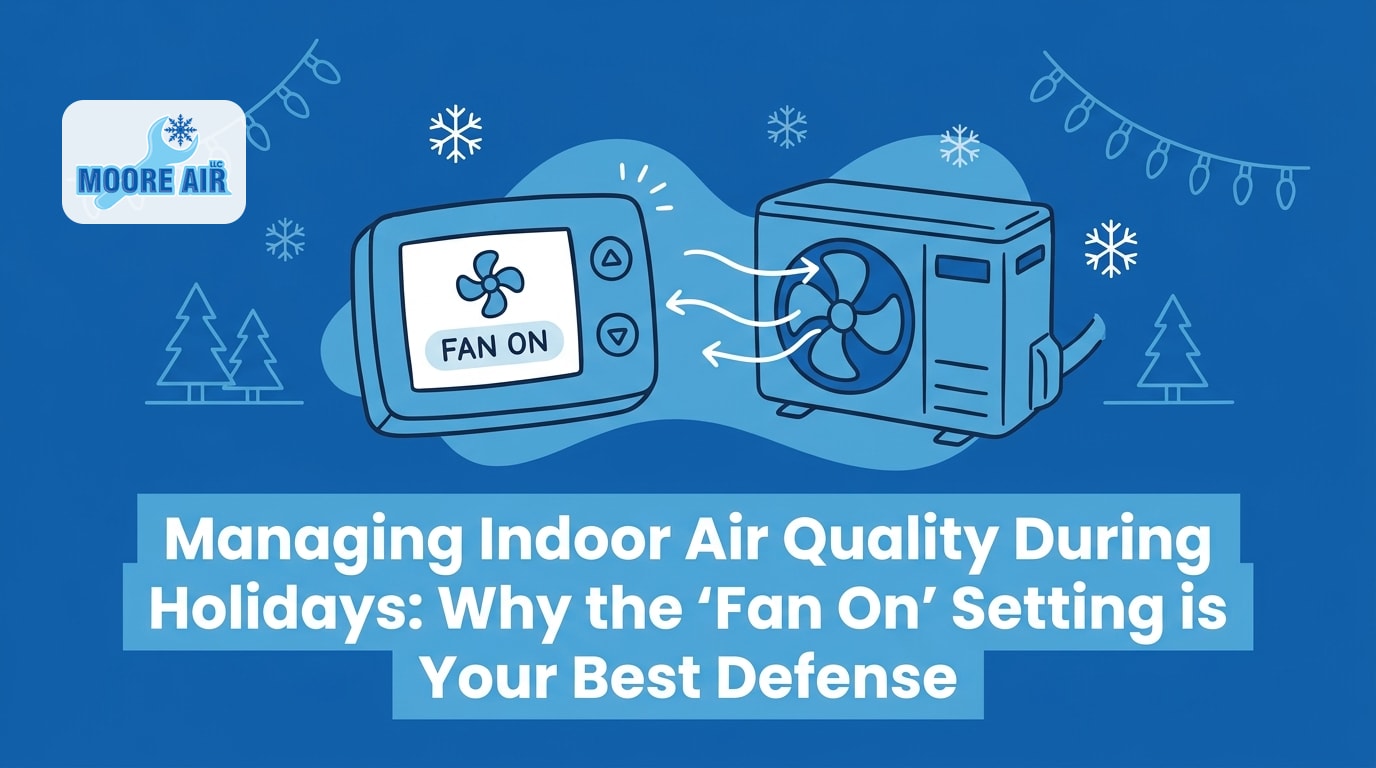
Managing Indoor Air Quality During Holidays: Why the ‘Fan On’ Setting is Your Best Defense
The Hidden Challenge of a Full House During the Holidays
Your home feels perfectly comfortable on a normal Tuesday, but managing indoor air quality during holidays is an entirely different challenge. As soon as family and friends arrive for November holiday hosting, the living room suddenly feels warm, stuffy, and stagnant. The air grows heavy, odors linger longer than they should, and guests might start shedding layers even if the heat isn’t running. This sudden shift in comfort is a concrete problem that nearly every host faces, yet the solution is often sitting right on the wall.
As a house fills up with people, the existing air becomes trapped. Without active circulation, the environment degrades rapidly, leading to discomfort for everyone gathered. Many homeowners don’t realize their existing HVAC system holds a simple, immediate solution. By making a quick adjustment to your thermostat fan setting (‘On’ vs ‘Auto’), you can actively manage the environment before guests even arrive. If you are exploring indoor air quality services, starting with a pre-holiday furnace tune-up ensures your system is ready for the extra workload.
Why Indoor Air Quality Plummets When the Guest List Grows
To understand how to fix a stuffy house, it helps to understand exactly why the air quality drops so quickly during high-occupancy events. A home’s ventilation system is typically sized and balanced for the everyday occupants. When you multiply the number of people inside, you fundamentally alter the indoor environment in several distinct ways.
The Biological Impact of a Full House
Every additional person in the home contributes to a rapid spike in indoor carbon dioxide (CO2) and moisture levels. Human respiration and body heat constantly add warmth and humidity to the surrounding air. In a crowded living room or dining area, this localized accumulation of heat and moisture creates the classic “stuffy” feeling. Without active air circulation, these biological byproducts remain suspended in the immediate living areas rather than dispersing evenly throughout the house.
The Kitchen’s Role in Stale Air
Heavy kitchen usage for holiday meals introduces an entirely separate set of airborne challenges. Preparing large feasts involves hours of roasting, boiling, and baking, which releases cooking-related volatile organic compounds (VOCs), grease particles, smoke, and lingering odors into the air.
- Airborne grease and oils: Microscopic droplets from sautéing and frying travel far beyond the kitchen boundaries.
- Excess humidity: Boiling large pots of water for vegetables or pasta pushes heavy moisture into the surrounding rooms.
- Lingering food odors: Without proper extraction, the smell of roasted meats and heavy spices can settle into fabrics and upholstery.
When you combine body heat, respiratory moisture, and heavy cooking output, the indoor air quality rapidly degrades. The air feels thick because it is physically denser with moisture and particulates.
The ‘Auto’ Dilemma: How Mild Late-Fall Weather Works Against You
Most residential thermostats are left in the default “Auto” position year-round. While this is generally the most energy-efficient choice for daily life, it becomes a distinct disadvantage during a crowded gathering, specifically due to how the equipment responds to ambient weather.
Why ‘Auto’ Mode Fails During Parties
In “Auto” mode, the HVAC blower fan only runs when the system is actively heating or cooling the home. The thermostat monitors the room temperature; when it drops below your setpoint, it triggers the furnace and the fan simultaneously. Once the target temperature is reached, the entire system shuts down. Because late-fall weather is often mild, the system rarely triggers a full heating or cooling cycle. The ambient temperature might sit perfectly at 70 degrees, meaning your blower motor remains entirely dormant while CO2 and cooking odors build up in the stagnant air.
The Window Trap in the Desert
When the house feels stuffy, the immediate instinct is to crack open a few windows to let fresh air inside. However, this strategy often backfires depending on your local climate. In our region, the specific conditions of Litchfield Park—cooler November nights combined with pervasive desert dust—mean homes are actually better off kept closed. Opening windows invites fine dust, outdoor allergens, and unpredictable drafts into the home, compromising cleanliness and making temperature control nearly impossible. Relying on the “Auto” setting during a party with the windows closed means the home’s air filter is essentially sitting idle when you need it most.
| Thermostat Setting | When the Fan Runs | Air Filtration Frequency | Best Used For |
|---|---|---|---|
| Auto Mode | Only during active heating or cooling cycles | Minimal during mild fall weather | Everyday energy efficiency and normal occupancy |
| On Mode | Continuously, 24 hours a day | Maximum (air cycles multiple times per hour) | High-occupancy events, parties, and heavy cooking |
How the ‘Fan On’ Setting Transforms Your Existing HVAC System
Your central heating and cooling system is more than just a temperature control device; it is a powerful, whole-home air mover. By understanding how to manipulate the thermostat fan setting (‘On’ vs ‘Auto’), you can harness this power on demand.
The Mechanics of Whole-Home Filtration
Switching the thermostat from “Auto” to “On” forces the blower motor to run continuously, regardless of temperature demands. Even if the furnace burners are off and the AC compressor is silent, the indoor fan continues to pull air through the return grilles, push it through the central air filter, and redistribute it through the supply vents. This continuous operation pulls the home’s air through the HVAC filter multiple times per hour. Active circulation prevents hot and cold spots, evening out the temperature between a crowded, warm living room and empty, cooler bedrooms. It serves as a constant filtration cycle that actively removes dust, pet dander, and cooking odors before they can settle.
Steps for Pre-Party HVAC Preparation
To get the most out of your system before guests arrive, follow this simple preparation checklist:
- Inspect the filter: Check and replace your existing air filter to ensure maximum airflow and filtration efficiency.
- Adjust the thermostat: Switch the thermostat fan setting to “On” at least two hours before the first guests arrive to establish a baseline of clean air.
- Open interior pathways: Leave interior doors open to promote cross-ventilation and allow air to reach the central return grilles.
- Monitor the temperature: Lower the target temperature by a degree or two to account for the extra body heat that will soon fill the rooms.
- Revert after the event: Return the setting to “Auto” after the gathering concludes to conserve energy and reduce wear on the blower motor.

A Free Comfort Upgrade vs. Expensive Air Purifiers
When faced with a stuffy, uncomfortable home during the holidays, many homeowners rush out to buy expensive, noisy portable air purifiers. While there is a time and place for supplemental filtration, your central HVAC system is already designed to move and filter air throughout the entire home.
The Limitations of Portable Units
Portable air purifiers are generally designed for single-room application. A unit placed in the corner of a dining room might filter the air in a 200-square-foot radius, but it does absolutely nothing for the kitchen, the hallways, or the guest bathrooms. Furthermore, running multiple high-capacity portable units during a party adds significant background noise, forcing guests to speak louder and contributing to a chaotic environment.
Why We Recommend the Free Option First
Utilizing the continuous fan setting leverages equipment you already own at no additional upfront cost. At Moore Air, we believe in a “no games” approach: providing homeowners with free, actionable advice to improve comfort immediately, rather than using a stuffy home as an excuse to push expensive IAQ products. This simple thermostat adjustment often resolves temporary stuffiness without the need for high-pressure sales pitches or immediate equipment upgrades. By forcing the air through your existing ductwork, you turn your entire house into a unified, filtered environment, quietly managing indoor air quality during holidays without adding clutter to your living spaces.
Supporting Your System’s Continuous Operation
While switching the fan to “On” is a highly effective strategy for November holiday hosting, continuous operation is only as effective as the infrastructure supporting it. The air moving through your home relies on two critical components: the filter and the ductwork.
The Role of Your Air Filter
Continuous fan operation pushes a massive volume of air through your HVAC filter. If you begin a three-day holiday weekend with a filter that is already partially clogged, running the fan constantly will quickly load it to capacity. A dirty filter restricts airflow, which strains the blower motor and drastically reduces the amount of air circulating through the living spaces. Before utilizing this strategy, installing a fresh, high-quality pleated filter ensures the system can breathe easily while capturing the maximum amount of airborne debris.
Why Ventilation Pathways Matter
The condition of the home’s ventilation network plays a massive role in how well air circulates when the fan is running. Leaky, disconnected, or poorly designed vents can prevent the freshly filtered air from reaching the living spaces where guests are gathered. If your central blower is pushing air into the attic instead of the living room due to a disconnected duct, the “Fan On” strategy will fall flat. Ensuring the pathways are clear and intact maximizes the benefit of this thermostat strategy. If you suspect your airflow is weaker than it should be, exploring duct work services can help seal leaks and restore proper circulation to the main entertaining areas.
Ensuring Comfort in Guest Rooms and Overflow Spaces
While the main living areas might feel perfectly comfortable with the fan running constantly, isolated rooms present a different challenge. Homes are dynamic environments, and the way air travels through them changes when interior doors are closed for privacy.
Troubleshooting Stuffy Guest Rooms
During the holidays, out-of-town guests often retreat to bedrooms and close the doors. Closed doors and blocked return vents can disrupt the continuous airflow cycle. If a bedroom does not have its own dedicated return grille, closing the door traps the air inside, preventing it from traveling back to the central system to be filtered and reconditioned. This is why a guest room can quickly become stuffy and warm while the hallway right outside remains perfectly comfortable.
It’s important to verify that air is properly reaching the rooms where out-of-town guests will be sleeping. Encourage guests to leave doors slightly ajar when the rooms are unoccupied, and ensure that luggage or temporary bedding isn’t blocking the supply registers on the floor or lower walls. If continuous fan operation doesn’t resolve uneven temperatures in these specific zones, it may indicate a broader need for professional assessment. You can learn more about checking HVAC airflow for guest rooms to identify localized blockages, or look into comprehensive HVAC services to balance the system permanently. By taking control of your thermostat and understanding how air moves through your home, you can ensure a fresh, welcoming environment for everyone who walks through your door this season.
Frequently Asked Questions
Does running the HVAC fan improve air quality?
Yes, running the fan continuously can significantly improve indoor air quality. By keeping the air moving, the system constantly pulls suspended particles, dust, and odors through the central air filter rather than allowing them to settle in your living spaces. This is especially effective during gatherings when airborne contaminants naturally increase.
How do I stop my house from getting stuffy with guests?
The most effective immediate step is to switch your thermostat fan setting from “Auto” to “On.” This forces the blower to circulate air continuously, preventing the buildup of body heat, cooking moisture, and exhaled carbon dioxide that causes the classic stuffy feeling in crowded rooms.
Should I set my thermostat to On or Auto for a party?
You should set your thermostat to “On” a few hours before the party begins and leave it there until guests depart. “Auto” mode only circulates air during active heating or cooling cycles, which may not happen frequently enough during mild fall weather to keep a crowded house feeling fresh.
How to get rid of cooking smells when guests are over?
Combine local ventilation with whole-home circulation to clear odors quickly. Run your kitchen exhaust hood on high while cooking, and keep the HVAC fan set to “On” so any escaping odors are pulled into the return grilles and trapped by the central air filter before they can permeate the upholstery.
Will running the HVAC fan continuously damage the motor?
No, modern HVAC blower motors are designed to handle continuous operation safely. In fact, leaving the fan on can sometimes reduce wear and tear on the motor components, as the system avoids the repetitive stress of starting and stopping multiple times per hour.
How often should I change my filter if I run the fan constantly?
If you choose to run your fan continuously, you will likely need to replace your air filter more frequently. Because the system is actively filtering air 24 hours a day, a standard pleated filter that usually lasts 90 days may become loaded with debris in just 45 to 60 days, requiring closer monitoring.