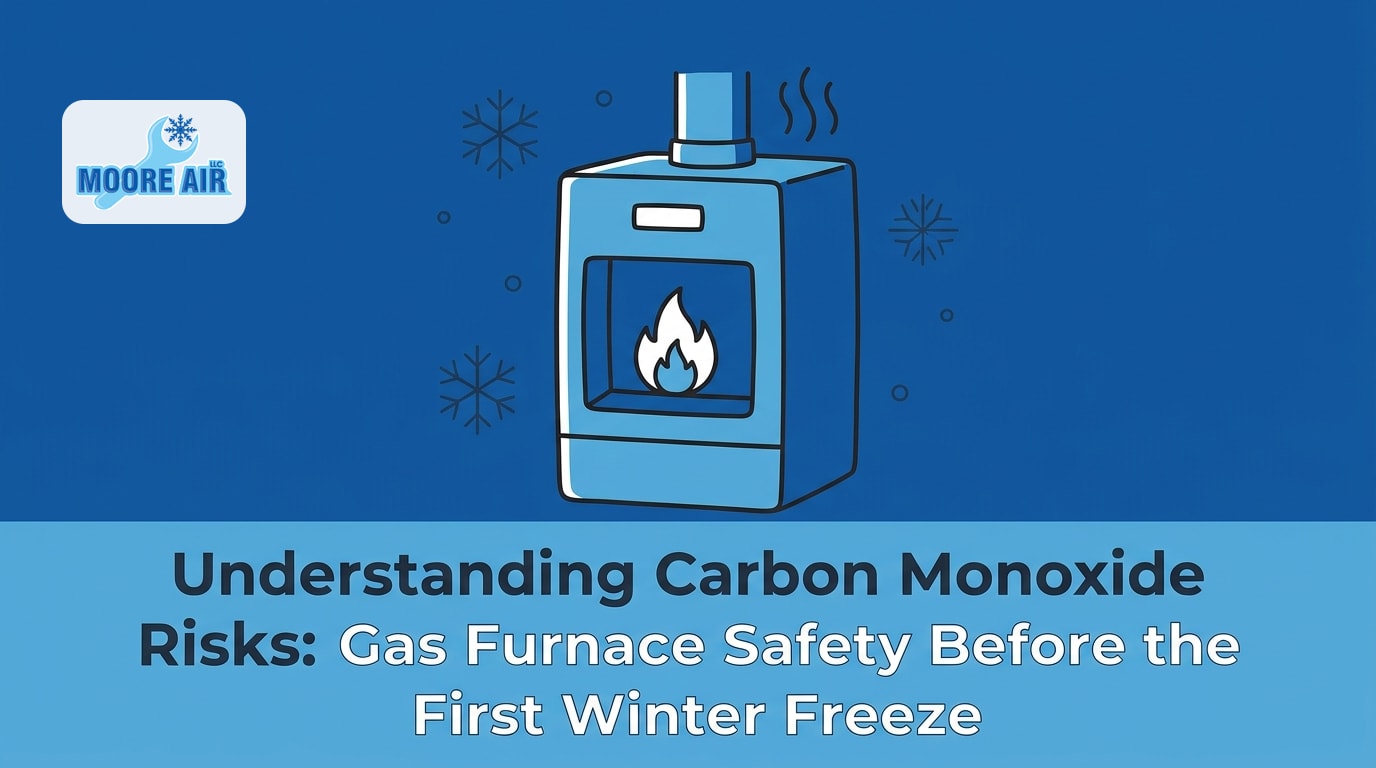
Understanding Carbon Monoxide Risks: Gas Furnace Safety Before the First Winter Freeze
The Hidden Danger Awakening in Your Dormant Heating System
Understanding the hidden carbon monoxide risks gas furnace systems can develop is critical when your heating equipment has been sitting completely idle for months. You might notice a slight chill in the air and instinctively reach for the thermostat, assuming everything will work just as safely as it did last winter. However, a heating system that has been baking in the extreme desert heat for eight or nine months is not the same machine you turned off in the spring. Unseen physical stress takes a toll on dormant internal components, meaning that firing up an untested system on the first chilly night of the year carries significant, invisible hazards.
Before the November first-freeze arrives, scheduling professional gas furnace services is the only way to ensure your home remains both warm and safe.
The Long Desert Dormancy
In many parts of the country, HVAC systems get a relatively balanced workout throughout the year. Here in the desert, the operational cycle is heavily skewed. Your air conditioning runs relentlessly for over half the year, while the furnace portion of your system sits entirely dormant. During this extended eight to nine-month hibernation, the metal components of your heating system are not simply resting in a climate-controlled vacuum. They are subjected to the intense, passive ambient heat of your attic or garage.
When you combine this long period of inactivity with extreme environmental temperatures, the seals, joints, and metal barriers within the system begin to experience subtle changes. Dust settles thickly over the burners, lubrication dries up, and the structural integrity of critical safety barriers can be compromised without showing a single outward sign of damage.
The Risk of the First Chilly Night
The true danger reveals itself when the temperature suddenly drops and you demand immediate, high-capacity heat from a system that has been asleep since March. The sudden introduction of active combustion flames into a cold, stressed metal chamber creates a massive thermal shock. If the dormant period has weakened the system, this initial start-up is exactly when microscopic stress fractures can widen into active leaks. Relying on assumptions that the system is fine just because it worked last year is a dangerous gamble when it comes to combustion appliances.
How a Gas Furnace Produces—and Contains—Carbon Monoxide
To understand why a neglected system is dangerous, it helps to understand how a gas furnace operates safely under normal, healthy conditions. Creating heat requires burning fuel, and burning fuel always creates chemical byproducts. Carbon monoxide is not a sign that your furnace is fundamentally broken; it is a natural, expected result of the combustion process. The difference between a safe home and a dangerous one lies entirely in how the furnace contains and exhausts that gas.
The Mechanics of Safe Combustion
When your thermostat calls for heat, the furnace opens a gas valve and ignites the burners. This controlled fire burns inside a specialized metal chamber called the heat exchanger. As the natural gas burns, it generates intense heat, along with a mixture of combustion gases that includes water vapor, carbon dioxide, and carbon monoxide. In a properly functioning system, these toxic gases never mix with the air you breathe inside your home.
Instead, the blower motor pulls cold air from your return vents and pushes it over the outside of the hot metal heat exchanger. The air absorbs the heat radiating through the metal, warms up, and is pushed out through your supply vents to heat your rooms. Because the heat exchanger acts as an absolute physical barrier, the breathing air and the combustion gases remain completely separated.
The Crucial Role of the Flue System
Once the heat has been extracted from the combustion process, the remaining toxic gases must be safely removed from the home. This is the job of the flue or venting system. A dedicated draft inducer fan pulls the carbon monoxide and other byproducts out of the heat exchanger and pushes them up through a metal or PVC pipe, venting them safely outdoors into the atmosphere.
As long as the heat exchanger remains fully intact and the flue pipe remains clear, the carbon monoxide generated by your furnace poses no threat to your household. Ensuring this barrier is uncompromised is the primary goal of a comprehensive furnace tune-up and safety inspection.
Why Heat Exchangers Crack: The Desert Climate Factor
A cracked heat exchanger is the most common and dangerous way that carbon monoxide escapes a furnace and enters a home’s breathing air. When the metal wall of the heat exchanger develops a fissure, the physical barrier between the toxic combustion gases and your clean indoor air is broken. As the blower fan pushes air over the cracked metal, it can force those toxic gases out into your ductwork, distributing carbon monoxide into every room of the house.
The Toll of a Litchfield Park AZ Summer
The problem: Many homeowners do not realize that the local climate plays a massive role in heat exchanger failure. In Litchfield Park AZ, HVAC units are often installed in attics or unconditioned garages. During the peak of summer, ambient temperatures in these confined spaces can easily exceed 140 to 150 degrees Fahrenheit.
The cause: Even though the furnace is turned off, the metal heat exchanger is still subjected to extreme passive thermal expansion. Day after day, the metal expands in the afternoon heat and contracts slightly at night. Over an eight to nine-month dormant period, this constant, passive flexing stresses the metal. Welds can become brittle, and microscopic weak points begin to form. Furthermore, the extreme heat dries out any protective seals or gaskets within the surrounding casing.
The solution: When November arrives and the furnace is suddenly fired up, the burners blast the heat exchanger with temperatures exceeding 400 degrees. The metal, already stressed from months of passive summer expansion, is violently forced to expand again. This sudden thermal shock is often the exact moment a stressed weld snaps or a brittle panel cracks. Because this damage happens internally, it requires professional gas furnace repair diagnostics to identify before the blower fan spreads the danger through the home.
The Illusion of Safety: Why Standard Wall Detectors Aren’t Enough
Most homes are equipped with standard, wall-mounted carbon monoxide detectors. While these devices are an absolute necessity and required by building codes, they often give homeowners a false sense of complete security. A common misconception is that a wall alarm will alert you the moment a furnace begins to leak. In reality, standard detectors are designed as a last line of defense against acute, life-threatening emergencies, not as proactive diagnostic tools.
Understanding UL Standard 2034
Standard residential carbon monoxide alarms are governed by Underwriters Laboratories (UL) Standard 2034. This standard specifically dictates that alarms must not sound at low levels of carbon monoxide. Why? Because manufacturers want to prevent nuisance tripping from minor, temporary sources like a car starting in an attached garage or a gas stove turning on.
Under this standard, a typical wall detector will not sound an alarm until it detects a sustained concentration of 70 parts per million (ppm) of carbon monoxide for anywhere from 60 to 240 continuous minutes. If the concentration is lower—say, 35 ppm—the alarm may never sound at all, even though prolonged exposure to low-level carbon monoxide can cause chronic headaches, fatigue, and nausea.
Comparing Detection Methods
| Feature | Standard Wall Detectors | Professional Combustion Analysis |
|---|---|---|
| Detection Threshold | Alerts at 70+ ppm after 60-240 minutes | Detects trace amounts (1-5 ppm) instantly |
| Testing Location | Ambient room air (often far from the source) | Directly inside the furnace exhaust stream |
| Primary Purpose | Prevents acute, life-threatening emergencies | Prevents long-term exposure and identifies mechanical failure |
| Proactive Value | None. Only alerts after the house is already contaminated | High. Catches failing components before they poison the air |
Relying solely on a wall detector to tell you if your furnace is safe is like relying on the airbags to tell you if your car’s brakes need replacing. By the time the alarm goes off, the physical barrier in your furnace has already failed, and your home is already filled with toxic gas.

Subtle Warning Signs of Carbon Monoxide Risks in a Gas Furnace
Because carbon monoxide is completely colorless, odorless, and tasteless, it is impossible to detect with human senses. You cannot smell a carbon monoxide leak, and you cannot see the gas filling a room. However, you can learn to spot the environmental and mechanical clues that indicate your furnace is struggling to combust fuel properly or vent exhaust safely.
If you notice any of the following warning signs, your system requires immediate professional evaluation:
- A yellow or flickering burner flame: A healthy gas furnace should produce a steady, bright blue flame with perhaps a tiny tip of yellow. If the flames are lazy, entirely yellow, or flickering wildly, the burners are not getting the correct mixture of oxygen and gas. This incomplete combustion dramatically increases carbon monoxide production.
- Excess soot buildup: Incomplete combustion also produces black soot. If you see streaks of black soot around the furnace cabinet, near the burner access door, or around the registers inside your home, it is a strong indicator that the system is not burning fuel cleanly.
- Rust or water streaks on the flue pipe: The combustion process creates a significant amount of water vapor. If the flue pipe is blocked, incorrectly sized, or failing to draft properly, that vapor will condense inside the pipe and run back down toward the furnace, causing rust. A rusting flue is a failing flue, which means exhaust gases are likely spilling back into the home.
- Unusual moisture on windows: While some condensation is normal in winter, excessive, unexplained moisture pooling on the inside of your windows can be a sign that humid combustion gases are escaping the furnace and lingering in your indoor air.
- Physical symptoms that disappear outdoors: Low-level carbon monoxide exposure often mimics the flu. If family members frequently experience headaches, dizziness, nausea, or unexplained fatigue while inside the house, but these symptoms consistently clear up when they leave for work or school, you must take the situation seriously.
Professional Combustion Analysis vs. Guesswork
When it comes to verifying the safety of a gas appliance, a quick visual glance with a flashlight is not enough. Unfortunately, some contractors use the threat of carbon monoxide as a scare tactic to push unnecessary, premature furnace replacements without showing the homeowner any actual proof of a failure. This is where an honest diagnostics approach makes all the difference.
A true professional safety inspection relies on verifiable data and specialized tools to educate the homeowner, rather than relying on guesswork or fear. Here is what a rigorous diagnostic process entails:
- Digital Combustion Analysis: Technicians use highly sensitive, calibrated digital analyzers inserted directly into the furnace exhaust stream. These devices measure the exact chemical makeup of the combustion gases, detecting parts-per-million (ppm) levels of carbon monoxide, oxygen, and flue temperatures. If the furnace is producing unsafe levels of CO, the analyzer provides immediate, undeniable numeric proof.
- Visual Camera Inspections: Because heat exchanger cracks can be microscopic and hidden deep within the metal folds of the chamber, technicians use specialized, flexible inspection cameras. If a crack is suspected, the camera is snaked into the heat exchanger to visually verify and photograph the breach. You should always be able to see the evidence of a failed heat exchanger yourself.
- Draft and Airflow Verification: The inspection must also verify that the flue is actively pulling gases outside. Technicians measure the draft pressure to ensure there are no hidden blockages (like bird nests or collapsed pipes) preventing toxic exhaust from escaping the home.
- Burner and Safety Switch Testing: Every furnace is equipped with internal safety switches designed to shut the system down if it overheats or fails to vent. A professional will manually test these limits to ensure they will actually function during a real emergency.
By relying on hard data and visual proof, honest diagnostics prioritize your safety while protecting your wallet from unnecessary replacements. For more details on this process, read our guide on testing your gas furnace before winter.
Timing Your Safety Inspection Before the Heating Season Begins
The most dangerous time for a gas furnace is the very first time it is asked to run under a heavy load. In our region, the November first-freeze is the critical window when dormant systems are suddenly pushed to their limits. Waiting until it is already freezing outside to discover that your system has developed a dangerous flaw during the summer puts your family at unnecessary risk and leaves you scrambling for emergency service.
By scheduling a professional safety inspection proactively in the late fall, you allow technicians to catch compromised components, clean away the summer dust, and verify the integrity of the heat exchanger before the system is under stress. The ultimate goal of this service is not just to clean a few parts—it is to provide you with absolute peace of mind. Knowing that the physical barrier keeping toxic gases out of your home is fully intact allows you to enjoy the winter season comfortably and safely, without giving hidden carbon monoxide risks gas furnace issues a second thought.
Frequently Asked Questions
Will a carbon monoxide detector go off if the furnace is leaking?
A standard wall detector will only go off if the leak produces a high enough concentration of gas for an extended period. Most UL-listed residential alarms are designed to avoid nuisance tripping, meaning they will not sound until levels reach 70 ppm for at least 60 minutes. If your furnace has a small crack causing a low-level leak, the detector may remain silent while your family experiences chronic headaches and fatigue. This is why detectors are a last line of defense, not a replacement for professional safety inspections.
What causes a furnace to produce carbon monoxide?
Carbon monoxide is a natural byproduct of burning combustible fuels like natural gas or propane. In a healthy furnace, this gas is safely contained within the heat exchanger and vented completely outdoors through the flue pipe. A furnace only becomes dangerous when incomplete combustion produces excess carbon monoxide, or when a physical failure—like a cracked heat exchanger or a blocked vent—allows those normal combustion gases to escape into the home’s breathing air.
How do I know if my furnace is leaking carbon monoxide?
Because carbon monoxide is invisible and odorless, you cannot detect the gas itself without specialized equipment. However, you can look for secondary signs of poor combustion, such as a yellow or flickering burner flame, excess black soot around the furnace cabinet, or rust forming on the exhaust flue. If members of your household experience flu-like symptoms that miraculously clear up when they leave the house, you should evacuate and have the system tested immediately.
Can a gas furnace leak carbon monoxide if it is turned off?
No, a gas furnace cannot produce or leak carbon monoxide when it is completely turned off and not running. Carbon monoxide is only generated during the active combustion process when the burners are ignited and consuming fuel. However, if you have a standing pilot light that is burning improperly, it could produce trace amounts, though modern electronic ignition systems have largely eliminated this specific risk.
Why is the first cold snap the most dangerous time for undetected furnace leaks?
The first major temperature drop forces a heating system to run continuously after sitting dormant for eight to nine months. During the long summer, the metal heat exchanger bakes in attic heat, causing passive thermal expansion that stresses welds and joints. When the furnace is suddenly fired up on high during the first cold snap, the extreme thermal shock can cause those weakened, stressed areas to finally crack, instantly creating a carbon monoxide leak.
What is considered a safe level of carbon monoxide in a home?
The only truly safe level of carbon monoxide inside a home’s living space is zero parts per million (0 ppm). While healthy adults may not feel acute symptoms at very low levels (under 9 ppm), long-term exposure to even trace amounts can be harmful, particularly to children, the elderly, or those with respiratory issues. Professional combustion analyzers are used during tune-ups specifically to ensure your furnace is contributing exactly zero ppm to your indoor air.