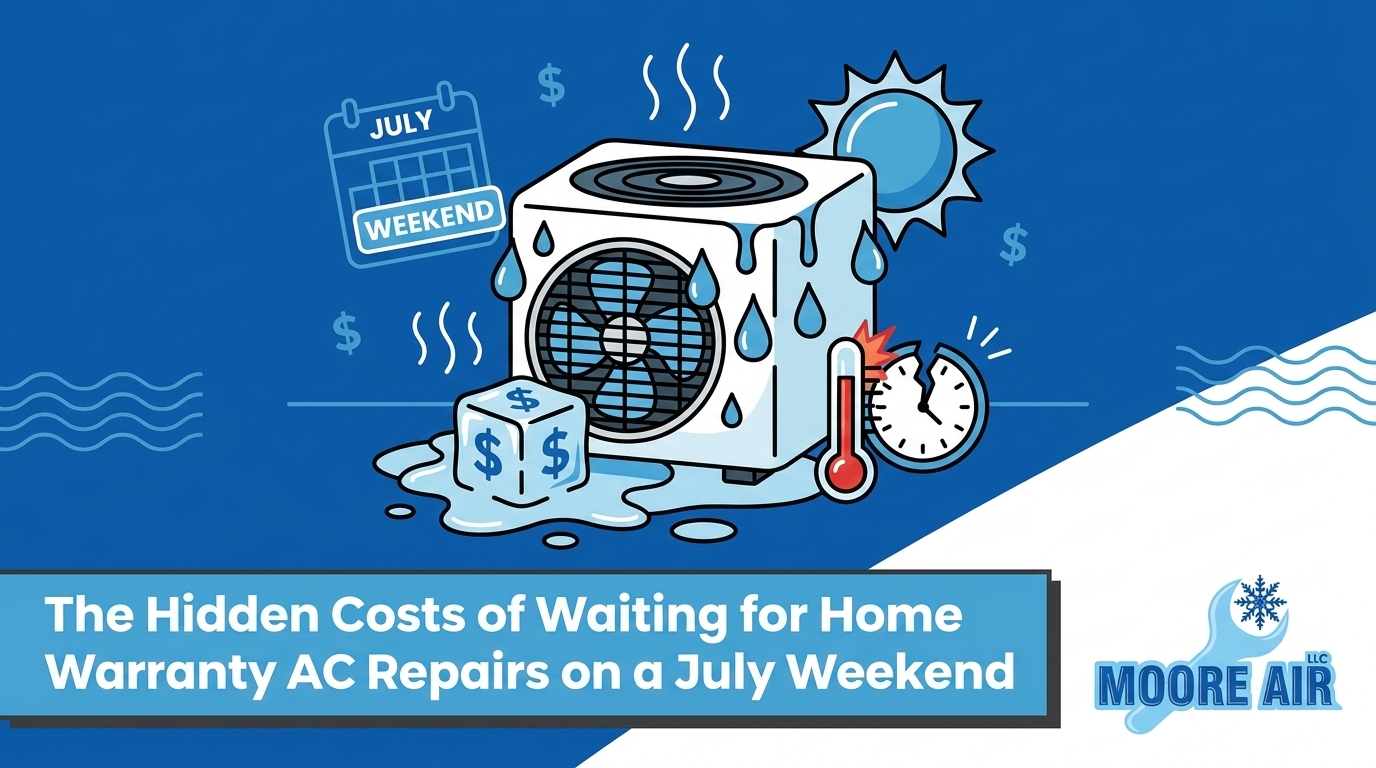
The Hidden Costs of Waiting for Home Warranty AC Repairs on a July Weekend
The Reality of a Complete AC Breakdown During Peak Summer
Your thermostat reads 85 degrees, the vents are blowing warm air, and you are suddenly facing the hidden costs of waiting for home warranty AC repairs on a July weekend. At Moore Air, LLC, our team fields countless calls every summer from homeowners trapped in this exact crisis. A sudden air conditioning failure creates an immediate physical and logistical nightmare. The moment the system stops cycling, the indoor temperature begins a relentless climb, turning your safe haven into an uncomfortable and potentially dangerous environment.
When this breakdown happens outside of standard business hours, standard home warranty procedures often introduce critical delays. Homeowners immediately reach for their warranty documents, expecting a swift resolution. Instead, they are frequently met with automated phone systems, long hold times, and the realization that a technician will not be arriving that day. The contractual obligations of a warranty policy prioritize process over urgency.
Homeowners face a crucial decision: wait for a warranty-assigned technician and endure dangerous temperatures, or bypass the warranty for immediate direct-to-contractor professional HVAC services. The initial instinct is always to use the coverage you have already paid for. However, understanding the true out-of-pocket costs of waiting can help homeowners make the safest and most financially sound decision. The longer the house sits without cooling, the more expensive the secondary consequences become.
The Bureaucracy of Delays: Why Warranties Take 48 to 72 Hours
The problem: You have a broken air conditioner and an active home warranty, yet you are told help will not arrive for days. This disconnect between a homeowner’s urgent need and the warranty provider’s timeline is a common source of intense frustration during the summer months.
The cause: Home warranty companies operate on business models that optimize for their own operational costs, not for customer dispatch speed. They negotiate discounted rates with a specific network of contractors. During peak season, those contractors are inundated with calls. In our years of providing HVAC services across Litchfield Park AZ, we’ve seen firsthand how warranty calls frequently fall to the bottom of a busy contractor’s scheduling queue. Standard warranty contracts typically stipulate a 48 to 72-hour window simply to assign a contractor. This window excludes the actual repair time, the time it takes to order parts, and the time it takes for the technician to return to install those parts.
The solution: Recognizing this structural bottleneck allows you to take control of the situation. You are locked into using the warranty’s chosen contractor if you want them to foot the bill, limiting your ability to find someone with immediate availability. Knowing this timeline upfront helps you calculate whether the wait is actually worth the perceived savings.
How Weekend Timing Impacts Dispatch
Weekend failures compound this dispatch issue significantly. Warranty networks have fewer active technicians available on weekends, and their contracted call centers often operate on limited weekend schedules. While many warranty contracts include an “emergency” clause, these clauses often have strict, hard-to-meet criteria before expedited service is approved.
| Service Type | Average Dispatch Time | Contractor Choice | Weekend Availability |
|---|---|---|---|
| Home Warranty Claim | 48 to 72 hours (minimum) | Assigned by provider | Highly limited; often delayed to Monday |
| Direct Local Contractor | Same-day or 24 hours | Homeowner’s choice | Fully staffed for emergency response |
The Real-World Financial Toll: Compounding Out-of-Pocket Expenses
When you wait out a warranty claim in Litchfield Park AZ during the summer, the “free” repair quickly becomes expensive. The hidden financial costs accumulate rapidly, often surpassing the deductible you pay the warranty company. Our technicians regularly speak with homeowners who ended up spending more on these secondary costs than they would have on a direct repair. These compounding out-of-pocket expenses must be factored into your decision-making process.
- Emergency hotel stays: Paying for a climate-controlled hotel room for two to three nights while waiting for a technician can easily become a massive unexpected expense. If parts need to be ordered, that stay can extend into a week.
- Pet boarding fees: Animals cannot safely remain in a house that is 90 degrees or hotter. Boarding pets at a local facility adds significant daily fees to your unexpected weekend expenses.
- Spoiled groceries and food: As ambient temperatures rise, your refrigerator must work overtime. If the house gets too hot, the fridge may fail to maintain safe internal temperatures, resulting in the loss of an entire refrigerator full of groceries.
- Missed work and lost wages: Warranty contractors often provide wide, unpredictable service windows (e.g., “between 8 AM and 5 PM”). Forcing yourself to stay home in a sweltering house to wait for a technician directly impacts your productivity and potentially your income.
- Dining out expenses: Cooking in an un-air-conditioned home during a July weekend is nearly impossible, forcing families to spend extra money eating at restaurants for every meal.
The cumulative total of these expenses often eclipses the cost of hiring an independent expert directly. When you add up the hotel, the pet boarding, and the lost groceries, paying out-of-pocket for a fast, reliable repair is frequently the more economical choice.

Immediate Health and Safety Risks in Un-Air-Conditioned Homes
Indoor temperatures can quickly surpass 90 degrees when an AC fails, creating a hazardous environment. In Litchfield Park AZ, average high temperatures regularly exceed peak-heat extremes during the height of summer. A home without cooling in these conditions acts like an oven, trapping heat inside and preventing any natural overnight cooling. This transforms a mechanical failure into a life-safety issue.
According to CDC guidelines, prolonged exposure to extreme indoor heat significantly increases the risk of heat exhaustion and heat stroke. The human body struggles to regulate its internal temperature when ambient indoor heat remains consistently high, especially when humidity levels rise alongside it. Treating a cooling failure as a logistical inconvenience rather than a health emergency is a dangerous oversight.
Vulnerable family members are highly susceptible to heat-related illnesses. The elderly, young children, individuals with chronic medical conditions, and family pets cannot safely endure a 48 to 72-hour wait in a severely overheated home. Recognizing the early warning signs of a struggling system—and understanding why your AC runs non-stop during Phoenix summer afternoons—can sometimes help you catch a failure before the system completely shuts down. However, once the breakdown occurs, prioritizing safety over warranty bureaucracy is paramount. We’ve responded to emergency calls where the indoor heat was absolutely stifling, putting families at serious risk before we arrived to restore their cooling performance.
Secondary Property Damage and HVAC System Strain
Beyond the immediate physical discomfort, extended periods without cooling can damage the home itself and put additional stress on the HVAC system. A house is designed to exist within a specific temperature and humidity range. When an AC fails on a July weekend, the internal climate of the home destabilizes rapidly.
- Structural and cosmetic damage: As indoor temperatures rise, humidity levels can fluctuate wildly. This excess moisture and heat can cause hardwood floors to cup, drywall to crack, and wooden cabinetry to warp.
- Appliance strain: Appliances like refrigerators and freezers must work significantly harder to maintain their internal temperatures when the ambient air in the kitchen reaches 90 degrees. This prolonged strain risks secondary appliance failure, adding another major replacement cost to the weekend.
- Thermal mass recovery: Everything inside your home—furniture, walls, carpets, and clothing—absorbs heat. This is known as thermal mass. When the AC is finally repaired days later, bringing a severely overheated house back down to a comfortable 72 degrees puts immense initial strain on the newly fixed system. The unit has to run continuously for hours, sometimes days, just to remove the heat trapped in the physical structure of the house, severely impacting energy efficiency under load.
Prolonged downtime can turn a minor component failure into a broader system issue due to ambient heat exposure. A simple capacitor replacement, if left unaddressed while the system bakes in the summer heat, can sometimes lead to more severe electrical or compressor stress when the system is finally forced back on.
Making the Call: When to Bypass the Warranty for Direct Emergency Service
Recognizing when the logistical and financial costs of waiting outweigh the benefits of warranty coverage is a vital skill for any homeowner. There is a specific tipping point where the money saved by using the warranty is entirely consumed by hotel bills, boarding fees, and the sheer stress of managing a heat crisis on a July weekend.
Local emergency contractors prioritize rapid dispatch and immediate problem resolution over bureaucratic approval processes. Direct-to-contractor emergency service intentionally bypasses 48-72 hour warranty red tape to prevent heat-related crises. By making the decision to hire an independent expert, you regain control over the timeline. You dictate who enters your home, you evaluate their reviews and reputation, and you ensure the quality of the repair meets your standards, rather than hoping the lowest-bidding warranty contractor does a thorough job.
Consider a typical situation our Moore Air, LLC team sees in our service area: an air conditioner stopped working on a Friday, and the homeowner needed repair by Saturday. The home warranty company simply could not find anyone in their network available for a Saturday dispatch. Instead of enduring the heat until Monday, the homeowner bypassed the warranty. One of our local technicians arrived promptly, quickly repaired the A/C unit, and provided valuable unit maintenance tips to prevent future issues. Taking decisive action prevents a stressful weekend from turning into a multi-day heat crisis. If your system fails during a dangerous heatwave, the safest choice is to contact us directly for emergency repair.
Frequently Asked Questions About Home Warranties and Emergency Repairs
How long does a home warranty have to fix an AC?
Most home warranty contracts stipulate a 48 to 72-hour window just to assign a contractor to your claim. This timeline only covers the initial dispatch, not the actual repair. If parts need to be ordered, the final repair can take a week or more to complete. Always check the specific terms of your contract, as peak summer seasons often stretch these timelines to their maximum legal limits.
Can I use my own contractor with a home warranty?
In most cases, home warranty companies require you to use a contractor from their approved network. If you hire your own contractor without getting explicit, written pre-authorization from the warranty provider, they will almost certainly deny your claim and refuse to reimburse you. A few premium policies offer an out-of-network option, but the approval process remains notoriously slow.
What happens if home warranty takes too long?
If the warranty company exceeds their contractual timeline, you can escalate the claim to a supervisor or file a complaint with consumer protection agencies. However, this does not cool down your house in the short term. Many homeowners ultimately choose to pay out of pocket for a local emergency repair to resolve the immediate crisis, though recovering those costs from the warranty company later is highly unlikely.
Does home warranty cover emergency AC repair?
Many home warranties include an “emergency” clause, but the criteria to trigger it are incredibly strict. A broken AC on a peak-heat day might feel like an emergency to you, but the warranty company may only classify it as an emergency if it threatens the structural integrity of the home or involves a life-threatening medical condition documented by a physician. Even then, “expedited” service can still take 24 to 48 hours.
Are out-of-pocket expenses like hotels covered by home warranties?
No, standard home warranties do not cover secondary out-of-pocket expenses resulting from a system failure. Hotel stays, pet boarding, spoiled food, and portable AC unit rentals are entirely the homeowner’s responsibility. This is why calculating the hidden costs of waiting is so critical during a peak summer breakdown.
Prioritizing Safety and Comfort When Your AC Fails
A clear, objective look at the hidden costs reveals that waiting for a warranty repair is often more expensive than paying for an independent fix. When you factor in the hotel bills, the logistical nightmares, and the sheer physical discomfort, the “free” warranty repair loses its appeal. The hidden costs of waiting for home warranty AC repairs on a July weekend simply outweigh the benefits when temperatures in Litchfield Park AZ soar. Protecting your family’s health and safety should always take precedence over navigating warranty bureaucracy. When faced with extreme indoor temperatures, reaching out to our Moore Air, LLC professionals ensures rapid, reliable relief and restores the safety and indoor air quality of your home.