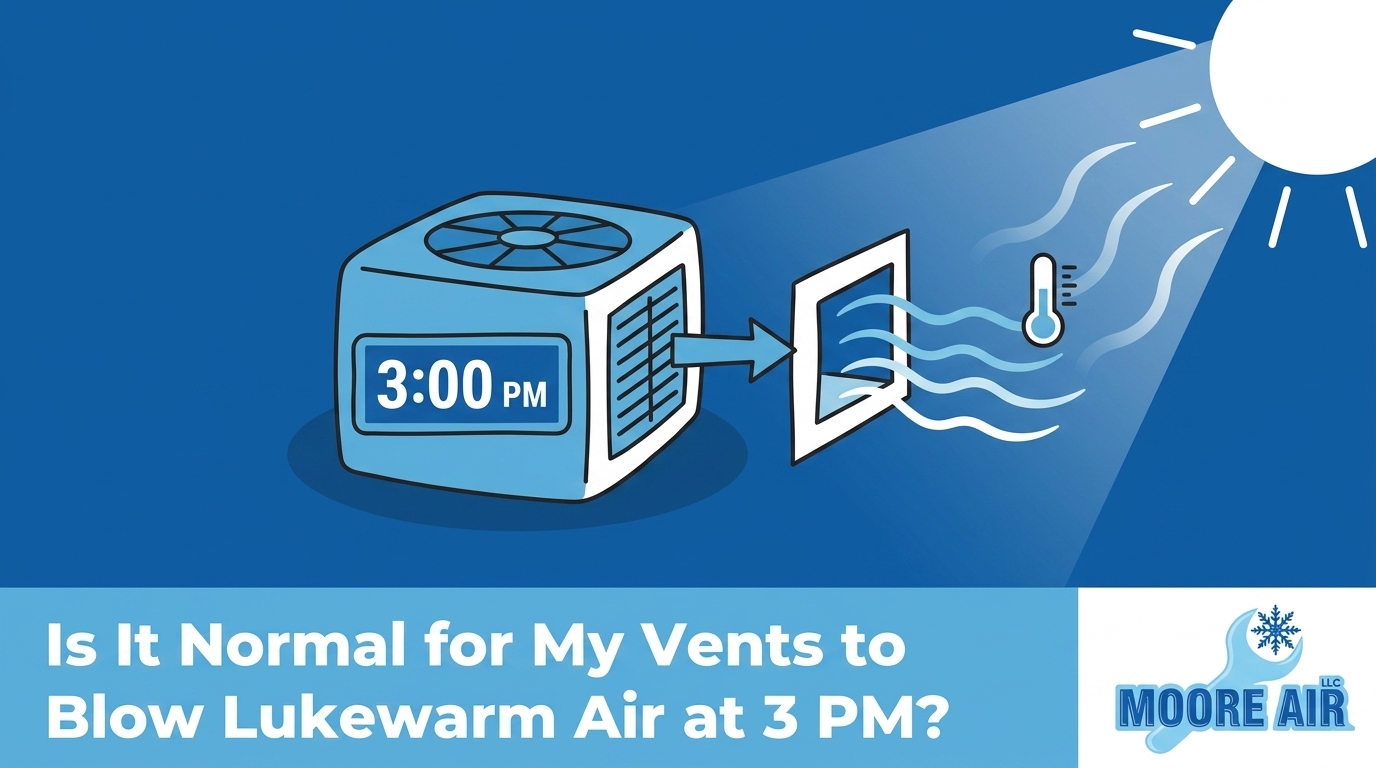
Is It Normal for My Vents to Blow Lukewarm Air at 3 PM?
Why Is My AC Struggling When I Need It Most?
Are you staring at your thermostat as the indoor temperature slowly creeps up, wondering if your cooling system is finally giving out? If you find yourself asking, “Is it normal for my vents to blow lukewarm air at 3 PM?”, you are not alone. That specific mid-afternoon window is the most stressful time of day for both homeowners and their cooling equipment. When the sun is beating down on your roof and the outside temperature is peaking, feeling anything less than ice-cold air coming from your ceiling registers can trigger immediate panic.
To keep your home safe and comfortable, you need reliable HVAC services that address these exact peak-heat challenges. The primary decision you face in the mid-afternoon is determining if your system is simply maxed out by extreme weather, or if a critical component is actively failing. Not every afternoon cooling struggle requires an immediate emergency repair, but these symptoms always require careful observation.
Living in Litchfield Park AZ means dealing with an intense summer climate that pushes mechanical equipment to its absolute limits. Local experts understand that what looks like a breakdown might just be the harsh reality of desert heat. However, knowing the difference between normal heat strain and a true mechanical failure is the key to protecting your investment and keeping your home comfortable when the sun is at its highest point.
Understanding the 20-Degree Rule in Extreme Heat
To understand why your air conditioner behaves differently in the afternoon, you first need to understand how residential cooling systems are designed. Air conditioners do not create infinite cold air; they remove heat from your home and transfer it outside. This process is governed by a mechanical design limit commonly referred to as the 20-degree rule, or “Delta T.”
The Delta T Concept: Delta T represents the temperature differential between the hot air outside your home and the cooled air inside your home. Standard residential air conditioning systems are engineered to maintain a maximum temperature drop of roughly 20 degrees from the outdoor ambient temperature. When the weather is mild, this limitation is invisible. When extreme weather hits, this limitation becomes the defining factor of your indoor comfort.
During the brutal reality of July peak summer in Arizona, the 20-degree rule is tested to its absolute limits. If the outdoor temperature climbs to 115 degrees, your air conditioner is working at maximum capacity just to keep your indoor temperature at 95 degrees. Expecting a crisp 70-degree living room during a 115-degree afternoon is outside the normal mechanical capabilities of standard residential equipment.
Here is a breakdown of how the 20-degree rule impacts your indoor expectations during extreme heat:
| Outdoor Temperature | Max Expected Indoor Cooling (Delta T) | System Workload Status |
|---|---|---|
| 90°F | 70°F | Normal Operation |
| 100°F | 80°F | Heavy Load |
| 110°F | 90°F | Maximum Strain |
| 115°F+ | 95°F+ | Exceeding Design Limits |
When the system reaches this thermal limit, the air coming out of your vents will naturally feel less cold than it did at 9 AM. The air conditioner is still removing as much heat as it was designed to remove, but the sheer volume of heat pressing against your home outpaces the machine’s capacity to cool it.
The Impact of a 140-Degree Attic on Your Ductwork
The Problem: Lukewarm Air at 3 PM
You walk past a ceiling register mid-afternoon and notice the airflow feels surprisingly mild. The thermostat is set to 75 degrees, but the house is hovering around 80 degrees. The system is running continuously, yet the air hitting your skin feels lukewarm rather than crisp and refreshing. This specific symptom is incredibly common during the hottest part of the day.
The Cause: Massive Radiant Heat Gain
Intense solar radiation peaks in the mid-afternoon, causing massive radiant heat gain through your roof. While the outside air might be 110 degrees, the trapped air inside your dark, enclosed attic can easily exceed 140 degrees. This creates a severe environmental challenge for your cooling system.
Your indoor air handler cools the air and pushes it into your ductwork. However, in most homes, that ductwork runs directly through the superheated attic. Even if the air starts out at a crisp 55 degrees when it leaves the indoor unit, it must travel through flexible tubes that are currently baking in a 140-degree environment. Heat naturally moves toward cold. As the chilled air travels through the ducts, it absorbs the intense heat radiating from the attic space. By the time that air finally arrives at your living room vents, it has warmed up significantly, resulting in that frustrating lukewarm sensation.
The Solution: Observation and Action
Understanding this heat transfer process helps you avoid unnecessary panic. Sometimes, what feels like a total breakdown is just severe heat transfer, but other times, it requires urgent action. For example, during a recent summer heatwave, one local homeowner experienced what they initially thought was just afternoon strain. When the system failed completely, they needed immediate diagnosis. A technician arrived, diagnosed the problem on the spot, and had the system fully repaired within 12 hours. Knowing the difference between attic heat gain and a real failure saves you time and stress.
- Check your duct insulation: Poorly insulated ducts absorb heat much faster than properly sealed and insulated ones.
- Improve attic ventilation: Reducing the overall temperature of the attic helps protect the chilled air traveling through your ducts.
- Adjust your expectations: Accept that during peak solar radiation hours, some minor heat gain in the ductwork is unavoidable.
Red Flags: When Lukewarm Air Means Mechanical Failure
While extreme attic heat and the 20-degree rule explain many afternoon cooling struggles, they do not account for everything. Sometimes, lukewarm air is a massive red flag pointing to an active mechanical breakdown. Differentiating between normal extreme-heat strain and actual equipment failure is vital for preventing further damage to your system.
Signs of a Struggling Compressor: The compressor is the heart of your cooling system. If it fails, your system will move air, but it will not cool it. If you hear unusual noises coming from the outdoor unit—such as loud buzzing, grinding, or clicking—the compressor may be struggling to start. If the indoor fan is blowing air, but the outdoor unit is completely silent, the compressor has likely tripped a breaker or failed entirely.
Symptoms of Low Refrigerant: Refrigerant is the chemical compound responsible for absorbing heat from your home. If your system has a leak and the refrigerant level drops, the system loses its ability to cool. Paradoxically, low refrigerant often causes ice to form on the indoor evaporator coils, even when it is blazing hot outside. The pressure drop causes the remaining refrigerant to freeze the natural condensation on the coils, completely blocking airflow and resulting in warm, weak air at the vents.
During a recent stretch of hot weather, another customer faced a massive challenge when their air handler completely failed. Replacing an air handler is a large job during peak summer, but the unit was successfully swapped out despite the challenging conditions. Catching these mechanical red flags early can sometimes prevent the need for a total system replacement.
| Symptom | Normal Heat Strain | Mechanical Failure |
|---|---|---|
| Air Temperature at Vent | Slightly cool, but not freezing | Completely unconditioned, same as room temp |
| Outdoor Unit Sound | Steady, consistent humming | Buzzing, grinding, or completely silent |
| Indoor Coil Condition | Wet with normal condensation | Covered in white frost or solid ice |
| Airflow Strength | Strong, normal pressure | Weak, barely pushing through the vent |

Safe Observational Checks You Can Do at Home
If you are sweating in your living room and worried about your cooling system, there are several safe, non-DIY troubleshooting steps you can take. These observational checks help you gather information without touching any high-voltage electrical components or handling hazardous refrigerants.
- Verify the Thermostat Settings: It sounds simple, but accidentally bumping the thermostat is incredibly common. Ensure the system is set to “Cool” and the fan is set to “Auto.” If the fan is set to “On,” the indoor blower will run continuously, even when the outdoor compressor cycles off. This means the system will blow unconditioned, warm air through the vents between cooling cycles.
- Inspect the Air Filter: A severely clogged air filter restricts airflow, suffocating the system. When the air handler cannot pull enough warm air across the cold evaporator coils, the system loses its ability to cool the house. This mimics a major mechanical failure. Pull the filter out and hold it up to a light source; if you cannot see light through it, replace it immediately.
- Listen to the Outdoor Unit: Step outside safely and listen to the condenser. You should hear the steady hum of both the large fan blade spinning and the compressor running. If you hear buzzing, clicking, or if the fan is spinning but the compressor is silent, you have a mechanical issue that requires a professional.
- Feel the Airflow Strength: Place your hand near a vent. Weak airflow points to different issues (like a frozen coil, a clogged filter, or a collapsed duct) than strong but lukewarm airflow (which points to attic heat gain or a failing compressor).
- Check the Vents for Blockages: Ensure rugs, furniture, or heavy curtains are not blocking your return or supply registers. The system needs to breathe freely to circulate air properly.
The Sundown Test: What Happens When the Heat Breaks?
The most definitive observational test you can perform to determine the health of your cooling system happens after the sun goes down. During the day, massive solar radiation and 140-degree attics obscure the true performance of your equipment. The real test is how your system behaves once that environmental pressure is lifted.
Passing the Sundown Test: As evening approaches and the outdoor temperature drops, the intense radiant heat stops baking your roof. The attic begins to cool down. If your system is healthy, you should notice a distinct change in performance between 8 PM and 9 PM. The air coming from the vents should feel noticeably colder, and the indoor temperature should slowly start dropping back down to your preferred thermostat setting. If the system successfully recovers the indoor temperature by late evening, the afternoon issue was almost certainly normal heat strain. This is a common phenomenon, which is why your AC runs non-stop during Phoenix summer afternoons.
Failing the Sundown Test: If the sun sets, the outside air cools down, and your system is still blowing lukewarm air well into the night, you have a confirmed problem. Without the burden of solar radiation, a healthy system should easily cool the house. If it cannot, a mechanical issue is preventing the heat transfer process.
As a local Litchfield Park expert, Moore Air accurately diagnoses extreme heat strain versus actual mechanical failure based on these exact performance patterns. If your system fails the sundown test, the best time to schedule service is immediately the next morning before the peak heat returns, ensuring a technician can assess the equipment before the afternoon rush.
Frequently Asked Questions About Afternoon AC Performance
Why does my AC blow warm air in the afternoon?
Your AC blows warm air in the afternoon due to a combination of maxed-out design limits and severe heat transfer. When outdoor temperatures soar, the system hits its 20-degree cooling limit, struggling to keep up with the heat load. Additionally, chilled air traveling through ductwork in a 140-degree attic absorbs radiant heat, causing it to feel lukewarm by the time it reaches your vents.
At what temperature does an AC stop cooling?
Air conditioners do not “stop” cooling at a specific temperature, but they lose the ability to overcome the heat load once outdoor temperatures push past their 20-degree design differential. If it is 115 degrees outside, the system is still working hard, but it physically cannot cool the house below 95 degrees. The machine is still functioning, but the environmental heat is simply too overwhelming.
Should my AC run constantly in 100 degree heat?
Yes, continuous operation during peak heat is completely normal and often necessary to maintain indoor temperatures. When the outside temperature exceeds 100 degrees, the system must run non-stop just to remove the massive amount of heat pressing against your home’s exterior. As long as the air coming from the vents is cool and the indoor temperature isn’t rising drastically, constant running is expected.
How do I know if my AC compressor is failing?
You can identify a failing compressor by looking for non-DIY signs like lukewarm air that persists long into the night after the sun goes down. You may also hear strange noises from the outdoor unit, such as loud buzzing, grinding, or clicking. Another major red flag is if the outdoor fan is spinning rapidly, but the system remains unusually quiet because the compressor itself is not turning on.
Can adding more refrigerant solve the 3 PM cooling slump?
No, simply adding more refrigerant will not solve an afternoon cooling slump caused by extreme heat. Refrigerant is not a consumable fluid like gas in a car; if it is low, you have a physical leak in the copper lines that must be repaired by a professional. Furthermore, “topping off” the system will not stop your ductwork from absorbing radiant heat in a blazing hot attic.
Get Expert Diagnostics for Your Cooling System
Understanding the difference between normal extreme-heat strain and actual mechanical failure saves you immense stress during the hottest months of the year. While a 140-degree attic can easily make your vents blow lukewarm air at 3 PM, persistent issues that fail to resolve after sundown require immediate attention. Ignoring a struggling compressor or a frozen coil will only lead to more extensive damage down the road.
If your system is failing to cool your home even after the sun goes down, it is time to seek professional help. A thorough inspection can pinpoint exactly where the heat transfer process is breaking down. Do not wait for a complete system failure in the middle of a heatwave; contact our AC technicians today to schedule an expert evaluation and restore your peace of mind.