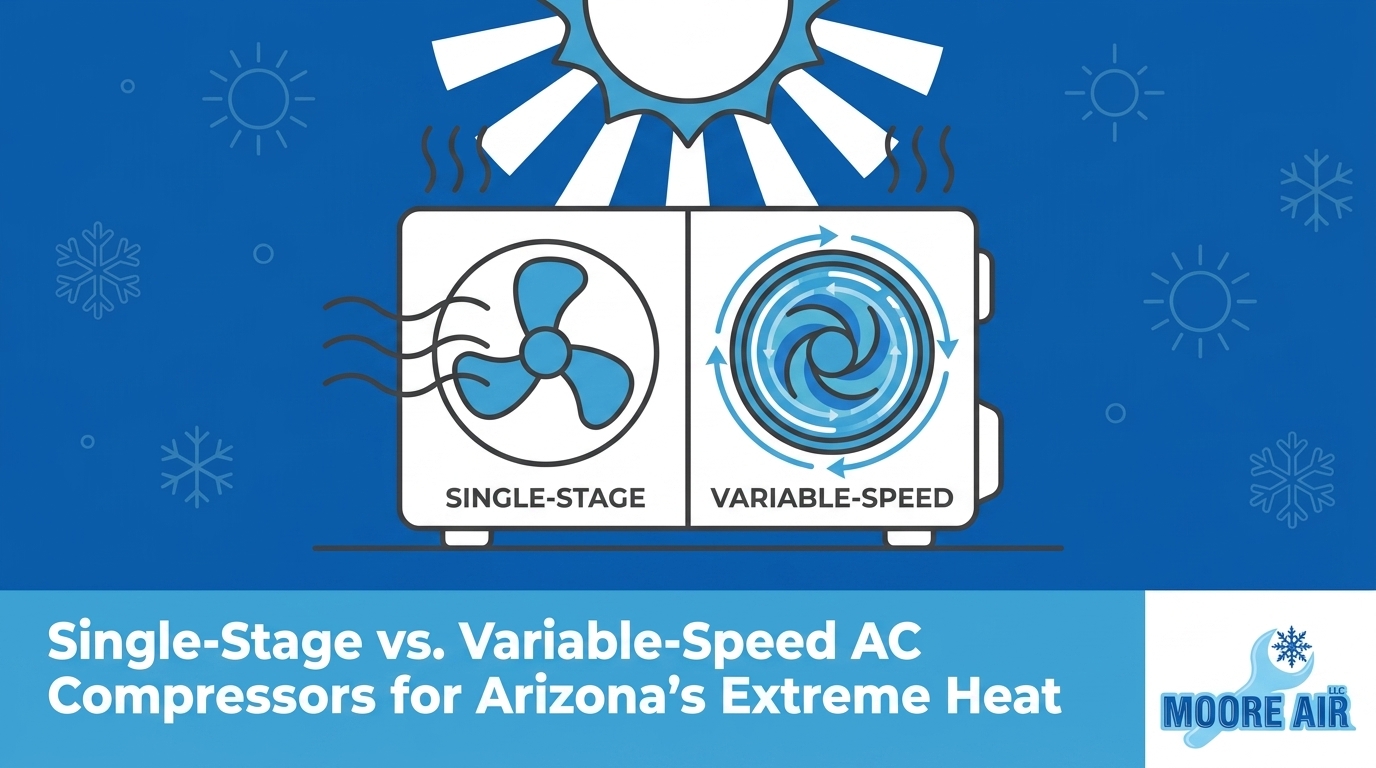
Single-Stage vs. Variable-Speed AC Compressors for Arizona’s Extreme Heat
The Myth of ‘One Size Fits All’ Cooling in the Desert
Most homeowners believe that any brand-new air conditioner will effortlessly handle a brutal desert summer, but when you are comparing single-stage vs. variable-speed AC compressors for Arizona’s extreme heat, that myth quickly falls apart. The reality is that generic national climate averages simply do not apply when you are facing the relentless heat loads of a southwestern summer. A cooling system that works perfectly well in the moderate temperatures of the Midwest will often struggle, short-cycle, or fail prematurely when subjected to the continuous, intense demands of our local climate.
When your current system begins to fail, you face a critical decision point: do you replace it with a traditional single-stage compressor, or do you invest in modern variable-speed technology? Making the right choice requires understanding exactly how these different mechanical systems respond to severe temperature swings and continuous operation. If you are ready to evaluate your home’s unique cooling requirements, exploring professional HVAC services with our experienced team at Moore Air is the best first step toward securing reliable comfort.
The extreme stress of non-stop operation requires a highly strategic approach to equipment selection. You cannot simply look at the size of the box or the recognizable brand name on the side. Instead, you must look inside the cabinet at the compressor technology driving the system, because that single component will dictate your indoor comfort, your monthly energy consumption, and the ultimate lifespan of your investment during the July peak summer heat.
The Mechanical Toll of Extreme Temperature Swings
To understand why compressor selection matters so much, you have to look at the specific environmental challenges your equipment faces in Maricopa County / Litchfield Park. Unlike regions where summer temperatures peak in the low 90s and cool off quickly, our local climate forces air conditioners to run a grueling marathon. The physical stress placed on compressor components during continuous 110-plus degree days is immense. The compressor must work exponentially harder to reject indoor heat into an outdoor environment that is already scorching hot.
Beyond the daytime high, the dramatic shift from blistering afternoon temperatures to warm 85-degree nights demands flexible cooling capacity. A system sized to handle the absolute peak of the afternoon heat is often oversized for the milder nighttime hours. This massive temperature swing creates a unique mechanical challenge that causes many standard systems to wear out long before their expected lifespan. At Moore Air, our technicians frequently see the results of this environmental stress firsthand. In one recent Litchfield Park service call, a homeowner faced an extreme crisis when their aging unit completely failed under the continuous summer load. The situation required a timely installation of a brand-new AC because the old equipment simply could not survive the brutal conditions any longer.
Furthermore, much of the national marketing you see for high-efficiency air conditioners focuses heavily on humidity control and dehumidification. While managing humidity is crucial in coastal areas, our primary battle is against massive sensible heat loads—the actual dry, radiant heat baking the walls and roof of your home. When systems are improperly matched to these local dry-heat demands, they suffer from premature wear and tear, leading to frequent breakdowns and compromised indoor comfort.
Single-Stage Compressors: The Traditional All-or-Nothing Approach
For decades, the single-stage compressor has been the undisputed standard for residential cooling. The mechanics are remarkably straightforward: a single-stage compressor operates at exactly 100 percent capacity when the thermostat calls for cooling, and it turns off completely when the target temperature is reached. There is no middle ground, no low gear, and no gradual ramping up. It is an all-or-nothing approach to climate control.
While this traditional design has a long history of mechanical reliability due to its simplicity, our team regularly sees it present several distinct challenges when battling July peak summer heat.
- The Problem: Massive Electrical and Mechanical Stress. Every time a single-stage compressor turns on, it draws a massive surge of electricity (known as Locked Rotor Amps) to jolt the heavy internal motors into motion. This hard start creates significant mechanical torque and heat within the compressor windings.
- The Cause: Rigid Operational Design. Because the system cannot operate at a lower capacity, it must blast at full power even if the home only needs a small amount of cooling to maintain the temperature.
- The Solution: Understanding the Limitations. While single-stage units are generally more affordable upfront, homeowners must accept that the constant on-and-off cycling causes cumulative wear and tear on the electrical components, capacitors, and contactors over the lifespan of the unit.
Another significant limitation becomes apparent during milder night temperatures. Because a single-stage unit is sized to handle the 110-degree afternoon, it is technically “oversized” for an 85-degree evening. This causes the system to short-cycle—turning on, blasting the house with cold air, rapidly satisfying the thermostat, and shutting off just minutes later. This rapid cycling leads to uneven indoor cooling, leaving some rooms freezing while others remain uncomfortably warm, and prevents the system from properly filtering the indoor air.
Variable-Speed Compressors: Precision Cooling for Desert Extremes
If a single-stage compressor is like a car with only two settings—park and 100 miles per hour—a variable-speed compressor is like a car with a highly responsive gas pedal. Using advanced inverter technology, variable-speed compressors can modulate their output in tiny increments, often dialing down to just 25 or 30 percent of their total capacity to exactly match the home’s real-time cooling demand.
This modulating capability is uniquely suited for the significant temperature swings we experience in Maricopa County / Litchfield Park. During a scorching afternoon, the variable-speed compressor will ramp up to 100 percent capacity to fight the heat. But as the sun goes down and the outdoor temperature drops to 85 degrees, the compressor seamlessly dials back its speed. Instead of shutting down completely, it hums along at a low, continuous speed to maintain perfect comfort.
This continuous, lower-speed operation eliminates the harsh wear-and-tear of constant on/off cycling. By avoiding the violent hard starts associated with single-stage units, variable-speed compressors experience significantly less mechanical stress over time. The benefits extend directly into the home as well. Because the system runs almost continuously at low speeds, air is constantly circulating through your ductwork and your HVAC filters. This results in incredibly even temperature distribution across every room in the house and vastly superior indoor air quality.
Proper setup is critical for these advanced systems to deliver their full potential. For example, during a recent peak summer installation of a new Amana split system in the local area, precise wiring and final operational adjustments by our Moore Air installation team ensured the modulating equipment communicated flawlessly with the thermostat. When installed correctly, variable-speed units prove their worth. While they are often sold nationally on their ability to dehumidify, their primary value in the desert is their unmatched ability to manage massive sensible heat loads with precision efficiency.
Head-to-Head Comparison: Which Technology Survives Best?
When weighing your options for a system replacement, a direct side-by-side comparison helps clarify which technology aligns best with your comfort goals and budget. Making the choice between repairing an older AC vs. installing a new system often hinges on understanding exactly what you gain by upgrading to modern compressor technology.
| Performance Metric | Single-Stage Compressor | Variable-Speed Compressor |
|---|---|---|
| Cooling Capacity | Operates strictly at 100% or 0% | Modulates between 25% and 100% |
| Energy Efficiency | Standard SEER2 ratings; high startup power draw | Maximum SEER2 ratings; low continuous power draw |
| Temperature Consistency | Noticeable temperature swings (1-3 degrees) | Precise control (within 0.5 degrees of setpoint) |
| Noise Levels | Loud startup “clunk” and noticeable airflow noise | Ultra-quiet ramping and whisper-quiet continuous airflow |
| Air Filtration | Air is only filtered when the system is actively cooling | Continuous air circulation provides 24/7 filtration |
Startup Stress vs. Continuous Operation
The most significant mechanical difference between these two technologies during the July peak summer heat is how they handle the demand for cooling. Single-stage units suffer from the electrical and mechanical impact of hard starts. Every time the thermostat clicks on, the compressor must overcome immense internal pressure and inertia instantly. This draws a massive spike of electricity and puts sudden torque on the internal components. Over thousands of cycles per summer, this takes a toll. Variable-speed inverters utilize a smooth ramping process. They start slowly, gently increasing the motor speed until the desired capacity is reached, drastically reducing electrical spikes and mechanical friction.
Indoor Comfort and Temperature Consistency
If you have ever felt a sudden blast of freezing air followed by a period of stuffy warmth, you have experienced the temperature fluctuations common with single-stage cycling. Because the unit blasts at full capacity, it often overcools the area right near the thermostat before shutting off, leaving distant bedrooms hot. Variable-speed systems offer precision temperature control. By running longer cycles at lower speeds, they push conditioned air gently and evenly to the furthest reaches of your ductwork, eliminating hot and cold spots entirely.

Energy Efficiency and Long-Term Reliability Under Load
When evaluating cooling equipment, understanding the financial and efficiency implications is just as important as the mechanical specs. The Department of Energy (DOE) establishes strict efficiency standards for all central air conditioning systems, currently measured by the SEER2 (Seasonal Energy Efficiency Ratio 2) metric. The SEER2 rating calculates how much cooling a system delivers per watt of electricity consumed over a typical cooling season.
Variable-speed units consistently achieve significantly higher SEER2 ratings than their single-stage counterparts. This superior efficiency is achieved through their low-amperage continuous operation. Because the inverter technology allows the compressor to run at a fraction of its total capacity, it consumes far less electricity than a single-stage unit that must constantly surge to 100 percent power. While a variable-speed unit may run for longer periods of time, the total amount of energy it uses is substantially lower.
Because of this high-efficiency performance, generic energy rebates, federal tax credits, or local utility incentive programs may apply to qualifying high-efficiency variable-speed installations. Homeowners are always advised to verify current programs with their utility provider or a tax professional, as these incentives can help offset the initial investment in premium technology.
However, it is crucial to remember that the highest SEER2 rating in the world means nothing if the system is not installed correctly. Proper sizing, meticulous ductwork evaluation, and professional installation are just as critical to the energy efficiency and long-term reliability of the system as the compressor technology itself in Maricopa County / Litchfield Park.
Why Local Installation Expertise Dictates System Survival
The most advanced variable-speed compressor on the market will still fail prematurely if it is not installed with local climate realities in mind. Complex modulating systems require rigorous attention to detail during installation. Proper duct sizing is absolutely vital; if the ductwork is too small, the variable-speed blower will struggle against high static pressure, reducing efficiency and straining the motor. Refrigerant charging must be calibrated precisely, and airflow must be balanced to ensure the system can modulate correctly.
Extreme heat impacts the installation process itself, requiring specific local knowledge. The ambient temperature during installation affects how refrigerant pressures are read and adjusted. Relying on a team with a deep history of local installations ensures the system is optimized for peak summer survival. In our years of serving the area, Moore Air’s extensive local installation history and real-world expertise handling extreme Maricopa County weather means our technicians understand exactly what it takes to make these systems survive the summer. We don’t just follow generic factory manuals; we apply years of desert-specific experience to every calibration.
Furthermore, routine maintenance is required to keep complex variable-speed inverters operating flawlessly in our dusty, dry environments. The delicate electronic components and sensors that control the modulation need to be kept clean and properly calibrated. A system installed and maintained by local experts who understand the demands of Maricopa County / Litchfield Park will outlast and outperform a system installed by someone unfamiliar with the unique stresses of our climate.
Frequently Asked Questions About AC Upgrades in Arizona
Is a variable speed AC worth it in Arizona?
Yes, variable-speed air conditioners are highly beneficial in Arizona’s climate. They provide superior temperature consistency and drastically reduce mechanical wear during the massive sensible heat loads of summer. By modulating their cooling output, they manage the extreme temperature swings between scorching afternoons and warm nights far better than traditional systems.
How does a single-stage AC perform in 110-degree heat?
In 110-degree heat, a single-stage AC will run almost continuously at maximum capacity just to keep up with the intense heat load. Because it is operating at 100 percent power for hours on end, it experiences increased wear on electrical components and the compressor motor. While it will cool the home, it does so with maximum energy consumption and mechanical stress.
Does a variable speed AC run all the time?
Yes, by design, a variable-speed AC will run for much longer cycles than a traditional unit. It runs continuously at lower, highly energy-efficient speeds to maintain a precise indoor temperature without harsh on/off cycles. This constant operation is exactly what provides better indoor air filtration and eliminates hot and cold spots throughout the house.
What is the difference between single-stage and variable-speed compressors?
The primary difference is how they deliver cooling capacity. A single-stage compressor operates only at 100 percent capacity or is completely off, resulting in frequent, energy-heavy startup cycles. A variable-speed compressor uses an inverter to modulate its output in small increments, allowing it to exactly match the real-time cooling demand of the home with continuous, low-power operation.
How does extreme heat affect an AC compressor?
Extreme heat forces the compressor to work significantly harder to reject indoor heat into the already-hot outdoor environment. This increases internal operating pressures and raises the electrical draw required to keep the motor turning. Over time, this continuous thermal and electrical stress can degrade internal components if the system is not properly maintained or correctly sized for the July peak summer heat.
Make the Right Choice for Your Maricopa County Home
Choosing the right cooling technology comes down to understanding your specific comfort needs and the brutal realities of our local climate. Variable-speed units offer unmatched precision, quiet operation, and superior energy efficiency by adapting to the exact heat load of the moment. Single-stage units, while less efficient and prone to temperature fluctuations, offer traditional mechanical simplicity that has cooled homes for decades.
Ultimately, the right choice depends on your home’s specific cooling demands, your ductwork, and how you want to manage the severe temperature swings in Maricopa County / Litchfield Park. Don’t leave your summer comfort to chance or rely on generic advice. Schedule a professional evaluation with Moore Air to determine which system best fits your home, ensuring you have the reliable, efficient cooling you need to comfortably survive the extreme heat ahead.