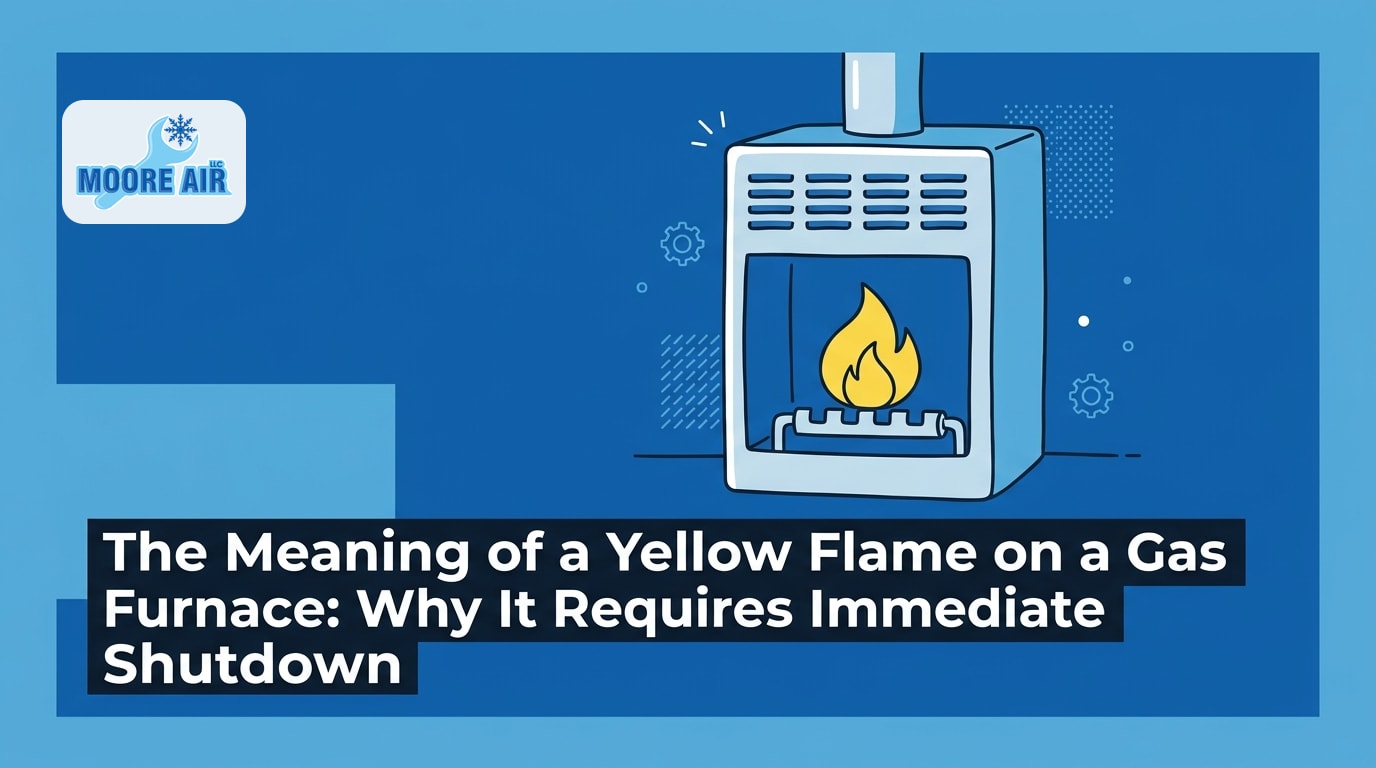
The Meaning of a Yellow Flame on a Gas Furnace: Why It Requires Immediate Shutdown
The Sudden Chill: Facing a Heating Emergency on the First Cold Night
You finally switch your thermostat from cooling to heating, but instead of the reassuring sound of warm air filling your home, you notice something unsettling inside the unit. When you search for the yellow flame on gas furnace meaning, the results can be alarming. Your heating system is supposed to operate with a crisp, steady blue flame. Seeing a lazy, flickering yellow or orange fire inside the burner compartment is a clear signal that something has gone wrong.
In our years of providing heating services across Litchfield Park, we notice this discovery almost always happens during the November first-startup season. The temperature drops, you call upon your heating equipment for the first time in months, and suddenly you are faced with a serious decision: do you let the system run and hope it clears up, or do you shut it down immediately? The short answer is that a yellow flame is never a cosmetic issue. It is a strict safety hazard that requires your immediate attention.
If you are facing this situation right now, turn off your heating system at the thermostat. Running a compromised unit puts your household at risk. To restore safe operation, you need professional gas furnace services to diagnose the underlying combustion problem.
Decoding the Burner: The True Yellow Flame on Gas Furnace Meaning
To understand why this issue is so serious, you have to look at the foundational science of how your heating system generates warmth. Natural gas is an incredibly efficient fuel source, but it requires a very specific environment to burn safely. When you search for the yellow flame on gas furnace meaning, you are actually looking at the visual difference between complete and incomplete combustion. The color of that fire is the primary indicator of your system’s internal safety.
The Anatomy of a Safe Blue Flame
When your unit is operating exactly as the manufacturer intended, it achieves what professionals call complete combustion. This happens when the natural gas mixes with the perfect amount of oxygen before it ignites.
- The visual cue: The fire will be crisp, steady, and predominantly blue. You might see a very tiny, light blue or nearly invisible inner cone.
- The sound: A healthy burner produces a smooth, consistent roaring sound without sputtering or popping.
- The byproducts: Complete combustion is highly efficient. The only chemical byproducts produced are harmless water vapor and carbon dioxide, which are safely vented out of your home through the exhaust flue.
A blue flame means your equipment is extracting the maximum amount of heat from the fuel while maintaining a safe environment for your family.
Why a Yellow Flame is a Warning Sign
When the delicate ratio of oxygen to natural gas is disrupted, the system can no longer burn the fuel completely. This is known as incomplete combustion, and it fundamentally changes the chemical reaction happening inside your home.
- The visual cue: The fire becomes lazy, flickering, and turns yellow or orange. It often looks more like a campfire than a precision heating instrument.
- The physical evidence: Incomplete combustion creates excess soot. You might notice black streaks around the burner compartment or on the access panel.
- The danger: Because the fuel is not burning cleanly, the chemical byproducts shift. Instead of harmless water vapor, the system begins producing highly dangerous gases.
A yellow flame means fuel is being wasted, soot is building up inside your heat exchanger, and your system is actively generating hazardous exhaust.

Carbon Monoxide: The Silent Threat Behind Incomplete Combustion
The most severe risk associated with a yellow burner flame is the production of carbon monoxide (CO). When natural gas lacks the oxygen it needs to burn completely, this toxic gas is the direct result. Carbon monoxide is entirely invisible. It is odorless, colorless, and tasteless. Because you cannot rely on your senses to detect a CO leak, visual cues like a malfunctioning burner flame become your first and most vital line of defense.
According to the Centers for Disease Control and Prevention (CDC) and the Consumer Product Safety Commission (CPSC), prolonged exposure to carbon monoxide in residential settings is a severe health hazard. When CO enters the bloodstream, it displaces oxygen, leading to serious medical emergencies. Early warning signs of carbon monoxide buildup in a home often mimic the flu, including headaches, dizziness, nausea, confusion, and fatigue. If multiple family members or pets start exhibiting these symptoms at the same time your heating system is running, you must take immediate action.
This threat is particularly elevated in modern construction. Today’s homes in Litchfield Park AZ and the surrounding areas are built to be highly energy-efficient. They are sealed tightly to keep cooled air inside during the summer and warm air inside during the winter. While this is great for your utility bills, it means that if your heating system is malfunctioning and producing carbon monoxide, that toxic gas is trapped inside the living space much faster. If you suspect an issue, securing emergency furnace repair is not an overreaction—it is a necessary step to protect your household.
The 9-Month Slumber: Why Dormant Heating Systems Are Highly Vulnerable
Homeowners often ask our technicians why this specific malfunction seems to happen out of nowhere. Having serviced HVAC systems across the West Valley for years, we know the answer lies in the unique climate we experience in the desert. In the Litchfield Park and greater Phoenix area, extreme summer heat dictates our HVAC usage. As a result, our heating systems often sit completely dormant for eight to nine months out of the year.
This prolonged idle period creates a massive vulnerability. While the unit sits unused, the burner assembly becomes a magnet for environmental debris. Fine desert dust settles deep into the mechanical components. Spiders and other pests, seeking refuge from the summer heat or attracted to the faint smell of the mercaptan additive in natural gas, frequently build webs directly inside the burner tubes and orifices.
When the November first-startup season finally arrives, all of that accumulated debris acts as a physical roadblock. The dust and webs choke off the oxygen supply that the burners desperately need to achieve complete combustion. The gas flows in, but the air cannot mix with it properly, resulting in a starved, lazy yellow flame. This is why testing your gas furnace before November is heavily recommended by our professionals. Catching these blockages during a routine pre-season check prevents the sudden spike in late-fall heating emergencies.
Harmless Dust vs. Hazard: Reading the Burner Flame Accurately
While a steady yellow flame is a strict safety hazard, there is a brief phenomenon that can cause unnecessary panic. When you first turn on your heating system after its long summer slumber, it is common to see a temporary change in flame color. Understanding the difference between harmless dust burning off and a continuous hazard will help you make the right call.
| Characteristic | Harmless Dust Burn-Off | Hazardous Incomplete Combustion |
|---|---|---|
| Duration | Lasts only for the first 3 to 5 minutes of the initial startup. | Persists continuously as long as the system is running. |
| Color Pattern | Mostly blue with brief, dancing flashes of bright orange or red. | A solid, lazy yellow or orange flame with very little blue visible. |
| Flame Shape | Crisp and defined, despite the temporary color flashes. | Wobbly, lazy, and undefined, often reaching higher than normal. |
| System Sound | Normal, steady roaring sound. | May sound unusually quiet, lazy, or occasionally sputter. |
Our team frequently reassures homeowners that if you observe brief orange flashes that clear up after a few minutes, you are simply watching surface dust incinerate off the burners. The system is functioning normally. However, if the flame remains a steady, lazy yellow beyond that initial startup phase, you have a confirmed combustion issue. Never assume that a persistent yellow flame will eventually “resolve itself” if you just let it run. If the flame behavior remains questionable, utilizing professional HVAC troubleshooting is the safest path forward.
Strict Safety Protocols: Your Immediate Next Steps
If you have confirmed that your heating system is producing a continuous yellow flame, you must act quickly. Handling a combustion appliance requires strict adherence to safety protocols. Do not attempt to clean the burners, adjust the gas pressure, or dismantle the unit yourself. Tampering with gas lines and combustion chambers is highly dangerous and illegal for unlicensed individuals. Instead, follow these steps we strongly recommend to secure your home in Litchfield Park AZ:
- Turn off the system immediately: Go to your thermostat and switch the heating function to the “OFF” position. This stops the call for heat, closes the gas valve, and halts the combustion process entirely.
- Check your carbon monoxide detectors: Ensure your CO alarms are functioning. If an alarm is currently sounding, or if anyone in the home is experiencing headaches, dizziness, or nausea, evacuate the property immediately and call 911 or your local emergency services.
- Ventilate the area: If you do not have active alarms but want to be cautious, open a few windows to allow fresh air to circulate through the home while you wait for a technician.
- Schedule a professional inspection: Contact a licensed HVAC technician to diagnose the system. Explain that you shut the unit down due to a persistent yellow flame so they understand the urgency of the call.
Ignoring the problem or deciding to “tough it out” for the night puts your entire household at severe risk. Safety must always come first when dealing with natural gas appliances.
Honest Diagnostics Over Scare Tactics: A Professional Standard
Finding a yellow flame and shutting down your system can be stressful, especially when you are worried about the cost of a major repair. Unfortunately, a common problem we see in the HVAC industry is the use of carbon monoxide risks as a scare tactic. Some contractors will use the presence of a yellow flame to immediately push for a costly, full-system replacement without properly diagnosing the root cause.
While a yellow flame requires a strict safety shutdown, it does not automatically mean your equipment is dead. At Moore Air, our professional standard is built on honest diagnostics and “no games” pricing. We’ve spent years helping local families safely navigate heating emergencies, and we frame the safety shutdown as an act of professional care—a necessary step to keep you safe while we figure out exactly what is wrong.
An objective assessment by our technicians often reveals that the system simply needs a comprehensive furnace tune-up. Our team will meticulously clean the burner assembly, clear out the spider webs and desert dust, inspect the heat exchanger for structural integrity, and measure the gas pressure. Our goal is to restore safe, efficient operation and repair the system whenever possible, rather than immediately pushing a sale. You deserve peace of mind knowing that your heating system is safe, and that your service provider is treating you with integrity.
Frequently Asked Questions
Is a yellow flame on a gas heater dangerous?
Yes, a persistent yellow flame is highly dangerous. It indicates that the system is experiencing incomplete combustion due to a lack of oxygen. This improper burning process produces carbon monoxide, a toxic and potentially fatal gas, instead of safe exhaust. You should turn off the heater immediately if you see this.
Why is my furnace flame yellow instead of blue?
The flame turns yellow when the natural gas cannot mix with enough oxygen to burn completely. This is most commonly caused by a physical blockage in the burner assembly, such as accumulated dust, dirt, or spider webs. It can also be caused by an improper gas pressure setting that overwhelms the available air supply.
What should I do if my furnace flame is yellow?
Your first step is to go to your thermostat and turn the heating system completely off to stop the combustion process. Do not attempt to clean the burners or adjust the unit yourself. Once the system is safely off, contact a licensed HVAC professional to inspect and clean the equipment.
Can a dirty filter cause a yellow flame?
While a dirty air filter severely restricts the airflow circulating through your home, it does not directly cause a yellow flame inside the burner compartment. The combustion air (which mixes with the gas) is drawn from a different source than the household air passing through your filter. However, a severely neglected system often has both a clogged filter and dirty burners.
How often should a gas furnace be inspected to prevent incomplete combustion?
Gas heating systems should be professionally inspected and tuned up once a year, ideally in the fall before you turn the unit on for the first time. This annual maintenance allows technicians to clean out the dust and debris that accumulated over the summer, ensuring the burners have the oxygen they need for a safe blue flame.
Will a yellow furnace flame trigger my carbon monoxide detector?
It might, but you should never wait for the alarm to sound before taking action. A yellow flame means carbon monoxide is being produced, but whether the alarm triggers depends on if that gas is successfully venting out the flue or spilling back into your home. If you see a yellow flame, shut the system down immediately, regardless of what the detector says.