Upgrading Your Insulation vs. Buying a Larger HVAC Unit
The ‘Bigger is Better’ Cooling Myth
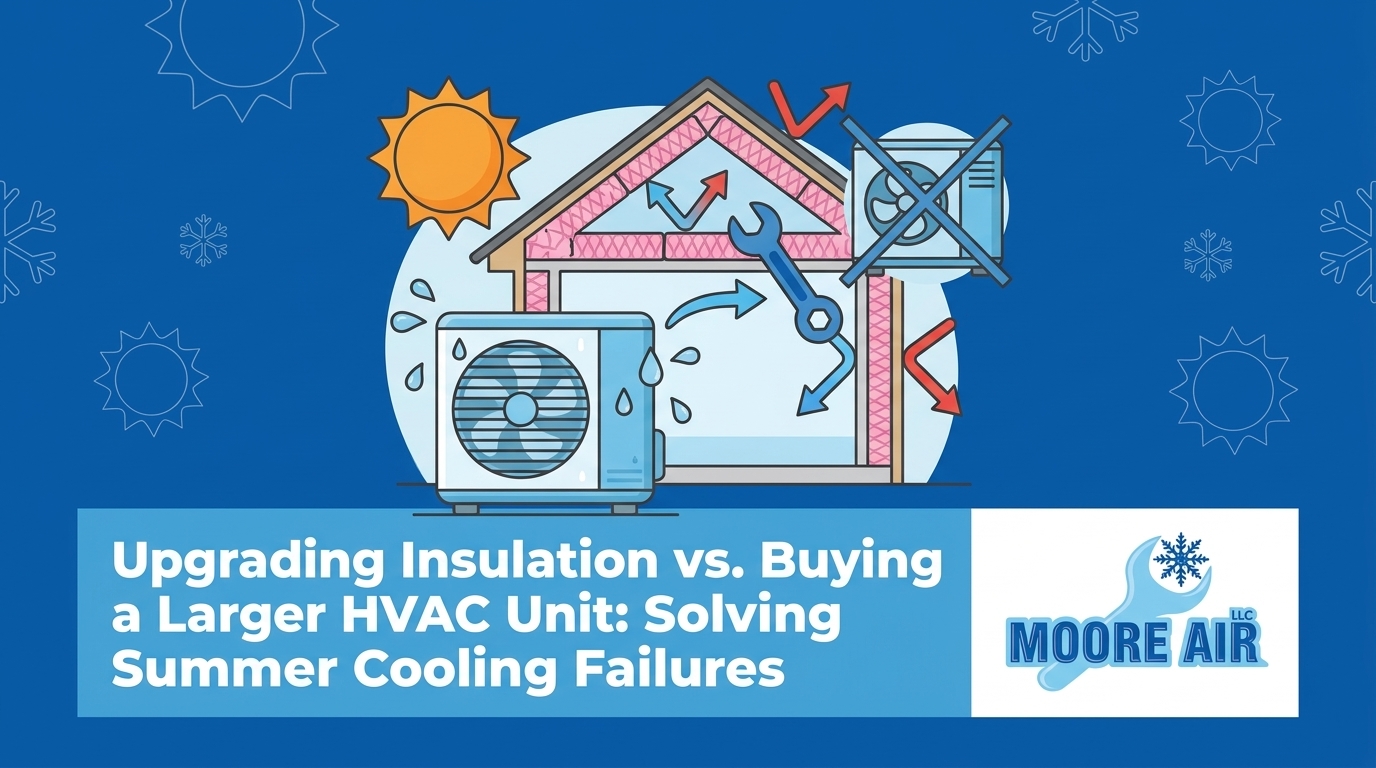
At Moore Air, we often encounter a common misconception among homeowners: that a struggling air conditioner always requires a bigger replacement. In reality, the debate often comes down to upgrading your insulation vs. buying a larger HVAC unit. If your system ran non-stop this past summer without ever reaching the set temperature on your thermostat, it is easy to assume the equipment simply lacks the power to cool your home. This leads many people to believe that purchasing a higher-tonnage system is the ultimate fix for their comfort issues.
However, your home operates as a complete thermal system. The mechanical equipment is only one half of the equation; the physical structure of your house is the other. As you engage in a September post-summer reflection, this early fall transition period is the ideal time to evaluate why your system failed to keep up. Rushing into a major equipment purchase without understanding where the heat is actually coming from can leave you with the exact same comfort problems next year.
If you are tired of battling indoor heat, exploring comprehensive air conditioning services can help you identify the true source of the problem before you invest in new equipment.
Understanding the Thermal Envelope’s Role in Cooling
To truly solve a cooling failure, you must first understand the concept of the thermal envelope. This envelope consists of your roof, exterior walls, windows, doors, and insulation. It acts as the physical barrier between the conditioned air inside your living space and the unconditioned air outside. When this barrier is weak, no amount of mechanical cooling can maintain a consistent indoor temperature efficiently.
In our years of serving Litchfield Park AZ, the team at Moore Air has seen firsthand how extreme weather puts immense pressure on this barrier. During peak summer months, 110-degree exterior heat is a daily reality. Because of radiant heat transfer, the sun beats down on your roof, causing trapped attic temperatures to soar beyond 140 degrees. If your attic lacks adequate insulation, that massive blanket of heat radiates directly down through your ceiling and into your living space.
An air conditioning unit is designed to extract heat from the indoor air and move it outside. However, if your thermal envelope is compromised, heat enters the home much faster than the system can remove it. The equipment is not necessarily undersized; it is simply fighting a losing battle against a highly inefficient building structure.
How Heat Infiltration Overwhelms Your System
When a home has poor insulation, it creates a continuous, exhausting cycle for your HVAC equipment. Cold, conditioned air constantly escapes through gaps and poorly insulated barriers, while heavy, hot air continuously infiltrates the space.
- Non-stop operation: Because the indoor temperature rises as quickly as the AC cools it, the thermostat never registers that the target temperature has been reached.
- Excessive energy consumption: The system runs continuously in a desperate attempt to overcome the heat infiltration, driving up utility bills without delivering actual comfort.
- Uneven cooling: Rooms closer to the attic or exterior walls remain noticeably warmer than interior hallways, creating frustrating hot spots throughout the house.
The Hidden Dangers of an Oversized Air Conditioner
The Problem: When homeowners call us about poor cooling performance, a common knee-jerk reaction is to ask for a larger capacity air conditioner. The assumption is that more tonnage equals more cooling power, which will finally conquer the summer heat.
The Cause: Unfortunately, installing an oversized unit in a poorly insulated home introduces a destructive phenomenon known as “short-cycling.” An oversized air conditioner blasts a massive volume of cold air into the house very quickly. The thermostat senses the rapid drop in air temperature and shuts the system off prematurely. Because the house is still poorly insulated, heat quickly seeps back in, causing the thermostat to trigger the system to turn on again just minutes later.
The Solution: To avoid this damaging cycle, the focus must shift away from sheer capacity and toward proper system operation. Short-cycling prevents the unit from running long enough to properly dehumidify or filter the indoor air, leaving the home feeling cold but uncomfortably clammy. Furthermore, the constant starting and stopping places severe stress on the compressor, leading to premature breakdowns and a shortened lifespan for the equipment. Understanding why standard AC sizing fails on 110-degree days is critical to protecting your investment and ensuring long-term reliability.
Why Upgrading Insulation Should Come First
Before making any decisions about HVAC equipment sizing, improving the home’s physical barrier must be the foundational step. Adding mechanical cooling power to a leaky house is like trying to bail water out of a sinking boat without first plugging the hole.
Here is why addressing the building envelope takes priority:
- Reduces the cooling load: Upgrading the R-value (thermal resistance) of your attic insulation significantly slows the rate at which heat enters your living space. This directly reduces the total amount of heat your AC needs to remove.
- Maximizes air sealing: Insulation works best when paired with aggressive air sealing. Closing gaps around fixtures, duct penetrations, and attic hatches stops the physical transfer of conditioned air into unconditioned spaces.
- Improves overall efficiency: According to Department of Energy data, a properly sealed and insulated envelope yields massive efficiency gains, allowing your mechanical systems to operate as the manufacturer intended.
By securing the perimeter of your home, you establish a stable environment. If you want to explore how these improvements work together, professional energy efficiency services can pinpoint exactly where your home is losing the most conditioned air.
Reducing the Required HVAC Tonnage
One of the greatest benefits of upgrading insulation first is that it can actually lower the size of the AC unit you ultimately need. When the home retains cold air better, the required cooling load drops. A right-sized unit in a well-insulated home provides compounding benefits: it runs in smooth, consistent cycles, effectively removes humidity, and consumes far less electricity than a massive unit struggling in a leaky house.
Side-by-Side Comparison: Insulation vs. HVAC Tonnage
When deciding how to allocate your home improvement budget to solve poor cooling performance, it helps to look at the direct impacts of both approaches. The table below breaks down the differences between sealing the home versus simply upsizing the equipment.
| Performance Metric | Upgrading Insulation First | Buying a Larger HVAC Unit First |
|---|---|---|
| Daily Comfort | Provides even temperatures in all rooms and eliminates hot spots by stopping heat at the source. | Often results in a cold, clammy environment due to short-cycling and poor dehumidification. |
| Equipment Lifespan | Extends the life of the AC unit by allowing it to run in normal, steady cycles without overworking. | Reduces compressor lifespan significantly due to the constant wear and tear of frequent starts and stops. |
| Monthly Utility Consumption | Lowers energy bills by keeping conditioned air inside and reducing the total run time of the system. | Increases energy bills due to the massive power draw required to start a larger compressor repeatedly. |
| Root Cause Addressed? | Yes. Fixes the thermal leak causing the heat gain. | No. Only masks the symptom with brute mechanical force. |
The Role of Manual J Load Calculations in Proper Sizing
If you have addressed your insulation and are ready to replace your air conditioner, the next critical step is ensuring the new unit is sized accurately. The technical standard for this process is a Manual J load calculation, established by the Air Conditioning Contractors of America (ACCA). This diagnostic tool is the only accurate way to determine the exact cooling capacity a specific home requires.
A proper Manual J calculation heavily weighs the existing insulation levels, window types, square footage, orientation to the sun, and the condition of the ductwork. Because these factors dictate how much heat enters the home, they are non-negotiable for accurate sizing. You should always be wary of contractors who rely on outdated “rule of thumb” square footage estimates to sell larger, more expensive units.
Just recently, our team at Moore Air helped a homeowner who needed a new air conditioning unit installed. They had previously received poor troubleshooting assessments elsewhere, with unrealistic quotes for aggressively oversized systems. By prioritizing our core value of Honest Quality Work & Fair Prices, our installers provided a fair, accurate diagnostic solution based on real data rather than just upselling a larger unit. The result is a timely installation that perfectly matches the home’s true cooling load.
Accurate sizing also relies heavily on the distribution system. To ensure the newly calculated air volume reaches every room efficiently, evaluating your existing layout through professional duct work services guarantees the entire system works in harmony.

Evaluating Your System During the Fall Transition
As the intense summer heat begins to break, early fall presents a brief window to get your home in order. A September post-summer reflection allows you to accurately assess how your system performed when it was pushed to its limits. Taking proactive steps now ensures you are prepared for both the upcoming winter heating season and next year’s inevitable summer heat.
Immediate next steps for homeowners:
- Review summer utility bills: Look for sudden spikes in consumption compared to previous years, which often indicates a drop in efficiency or failing insulation.
- Check for uneven temperatures: Note which rooms consistently stayed warmer than the rest of the house during July and August.
- Schedule a comprehensive assessment: Have a professional evaluate both your attic insulation levels and your HVAC equipment performance simultaneously.
- Act before the season shifts: Planning upgrades during the fall transition prevents emergency breakdowns when extreme weather returns.
During a recent early fall transition, a Moore Air customer reported an ongoing air conditioner issue that had plagued their home through the summer. One of our technicians diagnosed the root cause on the spot and successfully repaired the system within 12 hours of the call, proving the value of acting quickly. If your system is failing, securing a professional air conditioner installation assessment now will give you clarity on your next steps.
Make an Informed Decision for Your Home’s Comfort
Solving a severe cooling failure requires looking at the big picture. Simply adding more HVAC tonnage will never fix a leaky house; it only forces a larger machine to work harder against an unsealed thermal envelope. By prioritizing insulation and air sealing first, you significantly reduce the amount of work your air conditioner has to do.
You do not have to guess whether your home needs more insulation or a new unit. A professional evaluation from our team will reveal the true source of your cooling issues through concrete data and proper load calculations. Schedule a comprehensive assessment today to get a clear, honest decision framework that restores your comfort and lowers your energy bills for good.
Frequently Asked Questions
Will a bigger AC cool a poorly insulated house?
No, a bigger AC will not effectively cool a poorly insulated house. While it may drop the temperature quickly, it will short-cycle and shut off before removing humidity. The poor insulation will then allow heat to seep right back in, leading to a clammy, uncomfortable home and high energy bills.
Is it better to upgrade insulation or buy a new AC?
It is almost always better to upgrade your insulation first. Improving your thermal envelope reduces the overall cooling load of your home. Once the house is properly sealed, you may find that you need a smaller, less expensive AC unit than you originally thought.
What happens if I put a bigger AC unit in my house?
Installing an oversized AC unit leads to rapid short-cycling. The system turns on, blasts cold air, and shuts off too quickly to filter or dehumidify the indoor air. This constant starting and stopping places severe strain on the compressor, leading to frequent breakdowns and a shorter equipment lifespan.
Does adding insulation help AC run less?
Yes, adding proper insulation helps your AC run significantly less. By slowing the transfer of radiant heat from your attic into your living space, the indoor temperature remains stable for longer periods. This allows your thermostat to stay satisfied, reducing the total operating hours of your HVAC system.
What is a Manual J load calculation?
A Manual J load calculation is the industry-standard diagnostic tool used to determine the exact heating and cooling capacity a home requires. It factors in variables like insulation levels, window efficiency, square footage, and local climate. This calculation ensures your new HVAC unit is perfectly sized for your specific home.
How do I know if my AC is short-cycling?
You can tell your AC is short-cycling if it turns on and off in rapid, brief bursts—often running for less than 10 minutes at a time. You may also notice that your home feels cool but unusually humid or sticky. Frequent temperature swings and unusually high utility bills are also strong indicators of short-cycling.