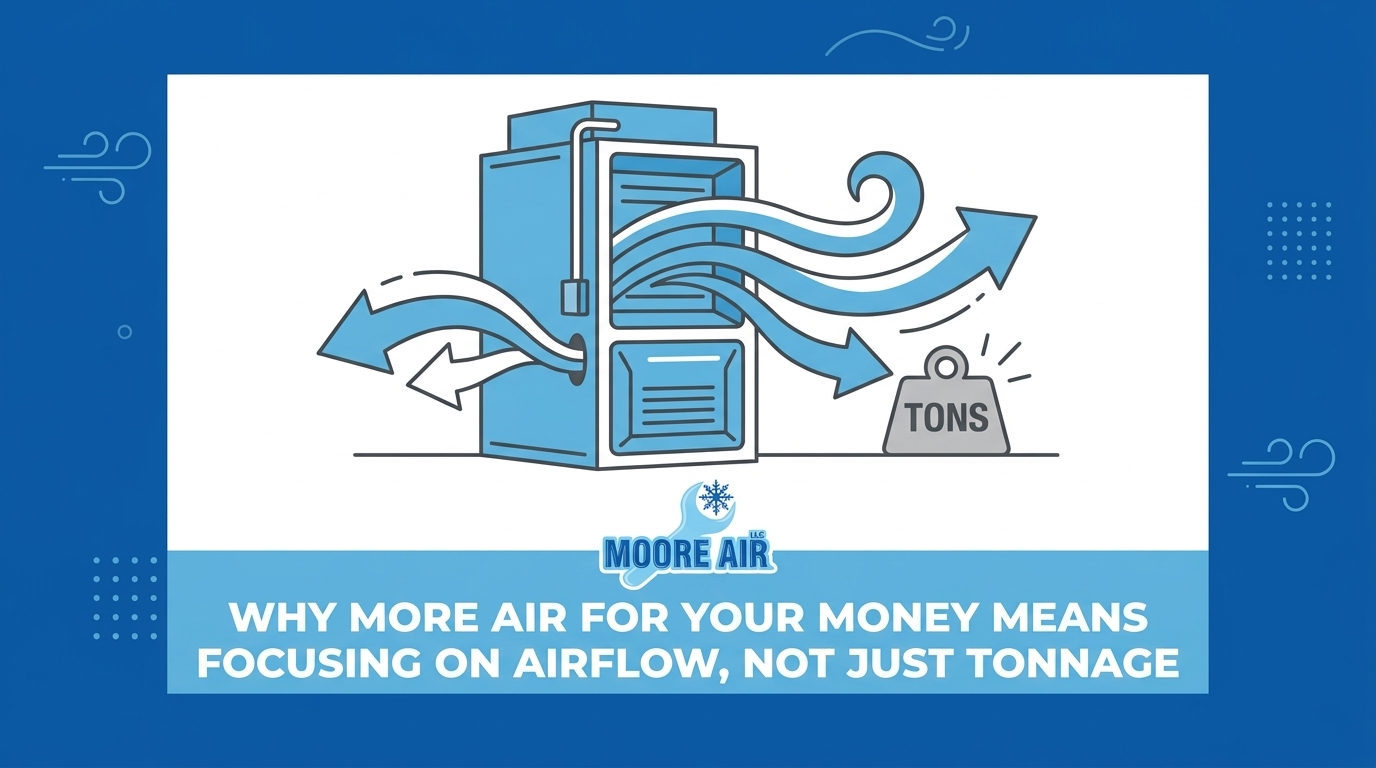
Why More Air for Your Money Means Focusing on Airflow, Not Just Tonnage
The Trap of the Tonnage Upgrade
Your air conditioning system has been running nonstop, yet certain rooms in your home still feel uncomfortably warm, which often leads to a critical misunderstanding of why more air for your money means focusing on airflow, not just tonnage. When persistent hot spots plague a house, many homeowners automatically assume their equipment is simply too small for the job. The immediate reaction is to request a higher-tonnage AC unit, believing that brute force cooling capacity will push enough cold air to finally reach those stubborn bedrooms or living areas.
However, upgrading your equipment without first assessing the delivery system—your ductwork—often exacerbates the very comfort issues you are trying to solve. The critical decision point is whether to blindly purchase a larger unit or to have a licensed professional evaluate your home’s airflow restrictions first. As we enter the September pre-heating-season transition, now is the ideal time to assess the cooling struggles you experienced over the summer before winter sets in. For comprehensive solutions, professional duct work services provide the diagnostic insight needed to determine if your home actually needs more tonnage, or simply better airflow.
The Physics of Comfort: Understanding Static Pressure
Airflow issues are rarely a mystery; they are a matter of basic physics. To understand why a larger air conditioner might not solve your comfort problems, you must first understand the concept of static pressure. In heating and cooling systems, static pressure is the resistance to airflow within the HVAC components and the ductwork itself. Just as blood pressure measures the resistance within your arteries, static pressure measures how hard your system’s blower motor has to work to push conditioned air through your home.
What is Static Pressure?
Static pressure is the balance between your blower’s capacity to move air and the ductwork’s resistance to that movement. When a system is perfectly balanced, air flows smoothly, quietly, and efficiently into every room. This resistance is quantified precisely; static pressure is measured in inches of water column (in. w.c.). This measurement is the ultimate metric of system health. If the in. w.c. reading is too high, it means the system is fighting against severe restrictions, which drastically reduces the volume of air that actually makes it out of your vents.
Proper airflow requires strict adherence to ACCA Manual D standards, which dictate the exact mathematical sizing required for residential duct systems. When ductwork is installed without following these rigorous calculations, or when a larger unit is retrofitted onto an older, undersized duct system, the static pressure skyrockets. The blower motor works harder, consumes more electricity, and ultimately delivers less comfort.
How Professionals Measure Airflow Resistance
Because static pressure measured in inches of water column (in. w.c.) is a highly technical diagnostic metric, it requires specialized tools and extensive training to evaluate accurately. Licensed HVAC technicians use sensitive digital manometers to measure the pressure differentials at specific points within the air handler and ductwork.
- Return-side readings: Technicians measure the pressure before the blower to see if the system is starving for air due to restrictive filters or undersized return grilles.
- Supply-side readings: Measurements taken after the blower reveal if the ductwork is too small to handle the volume of air being pushed out.
- Total External Static Pressure (TESP): Combining these readings gives the technician a complete picture of the system’s operational strain.
This diagnostic step cannot be skipped during a system evaluation. Attempting to measure or modify ductwork without professional tools and ACCA Manual D knowledge can lead to severe equipment damage and voided warranties. Relying on a licensed professional ensures the root cause of the airflow restriction is accurately identified.
The “Breathing Through a Straw” Dilemma
To visualize the impact of high static pressure, consider a simple analogy. Imagine trying to run a marathon while breathing exclusively through a narrow cocktail straw. No matter how strong your lungs are, the restriction prevents you from getting the oxygen you need to perform. Connecting a high-tonnage, high-capacity air conditioning unit to undersized ductwork creates the exact same dilemma.
The Mismatch Between Blower Capacity and Duct Size
Every air conditioning system is designed to move a specific volume of air, measured in Cubic Feet per Minute (CFM). A larger, higher-tonnage unit requires a significantly higher CFM to operate correctly. If you upgrade from a 3-ton unit to a 5-ton unit, but your ductwork was only originally sized to handle 1,200 CFM, the new unit will try to force 2,000 CFM through pipes that are mathematically too small. This mismatch ignores ACCA Manual D guidelines and destroys efficiency. For a deeper dive into how environmental extremes impact these calculations, understanding why standard sizing fails for 110-degree days is crucial.
The Ripple Effect on System Lifespan
High static pressure damages larger units even faster than smaller ones. When a powerful blower motor pushes against severe resistance, the mechanical strain is immense. The consequences of this “breathing through a straw” scenario are severe and expensive:
| Component | Impact of High Static Pressure (in. w.c.) | Resulting Damage |
|---|---|---|
| Blower Motor | Overheating due to excessive rotational resistance | Premature motor failure and high energy bills |
| Evaporator Coil | Inadequate airflow across the chilled fins | Coil freezing, water leaks, and compressor slugging |
| Compressor | Liquid refrigerant returning to the outdoor unit | Catastrophic compressor failure |
| Duct Seams | Excessive internal pressure forcing air outward | Blown seals, air leaks into the attic, and lost efficiency |
Ultimately, a larger unit will not cool a home better if the ductwork cannot accommodate the required CFM. Instead of delivering more cool air to your living room, the system simply wastes energy fighting itself, leading to premature breakdowns and a chronically uncomfortable home.

Recognizing the Symptoms of Restrictive Ductwork
Homeowners often misdiagnose airflow problems as a failing air conditioner. Because the symptoms of high static pressure mimic the symptoms of an aging, undersized unit, it is easy to assume that more tonnage is the only answer. However, differentiating between a failing AC unit and ductwork that is choking your system is critical for long-term comfort.
Short Cycling and Uneven Temperatures
One of the primary indicators of airflow restriction is short cycling. This occurs when the system turns on, runs for only a few minutes, and shuts off before it has properly conditioned the entire home.
- The thermostat is tricked: Poor air distribution often causes cold air to dump directly onto the thermostat, tricking it into thinking the house is cool.
- The system shuts down prematurely: The unit cycles off, leaving the bedrooms and distant spaces sweltering.
- Hot spots form: Because the static pressure measured in inches of water column (in. w.c.) is too high, the air simply lacks the velocity to reach the ends of the duct runs.
This physics-driven phenomenon explains why your living room might feel like a refrigerator while your primary bedroom feels like an oven.
Increased Wear and Tear on Components
Beyond temperature imbalances, poor airflow drastically impacts the environment inside your home. Restrictive ductwork forces air through tiny gaps and leaks, pulling unfiltered air from attics or crawlspaces into your living areas. This results in excessive dust accumulation and poor air quality. If you notice these symptoms, evaluating your system with professional indoor air quality services can help identify where the ductwork is failing. Furthermore, a struggling blower motor often produces audible signs of distress, such as a high-pitched whining or heavy humming sound, accompanied by unexplained spikes in energy consumption.
Why Extreme Summer Heat Masks Airflow Bottlenecks
In regions like Litchfield Park, where 110-plus degree summers are a harsh reality, diagnosing HVAC issues becomes uniquely challenging. Extreme heat has a way of disguising underlying static pressure problems, making it incredibly difficult for a homeowner to determine if their system is struggling due to the weather or due to restrictive ductwork.
The Illusion of “Normal” Cooling Struggles
When the outdoor temperature climbs into the triple digits, even perfectly calibrated air conditioners will run for long cycles. Because continuous operation is expected during a heatwave, homeowners often accept persistent hot spots and poor airflow as a “normal” climate inevitability. Surviving the peak summer heat masks the fact that the system might actually be fighting against high static pressure rather than just the outdoor temperature.
However, extreme temperatures compound energy waste and system strain rapidly. A unit that is already choked by undersized ducts will suffer accelerated wear when forced to run 18 hours a day in Litchfield Park’s extreme climate. The danger lies in accepting this poor performance. As we move into the September pre-heating-season transition, the slight break in the weather provides a critical window. If your system still struggles to balance temperatures when it’s 85 degrees outside, the problem is almost certainly airflow, not the heat. This highlights the absolute necessity of a professional evaluation before considering a new air conditioner installation.
The Honest Assessment: Evaluating Before Upselling
The HVAC industry often defaults to a predictable response when a homeowner complains about hot spots: quoting a larger, more expensive unit. This standard upsell is easy, profitable, and completely ignores the root cause of the problem. If the ductwork is undersized, installing a 5-ton unit where a 4-ton unit used to be will only increase the static pressure measured in inches of water column (in. w.c.), leading to louder operation, higher bills, and eventual system failure.
Why Bigger Isn’t Better Without Airflow
An ethical approach to HVAC service requires a comprehensive static pressure test before any equipment replacement is recommended. True professionals prioritize fixing the root cause—airflow—over unnecessary upsells. This philosophy aligns with the “Moore Air for Less Cash” ethos: providing an honest assessment of your ductwork saves you money by preventing you from buying excess capacity that your home cannot actually use.
Real-world patterns consistently prove the value of this approach. For example, during a recent fall season, a local homeowner faced an extreme crisis, receiving poor offers and aggressive upsells for massive new AC units from various contractors. By prioritizing thorough troubleshooting over a quick sale, the root airflow and mechanical issues were properly diagnosed. The result was a fair price on a correctly sized installation that actually solved the comfort issues, without the hidden costs of unnecessary tonnage. Homeowners should always feel empowered to ask a technician about their static pressure readings before agreeing to a full unit replacement.
Transitioning Smartly: Preparing for the Pre-Heating Season
Timing is everything when it comes to correcting deep-seated HVAC issues. The shift from summer to fall is not just a change in weather; it is a strategic opportunity to protect your equipment. The September pre-heating-season transition is the ideal time to evaluate static pressure and address the airflow bottlenecks that summer demands recently exposed.
Here is why transitioning smartly matters right now:
- Mild weather allows for accurate testing: Technicians can evaluate the ductwork without the system being forced to run under emergency cooling loads.
- Summer flaws are still fresh: You know exactly which rooms were uncomfortable over the past three months, providing a clear roadmap for the diagnostic process.
- Protecting the heating system: Your furnace or heat pump uses the exact same ductwork and blower motor as your AC. Addressing high static pressure now ensures your heating system won’t suffer the same restrictive fate when temperatures drop.
- Avoiding peak-season delays: Scheduling a professional evaluation while the weather is mild ensures you aren’t competing with emergency breakdown calls.
Taking action during the September pre-heating-season transition guarantees that your home will be perfectly balanced and efficient long before the winter chill arrives.
True Efficiency Starts With Proper Airflow
The core truth of residential cooling is that more air for your money requires optimized ductwork, not just a bigger AC unit. Throwing more tonnage at an airflow problem is a costly mistake that leads to premature breakdowns, higher utility bills, and persistent discomfort. The physics cannot be cheated: static pressure measured in inches of water column (in. w.c.) dictates exactly how well your system can perform.
As we navigate the September pre-heating-season transition, take the time to address the root cause of your home’s hot spots. Do not settle for the standard industry upsell. Demand an honest assessment of your ductwork’s capabilities. If you are ready to stop treating the symptoms and start fixing the real problem, explore comprehensive HVAC services to schedule a professional airflow evaluation today.
Frequently Asked Questions
Why is airflow more important than AC tonnage?
Airflow determines how effectively conditioned air is distributed throughout your home. If your ductwork is restrictive, even the highest-tonnage AC unit will fail to cool distant rooms, resulting in wasted energy and persistent hot spots.
What is static pressure in HVAC?
Static pressure is the resistance to airflow within your heating and cooling system’s ductwork and components. Measured in inches of water column (in. w.c.), it indicates how hard your blower motor must work to push air through the vents.
Why does a bigger AC unit not always cool better?
A larger AC unit requires a higher volume of air (CFM) to operate correctly. If connected to undersized ductwork, the system experiences severe static pressure, leading to short cycling, frozen coils, and an inability to properly dehumidify or cool the home.
What are the symptoms of high static pressure in ductwork?
Common symptoms include short cycling, uneven room temperatures, excessive dust, and a loud or whining blower motor. These signs indicate the system is struggling against severe airflow resistance.
How do professionals measure HVAC static pressure?
Licensed HVAC technicians use specialized digital manometers to measure pressure differentials across the system. By taking readings at the return and supply sides of the air handler, they calculate the Total External Static Pressure to accurately diagnose ductwork restrictions.