Gas Furnace Clearance Requirements: Why Utility Closet Storage is a Safety Risk
The Hidden Hazard in Your Utility Closet
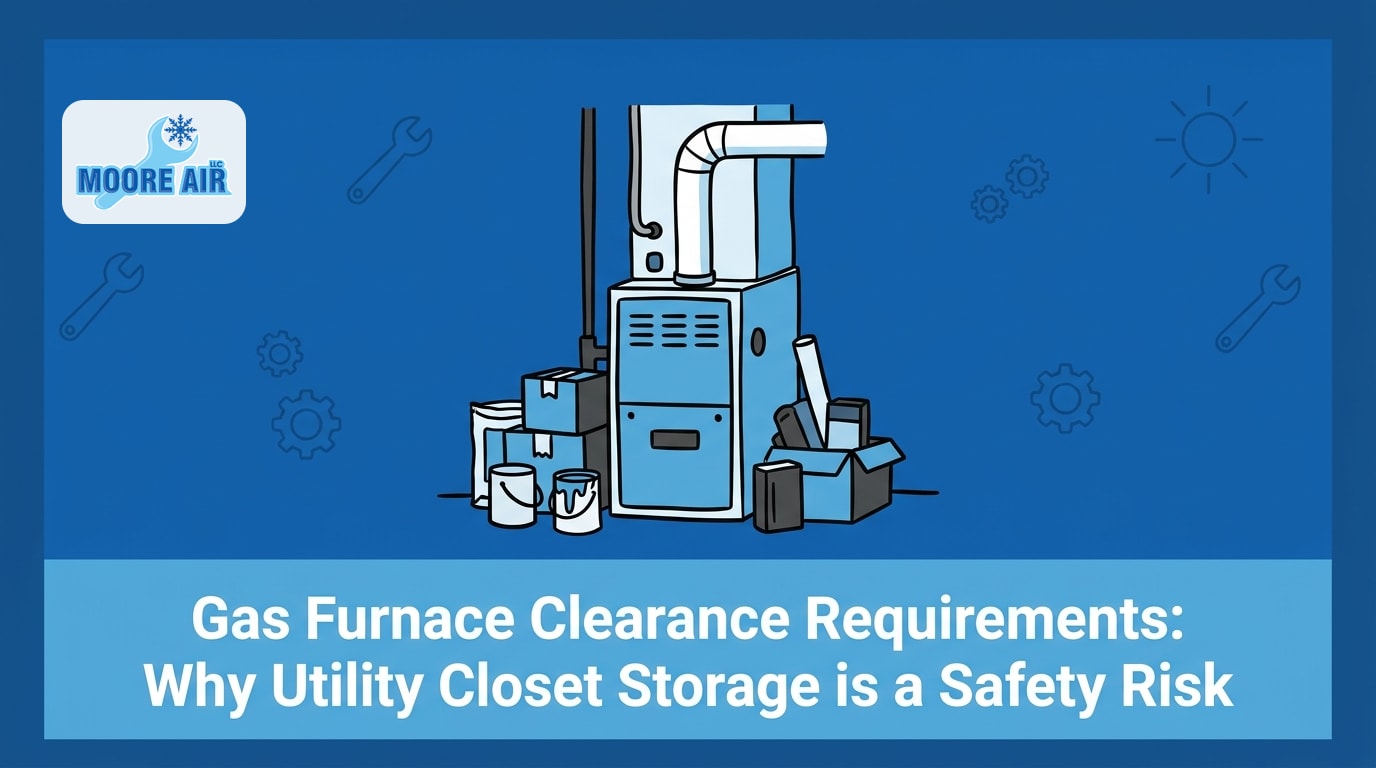
In our years of servicing homes throughout Litchfield Park AZ, our team at Moore Air constantly sees utility closets overflowing with boxes. However, ignoring proper gas furnace clearance requirements puts your entire home at risk. We often find that homeowners inadvertently turn the space around their heating equipment into a convenient storage area for holiday decorations, luggage, and winter gear. Blocking this critical area restricts vital combustion air and creates a severe fire hazard just when you need reliable heat the most. Before you activate your system for the chilly months ahead, establishing mandatory safety clearance zones is a critical first step for November pre-winter heating readiness. A professional inspection can identify hidden airflow restrictions that compromise your home’s safety.
If you need professional assistance evaluating your mechanical space, explore our furnace services to ensure your system is ready for the season.
Decoding Gas Furnace Clearance Requirements and Safety Codes
When our heating professionals discuss clearance zones, we are not making arbitrary suggestions. These measurements are rooted in strict building and safety codes designed to protect your property and your family. The International Residential Code (IRC) Section M1305 mandates a minimum of 30 inches of working space in front of the control side of the unit. This specific measurement ensures that a technician can safely access the internal components, remove the blower motor if necessary, and perform emergency shut-offs without obstruction.
Beyond physical access, the National Fuel Gas Code (NFPA 54) outlines strict combustion air requirements to ensure complete and safe fuel burning. Gas appliances consume massive amounts of oxygen. If the room is too tight or packed with belongings, the equipment cannot pull in the air it needs to operate safely. These clearances are enforceable life-safety measures designed to prevent catastrophic failures, fire hazards, and carbon monoxide buildup in residential homes across Litchfield Park AZ.
Understanding combustible materials: It is vital to understand the difference between combustible and non-combustible materials when measuring safe distances. Combustible materials include obvious items like cardboard and clothing, but also encompass drywall paper, wood framing, and certain types of insulation. Even if a flame never touches these materials, the radiant heat from a working furnace can dry them out over time, lowering their ignition temperature in a process called pyrolysis.
Standard Clearance Measurements
While every home setup is slightly different, basic building codes establish baseline rules for mechanical rooms. Always remember that these are minimums, not maximums—more space is always safer.
| Clearance Zone | Standard Minimum Distance | Primary Safety Purpose |
|---|---|---|
| Front (Control Side) | 30 inches | Provides safe working space for technicians and allows primary airflow into the cabinet. |
| Sides and Back | 1 to 6 inches | Prevents radiant heat transfer to nearby walls and allows the metal cabinet to safely dissipate heat. |
| Top (Plenum Area) | Varies by model (often 1-2 inches) | Prevents dangerous heat buildup near ceiling joists, closet roofs, or overhead framing. |
| Flue Pipe (Single Wall) | 6 inches | Keeps extreme exhaust heat away from combustible wall materials and insulation. |

Combustion Air Starvation: The Mechanical Threat to Your Heat Exchanger
To understand why these strict rules exist, you have to look at the mechanical processes happening inside your heating equipment. Gas systems require a constant, unimpeded supply of oxygen to burn fuel cleanly and efficiently. The mixture of gas and oxygen must remain perfectly balanced to produce a safe, crisp blue flame. When this balance is achieved, the byproduct is safely vented out of your home.
The problem begins with restricted airflow. When boxes, winter gear, or heavy dust block the intake vents on the closet door or the unit itself, the system experiences combustion air starvation. The burner flames become lazy, yellow, and produce excess soot. More importantly, the internal heat exchanger—the critical metal shield that separates the toxic combustion gases from your home’s breathing air—loses the cooling airflow it needs to regulate its own temperature.
The mechanical failure: Restricted airflow causes the internal heat exchanger to overheat rapidly. As the metal overheats, it expands beyond its design limits. When the system turns off and cools down, the metal contracts. Over time, this extreme expansion and contraction causes metal fatigue, eventually leading to a cracked heat exchanger. This is not just a minor breakdown; it is a severe health hazard. A cracked heat exchanger is a primary source of dangerous carbon monoxide leaks in residential homes.
The solution: Maintaining a completely clear utility closet ensures your system gets the oxygen it needs to operate safely. If you suspect your system has been running hot or struggling for air during your November pre-winter heating readiness checks, it is crucial to schedule a professional furnace repair evaluation before the extreme cold sets in.
The Dangers of Seasonal Storage Near Heating Equipment
Utility closets are notoriously cramped, making them tempting targets for homeowners looking to stash away seasonal items. During our November pre-winter heating readiness checks, our technicians frequently discover closets packed to the brim. However, the specific types of items typically stored in these spaces make the hazard exponentially worse. Cardboard boxes, plastic storage bins, wrapping paper, and artificial greenery are highly combustible materials. When stacked near a heating appliance, they create the perfect fuel source for a catastrophic house fire.
You do not need a direct flame to start a fire in a mechanical room. Radiant heat from the unit’s metal casing, or particularly from a hot exhaust flue, can ignite these materials over time. As mentioned earlier, constant exposure to ambient heat lowers the ignition point of cardboard and paper, meaning a box that has been sitting near a hot flue pipe for three years is much easier to ignite than a brand new box.
Beyond fire risks, chemical storage presents another hidden danger to your equipment. A pattern we see often is homeowners storing cleaning supplies, laundry detergents, water softener salt, and leftover paint in their utility rooms. These chemicals release volatile organic compounds and corrosive fumes into the air. When your heating system pulls in this contaminated air for combustion, the heat alters the chemical structure, creating highly corrosive acids (like hydrofluoric or hydrochloric acid). These acids literally eat away at your heat exchanger and metal venting from the inside out, causing premature failure in Litchfield Park AZ homes.
Maintaining a strict “no storage” policy in the mechanical room is the absolute easiest way to prevent these hazards. For more insights on protecting your home as temperatures drop, read our guide on gas furnace safety before the first winter freeze.
Manufacturer Specifications vs. General Building Codes
While the International Residential Code provides excellent baseline rules for home safety, it is not the final word on how much space your specific heating system requires. The equipment manufacturer’s specifications always take precedence over general building codes, especially if the manufacturer requires more space than the local code dictates. Every unit is engineered differently, and the engineers who designed the system dictate the exact parameters required for safe operation.
This distinction becomes incredibly important when upgrading older equipment. Newer, high-efficiency condensing models operate very differently from older, atmospheric units. A high-efficiency unit extracts so much heat from the combustion process that the exhaust gas is cool enough to be vented through PVC piping. These units often require dedicated PVC intake pipes to pull fresh air directly from outside, altering the clearance and venting needs of the closet space.
A professional installer must verify both local municipal regulations and the manufacturer’s installation manual during the setup process. If a unit is installed too close to a wall, or if a homeowner builds custom shelving that encroaches on the mandatory clearance zones, the consequences go beyond safety risks. Improper clearances can instantly void the manufacturer’s warranty, leaving homeowners completely unprotected if a major component fails during their November pre-winter heating readiness period.
Zero-Defect Installations and Safety Compliance
Safety codes and clearance requirements are only effective if they are strictly followed during the initial installation and maintained throughout the life of the system. Strict adherence to these safety codes is non-negotiable when protecting homeowners from fire and carbon monoxide risks. A sloppy installation that ignores clearance zones is a ticking time bomb in a residential home.
Working with a company dedicated to mechanical precision means that every unit is installed with the exact airflow required for safe, clean combustion. At Moore Air, our technicians see firsthand what happens when these rules are ignored, which is why our commitment to mechanical precision and zero-defect installations ensures that code compliance is treated as an absolute baseline, not an afterthought. For our team, a zero-defect approach means measuring the utility closet dimensions before the equipment is even ordered, ensuring the final setup will have ample room to breathe.
Thorough testing during installation or routine maintenance verifies that the space meets all operational safety thresholds. Technicians use advanced tools to measure static pressure, draft pressure, and combustion efficiency, proving that the system has enough air to operate safely in its specific environment. Furthermore, homeowners in Litchfield Park AZ are educated on maintaining these zones long after the initial setup is complete, ensuring the space remains safe year after year.
Preparing Your Utility Space for the Seasonal Switchover
While daytime desert temperatures remain mild, the sudden chilly desert nights require immediate, reliable heating. This rapid temperature shift makes pre-winter clearance checks essential. You do not want to discover a safety hazard on the first freezing night of the year. Take time now to prepare your mechanical room for the seasonal switchover.
Follow this pre-winter utility closet checklist:
- Clear the clutter: Remove all seasonal decorations, cardboard boxes, plastic bins, and winter clothing from the mechanical room. Establish a strict “no storage” rule for this space.
- Measure the working space: Use a tape measure to verify the distance from the front, sides, and back of the unit. Ensure you have a minimum of 30 inches of clear working space in front of the control panel.
- Inspect the doors: If your utility closet has a louvered door (a door with wooden slats to allow airflow), clean the slats thoroughly. Dust and pet hair can clog these openings and starve the system of air.
- Check the intake grilles: Ensure that any combustion air intake grilles on the walls or ceiling are completely unobstructed by furniture, rugs, or stored items.
- Relocate chemicals: Move all cleaning supplies, paints, solvents, and chlorine-based products to a different room or a detached garage to prevent corrosive fumes from entering the combustion process.
If you notice any unusual smells, strange noises, or soot buildup around your equipment during your November pre-winter heating readiness checks, do not ignore it. Use an HVAC troubleshooter tool to identify potential issues and schedule a comprehensive safety check to verify the system is ready for sudden temperature drops.
Frequently Asked Questions About Furnace Clearances
How much space is needed around a gas furnace?
The standard building code requires a minimum of 30 inches of clear working space in front of the control side of the unit. The sides and back typically require 1 to 6 inches of clearance, depending on the manufacturer’s specific design. Always consult your owner’s manual for the exact measurements required for your specific model in Litchfield Park AZ.
Is it safe to store items in a utility closet with a furnace?
No, it is highly dangerous to store items in a utility closet containing heating equipment. Cardboard, plastic, and clothing are combustible materials that can ignite from the radiant heat of the unit or the flue pipe. Additionally, stored items block vital airflow, causing the system to overheat and potentially crack the heat exchanger.
Why do gas furnaces need combustion air?
Gas appliances require a constant supply of oxygen to mix with the fuel for a clean, safe burn. Without adequate combustion air, the flame becomes unstable and produces excessive soot and carbon monoxide. Proper airflow also cools the internal heat exchanger, preventing the metal from warping and cracking under extreme stress.
What happens if a furnace doesn’t have enough air?
If the system is starved for air, it will overheat rapidly, triggering internal safety switches that shut the system down. Repeated overheating causes metal fatigue, which eventually leads to a cracked heat exchanger. A cracked heat exchanger allows deadly carbon monoxide gases to leak directly into your home’s breathing air.
Can I store non-combustible items near my heating system?
Even non-combustible items should be kept out of the mandatory clearance zones. While a metal toolbox won’t catch fire, it can still block the intake vents and cause combustion air starvation. Maintaining a completely clear 30-inch perimeter ensures technicians have safe access and the equipment has the airflow it needs to function properly.
Ensure Your Home’s Safety This Winter
Maintaining proper clearance zones is the single most effective way a homeowner can prevent fire hazards and ensure clean, safe combustion. Your utility closet is the mechanical heart of your home, not a secondary storage shed for holiday decorations and old luggage. Keeping this space clear protects your equipment from premature failure and protects your family from the silent threat of carbon monoxide.
Don’t wait until the first cold night to discover your utility closet is unsafe or your system is struggling to breathe. Take action during your November pre-winter heating readiness preparations to establish these mandatory safety zones. Reach out to local professionals to verify your system’s safety, airflow, and overall performance by scheduling a comprehensive furnace tune-up today.