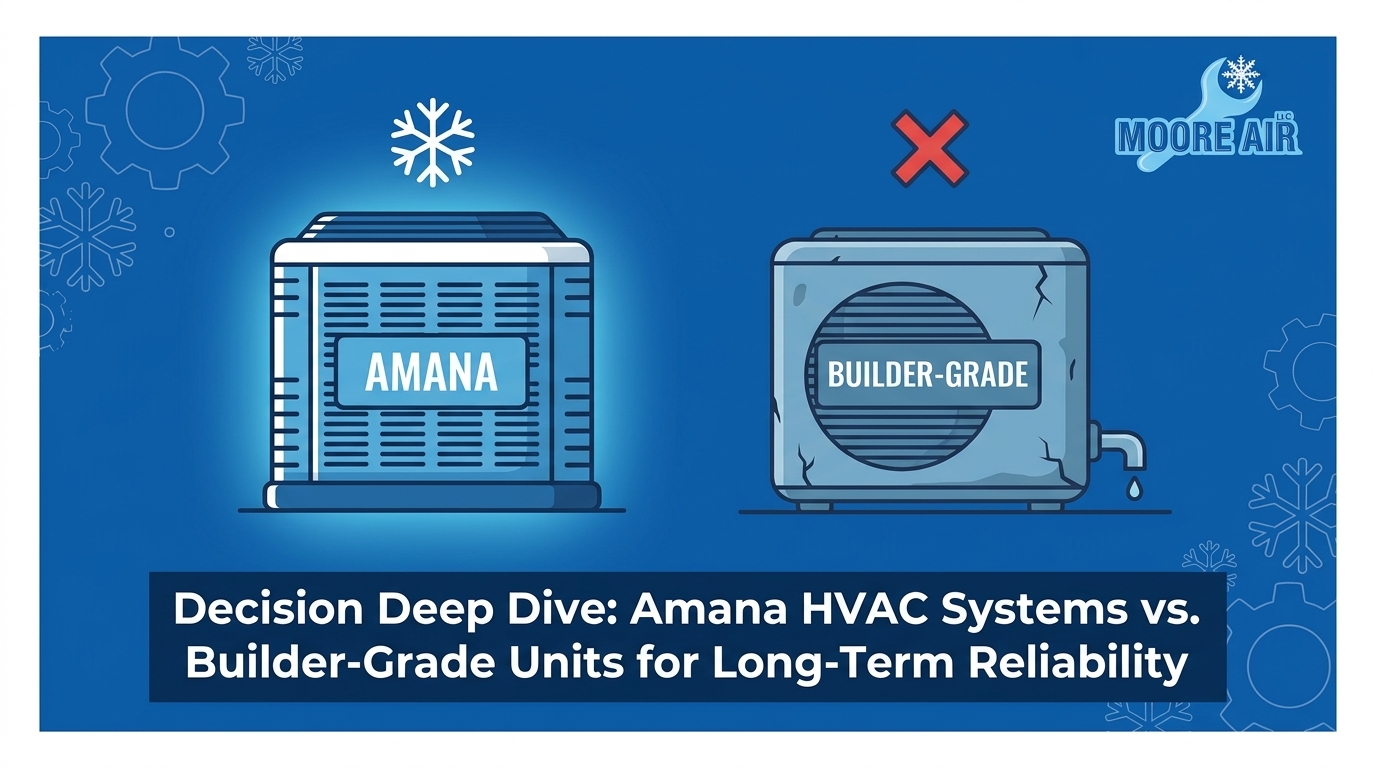
Amana HVAC Systems vs. Builder-Grade Units for Long-Term Reliability
Myth vs. Reality: The Lifespan of Tract Home HVAC Systems
When looking at Amana HVAC Systems vs. Builder-Grade Units for Long-Term Reliability, a common myth among new homeowners is that a freshly built house guarantees decades of trouble-free heating and cooling. The reality often looks very different. If you live in one of the newer Litchfield Park tract home developments, you might naturally assume your original air conditioner and furnace will last for fifteen to twenty years. However, a typical pattern we see is that these basic units frequently start failing around the five to seven-year mark.
If you are tired of pouring money into temporary fixes, exploring professional air conditioning services and planning a proper AC installation can save you from a complete breakdown.
Many homeowners are caught off guard when their relatively new system starts making strange noises or struggling to keep the house cool. This creates a stressful decision point: do you continue pouring repair money into a failing, out-of-warranty system, or do you invest in a reliable upgrade? Making this choice becomes especially urgent as we approach the September fall transition. During this time, your system is forced to switch back and forth between cooling during hot afternoons and heating during chilly nights. A compromised system rarely survives this dual-mode stress.
Early Warning Signs of Premature Failure
If your home is approaching that five to seven-year window, watch for these symptoms of a failing basic unit:
- Frequent cycling: The system turns on and off constantly without ever reaching the set temperature.
- Uneven temperatures: Certain rooms remain stubbornly hot while others are freezing.
- Rising energy bills: The unit works twice as hard to produce the same amount of cooling, driving up utility costs.
- Strange noises: Rattling, buzzing, or grinding sounds that indicate internal components are wearing out.
Understanding why these failures happen in Litchfield Park tract home developments is the first step toward making a smarter, long-term decision for your home’s comfort.
What Exactly Is a Builder-Grade HVAC Unit?
To understand why original equipment fails so quickly in Litchfield Park tract home developments, you have to understand the term “builder-grade.” When a developer constructs an entire neighborhood, their goal is to keep initial construction costs as low as possible while still meeting minimum local building codes. To achieve this, they bulk-order entry-level central HVAC systems that are designed for basic functionality, not long-term durability.
Builder-grade units are built with physical compromises that directly impact their lifespan. The manufacturers use thinner gauge metals for the outer cabinets and internal coils to save on material costs. These systems typically rely on basic, single-stage compressors that only operate at one speed: 100% capacity. Every time the system turns on, it blasts at full power, creating massive wear and tear on the internal components.
The Anatomy of a Cost-Saving System
The compromises made in basic equipment go beyond just the compressor. Here is what you are actually getting with a standard tract home unit:
- Thinner condenser coils: Cost-saving metals are highly susceptible to corrosion, leaks, and physical damage from debris.
- Basic fan motors: Standard motors lack the variable-speed technology needed to efficiently manage airflow and humidity.
- Flimsy cabinetry: The outer shell provides minimal protection against the elements and does little to dampen loud operational noise.
Furthermore, these cost-cutting measures are reflected in the warranty. Builder-grade units typically come with a standard five-year un-registered warranty. The moment that five-year mark passes, the financial risk of every blown capacitor, leaking coil, or dead compressor shifts entirely to you, the homeowner.
Why Basic Units Fail Fast in Extreme Heat
The five to seven-year failure rate of builder-grade equipment isn’t a coincidence; it is a direct result of severe climate degradation. Department of Energy guidelines clearly note that extreme operating conditions drastically reduce the lifespan of lower-tier HVAC equipment. In our region, the weather provides the ultimate stress test.
The Toll of 110-Degree Days
The Problem: Frequent 110+ degree summer days severely test and degrade thin builder-grade components. When the outside temperature spikes, your air conditioner has to work incredibly hard to extract heat from your home and release it outdoors.
The Cause: The thin, cost-saving coils in basic units struggle to dissipate this intense heat efficiently. The basic single-stage compressor is forced to run continuously for hours on end just to keep the indoor temperature bearable. This constant, high-stress operation accelerates the wear and tear on the system’s moving parts. The metal expands and contracts under the extreme thermal load, weakening the already thin materials and leading to microscopic cracks and refrigerant leaks.
The Solution: The compounding effect of running a compromised system continuously during peak heat means that hidden degradations are constantly accumulating. These hidden issues often cause catastrophic failures just as the September fall transition approaches. Upgrading your equipment before this critical shift ensures you aren’t left stranded when your system is forced to switch between cooling and heating.
The Amana Advantage: Engineered for Extreme Conditions
When you are tired of dealing with the limitations of basic equipment, it is time to look at heavy-duty alternatives. Amana HVAC systems provide a robust, long-term solution to the premature failures plaguing tract homes. These systems are engineered from the ground up to withstand the exact extreme conditions that destroy cheaper units.
The build quality differences are immediately apparent. Amana utilizes thicker gauge metals for their cabinetry, providing superior protection against the elements and significantly reducing operational noise. But the real magic happens inside the unit. Amana HVAC systems feature proprietary tubular heat exchangers constructed from heavy-duty stainless steel. This unique tubular design eliminates the weak points and sharp corners found in traditional clamshell heat exchangers, making them incredibly resistant to thermal expansion and cracking.
Investing in Uninterrupted Comfort
Beyond the structural integrity, Amana units utilize high-efficiency compressors designed for severe climates. Instead of the hard starts and stops of a basic single-stage unit, many Amana models feature advanced compressor technology that adjusts cooling output based on your home’s real-time needs. This reduces the mechanical stress on the system, lowers your energy consumption, and provides a much more consistent indoor temperature.
Positioning an Amana upgrade as an investment means looking past the initial installation and focusing on uninterrupted comfort. You are not just buying a new air conditioner; you are buying a heavy-duty machine built to handle the harshest weather without flinching.
Warranty Showdown: 5-Year Basic vs. Lifetime Limited Coverage
A manufacturer’s warranty tells you exactly how much confidence they have in their own equipment. When you contrast the weak warranties of tract home units with the industry-leading protection of Amana HVAC systems, the difference in long-term value becomes crystal clear.
Most basic builder-grade equipment defaults to a standard five-year un-registered warranty. This timeline perfectly aligns with the five to seven-year failure rate we commonly see. Once that short window closes, you are entirely responsible for the cost of replacement parts.
Amana takes a radically different approach. On select registered compressors and heat exchangers, Amana offers a Lifetime Unit Replacement Limited Warranty. This means that if the compressor—the heart and most expensive component of the air conditioner—fails while you still own the home, the manufacturer provides a complete replacement unit, not just a patch-job repair.
Comparing Warranty Protection
| Warranty Feature | Builder-Grade Units | Amana HVAC Systems |
|---|---|---|
| Standard Coverage Length | Typically 5 years (un-registered) | Up to 10 years on registered parts |
| Compressor Protection | Basic 5-year parts only | Lifetime Unit Replacement Limited Warranty (on select registered models) |
| Heat Exchanger Coverage | 10 to 20 years maximum | Lifetime Limited Warranty (on select registered models) |
| Homeowner Peace of Mind | Low; risk shifts to homeowner quickly | High; long-term financial protection |
Having a lifetime compressor warranty means true long-term peace of mind. You never have to worry about a catastrophic component failure draining your savings, because the manufacturer stands behind their heavy-duty engineering.
Side-by-Side: Builder-Grade vs. Amana Systems
To truly understand the gap in quality between what came with your house and what a premium upgrade offers, it helps to look at the specifications side-by-side. The differences in compressor quality, coil durability, and expected lifespan highlight exactly why Amana HVAC systems outperform basic tract home units.
| Component / Feature | Basic Builder-Grade Unit | Premium Amana System |
|---|---|---|
| Compressor Quality | Basic single-stage (runs at 100% only) | High-efficiency, heavy-duty (often multi-stage or variable) |
| Coil Durability | Thinner, cost-saving metals prone to leaks | Robust, extreme-weather resistant builds |
| Heat Exchanger Design | Standard clamshell design (prone to cracking) | Proprietary heavy-duty tubular heat exchanger |
| Warranty Protection | 5-year standard un-registered | Lifetime Unit Replacement Limited Warranty (select registered parts) |
| Expected Lifespan in Extreme Heat | 5 to 7 years before major failures | 15+ years with proper professional maintenance |
This clear contrast shows that while basic units are built to satisfy minimum requirements, Amana systems are engineered to thrive in punishing environments.

Why Professional Installation Outperforms Rushed Tract Builds
Even the highest-quality Amana HVAC systems will fail to reach their full potential if they are installed incorrectly. A premium unit requires meticulous, expert installation to realize its full lifespan and efficiency. Unfortunately, tract home HVAC systems are often installed rapidly in bulk. When crews are rushing to finish dozens of homes in a single phase, critical details are frequently overlooked. This leads to subpar duct connections, incorrect refrigerant charges, and poor airflow balancing.
A custom installation is an entirely different process. It involves precise load calculations to ensure the unit is perfectly sized for your specific home’s square footage, window placement, and insulation levels. It includes thorough wiring corrections and meticulous airflow balancing so every room receives consistent comfort.
We take pride in our firsthand installation expertise, contrasting our meticulous, high-integrity approach with those rushed tract home jobs. One local homeowner reached out to us last May when they required the installation of an Amana a/c and gas heat split system. Our technicians arrived on time, kept the workspace clean and courteous, and the owner personally made the final adjustments. The system was installed flawlessly with no surprises, bait-and-switch tactics, or hidden charges.
This is the level of care required when installing a new Amana split system. An expert team ensures the new system operates flawlessly from day one, communicating transparently throughout the entire process so you never have to guess about the quality of the work.
Preparing for the Fall Temperature Shift
Timing your HVAC upgrade is just as important as choosing the right equipment. The September fall transition is the ideal time to upgrade, well before the heavy heating demands of winter kick in. During this transition season, your system faces a unique mechanical challenge: dual-mode reliability.
In the span of twenty-four hours, your unit might need to blast air conditioning during a hot afternoon and then seamlessly switch to heating in the middle of the night. This back-and-forth shifting causes rapid thermal expansion and contraction within the system. For an aging, weakened builder-grade unit, this stress is a common breaking point.
The Value of Proactive Planning
Waiting for an emergency failure in the dead of winter or the peak of summer severely limits your options. It forces you into rushed decisions and emergency service fees. By planning your upgrade proactively during the September fall transition, you take control of the process. You have the time to research your options, schedule an installation at your convenience, and ensure your home is fully prepared for whatever the weather brings.
If you are concerned about the upfront investment of a premium system, exploring flexible HVAC financing options can make transitioning to a heavy-duty unit highly accessible. Upgrading on your own terms is always more cost-effective than dealing with a catastrophic breakdown.
Frequently Asked Questions About HVAC Upgrades
Why do builder grade AC units fail so fast?
Builder-grade units fail quickly because they are constructed with thinner materials and basic, entry-level components designed to keep initial construction costs down. These units lack the durability required to withstand continuous operation in extreme heat. Over time, the intense thermal stress degrades the thin coils and overworks the single-stage compressor, leading to premature breakdowns around the five to seven-year mark.
What makes Amana HVAC systems reliable?
Amana HVAC systems are reliable because they are engineered with heavy-duty components specifically designed for severe climates. They utilize proprietary tubular heat exchangers made of stainless steel, which resist cracking and thermal stress far better than standard designs. Additionally, their high-efficiency compressors are built to run smoothly and consistently, reducing the mechanical wear and tear that destroys lesser units.
How long is the warranty on an Amana AC unit?
Amana offers some of the strongest protection in the industry, featuring a Lifetime Unit Replacement Limited Warranty on select registered compressors and heat exchangers. If these critical components fail while you own the home, the manufacturer provides a replacement unit. This far exceeds the standard five-year un-registered warranties typically found on builder-grade equipment, offering unmatched long-term peace of mind.
Is upgrading to premium HVAC worth it for a tract home?
Yes, upgrading to a premium system is absolutely worth it for a tract home because it eliminates the cycle of frequent, stressful repair costs. While basic units struggle and fail early, a premium system provides consistent comfort and significantly better energy efficiency. With proper maintenance, a heavy-duty system can easily last 15 years or more, making it a smarter long-term financial decision.
When is the best time to replace a failing HVAC system?
The best time to replace a failing system is during the transition seasons, such as the fall, before extreme hot or cold weather hits. Upgrading during the fall transition allows for a planned, methodical installation rather than a panicked emergency replacement. It ensures your new system is tested and ready to handle the demanding dual-mode stress of switching between heating and cooling.
Secure Your Home’s Comfort with a Heavy-Duty Upgrade
Upgrading from a failing builder-grade unit to a robust Amana system is the smartest move you can make for your home’s long-term reliability. By stepping away from thin metals and basic compressors, you are investing in a machine engineered to handle extreme thermal stress without breaking a sweat.
The peace of mind that comes with superior build quality and Amana HVAC systems’ lifetime limited warranties means you can finally stop worrying about the next breakdown. Don’t wait for your aging tract home unit to fail during the demanding seasonal shifts. Secure your comfort by scheduling a professional AC installation with a local expert today. You deserve a clear, BS-free explanation of your options and a heavy-duty system that actually protects your home for the long haul.