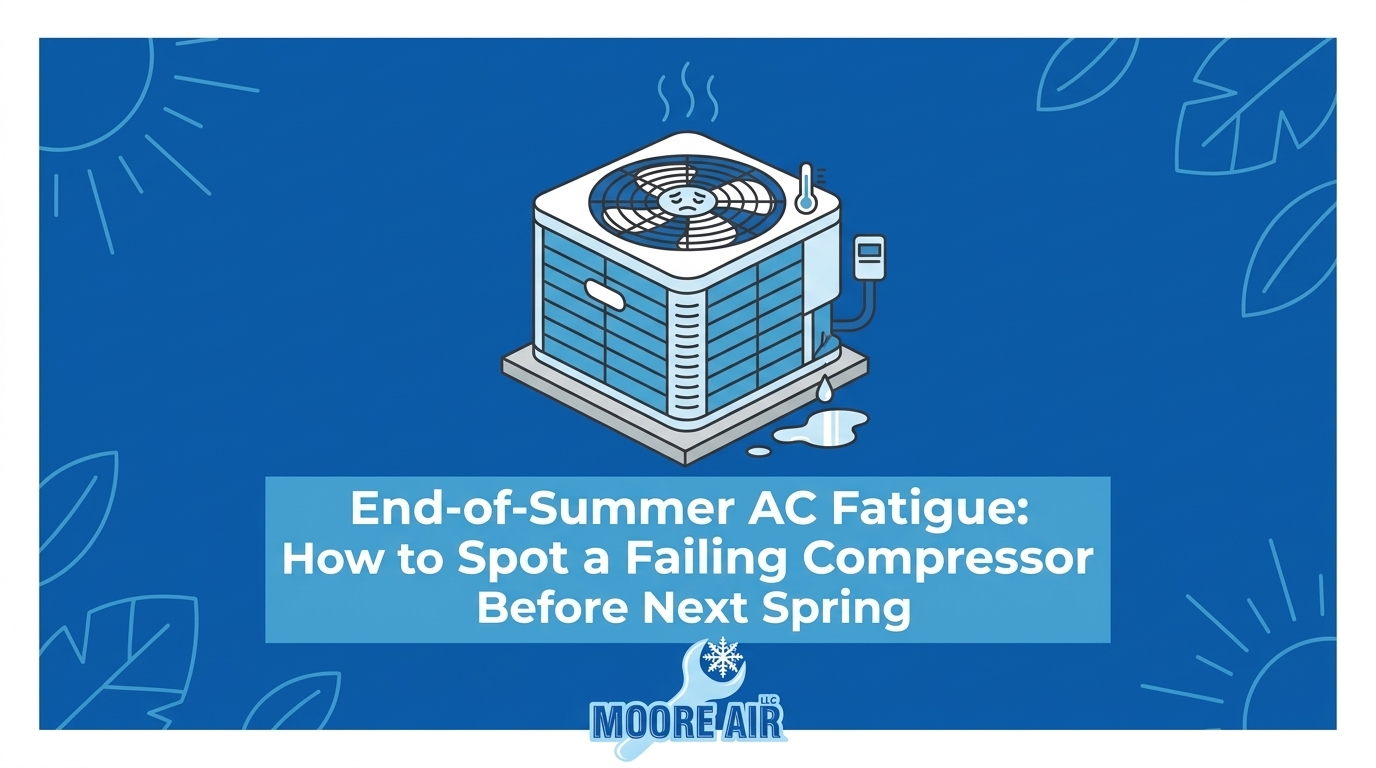
How to Spot a Failing AC Compressor Before It Dies Next Summer
The September Transition: Assessing Your AC After a Brutal Season
September in Arizona finally brings a hint of relief from the relentless heat, but your cooling system is just finishing a grueling marathon. Here at Moore Air, our technicians know that after running virtually nonstop for months, the end of the cooling season is exactly when hidden mechanical wear and tear begins to show. If you are wondering how to spot a failing AC compressor before it dies next summer, the best time to look is right now, during the September post-summer transition.
You might be noticing subtle electrical dimming in your home or hearing strange, hard-starting noises coming from the outdoor unit. In our experience, these early warning signs present a critical choice: you can either address these symptoms now in early fall, or ignore them and risk a catastrophic failure on the first triple-digit day next spring. Catching these subtle red flags early is the absolute best way to prevent avoidable and highly disruptive breakdowns.
When you need reliable air conditioning services, a proactive fall assessment is the smartest move you can make to protect your home’s comfort.
The Cumulative Toll of Extreme Heat on Your Compressor
To understand why fall is the most common time for compressor fatigue to appear, you have to look at what the equipment just endured. In our years of servicing systems across the area, we’ve seen firsthand how Litchfield Park’s extreme summer heat, frequently exceeding 110 degrees, creates sustained strain that degrades electrical components significantly faster than national averages. Your air conditioner is not just running; it is battling massive thermal loads around the clock.
The mechanics of thermal stress:
- Continuous operation: Running 24/7 prevents the compressor motor from cooling down between cycles, keeping internal temperatures perilously high.
- Oil degradation: The lubricant inside the compressor breaks down faster under extreme heat, increasing friction on moving metal parts.
- Electrical winding wear: The insulation on the internal electrical windings slowly bakes and degrades over a brutal summer, leading to electrical inefficiencies.
Because of this relentless workload, our team consistently finds that the highest state of equipment fatigue always occurs at the end of the cooling season. The stress is entirely invisible while it is happening, but as the internal components degrade, that invisible strain begins to manifest as audible and visible warning signs. The motor has to work harder to overcome the increased friction, and the electrical components struggle to supply the necessary power. If you notice a change in performance, scheduling an AC repair evaluation before the system shuts down completely can save the heart of your cooling system.
Auditory Red Flags: Decoding Hard Starts and Clanking Noises
Your ears are often the first diagnostic tool when it comes to compressor health. A healthy air conditioner starts with a smooth, even hum. When mechanical or electrical fatigue sets in, we typically hear that smooth startup replaced by jarring auditory red flags, specifically electrical dimming and hard-start clanking.
A “hard start” occurs when the compressor motor struggles to overcome internal resistance to begin its cooling cycle. Compressors draw their highest electrical current during startup—a measurement known as Locked Rotor Amps (LRA). When the system is fatigued, this startup phase takes longer and requires significantly more effort, putting immense stress on the entire unit. Understanding why capacitors fail in August is a big piece of this puzzle, as weakened electrical support directly causes these harsh startups.
Listen for these specific distress signals:
- Clanking: A loose internal component or broken spring inside the compressor shell often sounds like a heavy metal ball rattling inside a tin can.
- Grinding: This noise typically points to failing motor bearings. The protective lubrication has broken down, resulting in direct metal-on-metal friction.
- Screeching or squealing: High-pitched noises upon startup can indicate dangerous internal pressure buildups or failing compressor valves.
We always advise our customers to never ignore a sudden change in their system’s startup sound. These noises are not quirks of an aging system; they are mechanical cries for help.
What Does a Hard-Starting AC Sound Like?
Our technicians often describe a hard-starting compressor as producing a noticeable stuttering or booming sound. You might hear a loud, aggressive “buzz” or “hum” that lasts for several seconds before the fan finally engages with a heavy clunk. This noise is the sound of mechanical resistance. The motor is fighting against severe internal friction or inadequate electrical supply, desperately trying to gain enough momentum to turn the refrigerant pump. If the unit sounds like it is struggling to breathe or catch its rhythm, it is experiencing a hard start.
Electrical Anomalies: Why Your House Lights Dim
Compressor fatigue does not just stay outside in the condenser cabinet; it often reaches right into your home’s electrical panel. The relationship between your HVAC system’s power draw and your home’s electrical grid is highly sensitive. When the compressor motor starts to fail or faces extreme mechanical resistance, it demands significantly more electricity to force itself to run.
The connection between mechanical struggle and electrical signs:
- Flickering or dimming lights: If the lights in your living room or kitchen dim significantly for a moment when the AC kicks on, this is a major red flag. The compressor is pulling so much sudden amperage (voltage drop) that it is temporarily starving the rest of your house of electricity.
- Tripped circuit breakers: Your electrical panel uses breakers as a safety net. If the compressor pulls an unsafe amount of amperage due to internal binding or a failing motor, the breaker trips to prevent electrical fires and melted wires.
- Hot electrical panels: A struggling compressor forces high current through the wiring for longer periods, which can actually cause the breaker switch itself to feel warm to the touch.
The danger of the reset cycle:
If your air conditioner trips the breaker, our team strongly warns against treating it as a nuisance. Repeatedly flipping the breaker back on without a professional diagnosis is incredibly dangerous. Every time you force the system to run while it is pulling excessive amperage, you are actively baking the internal motor windings. What might have started as a minor electrical anomaly can quickly escalate into a permanently destroyed compressor motor.
The Honest Diagnosis: Bad Capacitor or Dying Compressor?
One of the most stressful experiences for a homeowner is hearing the terrible noises of electrical dimming and hard-start clanking during the September post-summer transition. Many people call us immediately assuming their compressor is completely dead. However, we frequently find that a failing run capacitor mimics the exact symptoms of a dying compressor.
The run capacitor acts as a powerful battery that delivers the massive jolt of electricity the compressor needs to start. When this small, inexpensive part weakens, the compressor does not get enough power. It struggles, it overheats, it makes clanking noises, and it trips breakers. A bad capacitor dramatically increases the electrical and thermal workload on the compressor. The good news is that many “dead compressors” we inspect are actually just in need of a simple capacitor replacement.
At Moore Air, this is where our commitment to an honest diagnostic approach shines. Working with professionals who prioritize truthful evaluations over jumping straight to a full system replacement makes all the difference. For example, one local homeowner with a 31-year-old air conditioner assumed their unit was beyond saving, but our honest focus on repair rather than pushing an immediate upgrade kept the aging unit running normally for another decade. If a system truly is beyond repair, you want to know all your options for an AC replacement, but that decision should always be based on facts, not guesswork.
| Symptom or Sign | Failing Run Capacitor | Dying Compressor |
|---|---|---|
| Startup Noise | Loud buzzing or clicking, unit fails to start | Heavy grinding, clanking, or screeching |
| Visual Inspection | Swollen, bulging, or leaking top on the capacitor cylinder | No visible exterior damage; internal failure |
| Air Temperature | Blowing warm air (fan runs, compressor doesn’t) | Blowing warm air or no air at all |
| Electrical Impact | Occasional light dimming, frequent hard starts | Immediate and repeated tripped breakers |

The Domino Effect: How Ignored Strains Cause Major Failures
Ignoring end-of-season symptoms creates a dangerous mechanical domino effect. Leaving a weak capacitor in the system forces the compressor to overwork every single time it turns on. The compressor motor runs hotter, the internal wiring degrades faster, and the mechanical bearings take on excess wear.
One of the biggest traps we see homeowners in Litchfield Park AZ fall into is the arrival of cooler fall weather. Once the temperatures drop, the air conditioner runs shorter cycles and has more time to cool down between starts. The hard starts might seem to disappear, and the house lights might stop dimming. The cooler weather masks the severity of the problem, tricking you into thinking the system fixed itself.
However, the internal damage remains. Those dormant, weakened components sit idle all winter, only to fail immediately when subjected to the extreme stress of the first major heatwave the following year. Routine end-of-season diagnostics can identify these anomalies before they cause permanent mechanical damage. Another local homeowner dealing with aging machines had their air conditioner fixed quickly over the summer by our team and received valuable longevity tips, proving that routine care extends equipment life significantly. Scheduling proactive AC maintenance now breaks the domino effect before it shatters your compressor.
Frequently Asked Questions About Compressor Health
What does a failing AC compressor sound like?
As our technicians often point out, a failing compressor typically produces loud, jarring noises like grinding, clanking, or squealing during startup. These sounds indicate severe internal friction, broken components, or failing motor bearings. If your formerly quiet system suddenly sounds like metal scraping against metal, the compressor is struggling and requires immediate professional evaluation to prevent total failure.
Will my AC run if the compressor is bad?
No, your system cannot cool your home if the compressor is bad. While the indoor fan might still run and blow air through your vents, the air will be warm because the compressor is not circulating the refrigerant needed to remove heat. If the compressor is completely locked up, it will often trip the circuit breaker the moment the thermostat calls for cooling.
Can a bad capacitor ruin an AC compressor?
Yes, a bad capacitor is one of the leading causes of premature compressor failure we encounter. The capacitor provides the massive electrical boost the compressor needs to start smoothly. When the capacitor is weak, the compressor motor struggles to turn on, overheats, and draws excessive amperage. Over time, this repeated stress burns out the compressor’s internal motor windings.
Why do my house lights dim when the AC turns on?
House lights dim when the AC turns on because the compressor is pulling an abnormally high amount of electrical current (amperage) to start. This sudden power draw creates a voltage drop across your home’s electrical panel. While a very slight, split-second dimming can be normal in older homes, significant or prolonged dimming indicates the compressor is experiencing a hard start and needs immediate attention.
What is a hard start on an air conditioning unit?
A hard start happens when the compressor motor encounters severe mechanical or electrical resistance and struggles to begin its cooling cycle. Instead of starting smoothly, the unit stutters, hums loudly, or shakes as it fights to overcome the resistance. Hard starts put immense thermal and electrical stress on the equipment and are a major warning sign of impending failure.
Protect Your Comfort: Schedule a Fall Diagnostic Today
Surviving the brutal summer heat is an accomplishment for any HVAC system, but the early fall months are when the true toll of that effort reveals itself. Early detection of hard starts and dimming lights saves your equipment from total failure and saves you from immense stress. At Moore Air, we’ve found that what truly gives homeowners peace of mind is having a clear, honest understanding of their system’s actual health before the next cooling season begins.
Do not let minor electrical anomalies turn into a disastrous mechanical failure. Take advantage of the milder weather and schedule a professional evaluation with our team today to ensure your compressor is ready to perform reliably when you need it most.