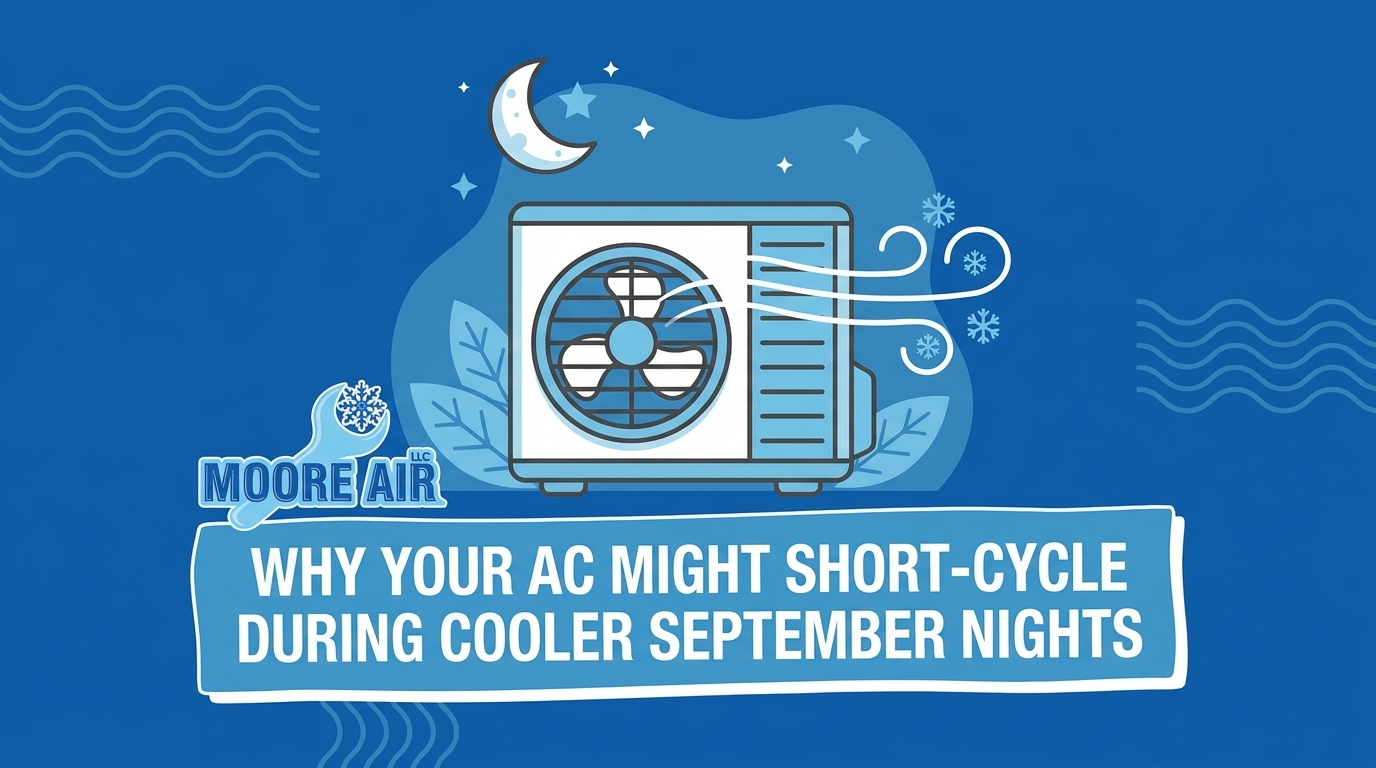
Why Your AC Might Short-Cycle During Cooler September Nights
When Nighttime Temperatures Drop but the AC Keeps Stopping and Starting
Understanding why your AC might short-cycle during cooler September nights is a critical step in protecting your home’s cooling equipment. Your air conditioner might run perfectly all afternoon, but as the sun sets, a frustrating new pattern emerges. You hear the system kick on, blast cold air for just a few minutes, and then abruptly shut down—only to repeat the entire process a few moments later. This jarring behavior leaves many homeowners wondering if they are dealing with a sudden mechanical failure, a glitching thermostat, or simply a bizarre reaction to the shifting weather.
If you are concerned about sudden system failures and need immediate professional help, explore our air conditioning services to get your system back on track.
In our years of serving homeowners in Litchfield Park, AZ, the team at Moore Air has seen firsthand how this seasonal transition creates a highly specific environment for HVAC systems. Daytime highs in early fall still demand massive cooling power, often pushing well past 100 degrees. However, once the sun goes down, the ambient temperature drops rapidly. Your air conditioner, which was working overtime just a few hours prior, suddenly finds itself operating in a completely different climate. Deciding whether this rapid cycling is a harmless seasonal quirk or a sign of impending equipment failure requires a closer look at how your home absorbs and loses heat.
The Physics of Heat Load in the Early Fall Desert Climate
To understand why your cooling system behaves erratically in the evening, you have to look at the concept of “heat load.” Heat load refers to the total amount of heat that must be removed from your home to maintain your desired indoor temperature. During the peak of summer, your heat load remains relatively constant day and night because the outside air rarely cools down enough to provide relief.
However, September evening temperature drops change the equation entirely. The extreme diurnal temperature variation in the Arizona desert means the transition from day to night is sharp and dramatic. Your air conditioner suddenly has a fraction of the heat load to process, completely altering its operational rhythm.
Understanding Solar Heat Gain vs. Ambient Night Air
During the day, your home experiences intense solar heat gain. The sun bakes your roof, your exterior walls, and your windows. The physical structure of your house absorbs this thermal energy, creating a massive amount of heat that your air conditioner must constantly battle to keep the indoor air comfortable.
Once the sun sets, that solar radiant heat vanishes. The heat load on your home plummets rapidly as the heat dissipates into the cooler night sky.
| Time of Day | Solar Heat Gain | Ambient Temperature | System Workload |
|---|---|---|---|
| Afternoon (2 PM) | Maximum exposure on roof and walls | 100°F+ | High capacity, long cooling cycles |
| Early Evening (7 PM) | Zero direct sunlight | Dropping rapidly | Moderate capacity, shorter cycles |
| Late Night (11 PM) | None (heat dissipating into sky) | 70°F – 80°F | Minimal capacity, very short cycles |
While the outside air cools down quickly, the thermal mass of your home (the drywall, the insulation, the furniture) retains some of that daytime heat. This creates a complex environment where the air inside your home cools down faster than the physical structure itself, setting the stage for irregular cooling cycles.
How Oversized Systems React to Reduced Cooling Demand
Air conditioners are sized based on the maximum cooling demand of your home. In the desert, that means your system is specifically designed to move massive amounts of heat quickly to combat 110-degree afternoons. But what happens when that high-capacity, powerful machine turns on in a much cooler evening environment?
A pattern we see often in local tract homes is that when an oversized system activates during a cool early fall night, it acts like a fire hose filling a water glass. It cools the ambient indoor air far too rapidly before it has the chance to complete a full, standard cooling cycle. This leads directly to rapid on/off cycles (short-cycling), which can be alarming to hear.
If you want to ensure your system is ready for these seasonal shifts, preparing your AC for the transition to shorter cycles is a smart proactive step.
The Thermostat’s Role in Premature Shutdowns
Your thermostat is the brain of the operation, but it only measures the temperature of the air immediately surrounding it. It does not measure the temperature of your walls or your furniture.
- Rapid Air Cooling: The powerful AC unit floods the room with cold air, dropping the ambient air temperature by several degrees in just a few minutes.
- Premature Shutdown: The thermostat registers that the target temperature has been reached and immediately shuts the system down.
- Thermal Rebound: Because the system didn’t run long enough to remove humidity or cool the actual structure of the house, the walls and furniture begin releasing their trapped daytime heat back into the air.
- The Cycle Repeats: The indoor air warms up quickly, tricking the thermostat into calling for cooling again just minutes later.

Is It Just the Weather, or Does Your AC Need Repair?
While the sudden drop in nighttime heat load can cause an oversized unit to short-cycle, rapid on/off behavior can also be a red flag for serious mechanical failures. It is vital to differentiate between a seasonal sizing quirk and an actual malfunction that requires professional intervention.
If you suspect your system is failing rather than just reacting to the weather, scheduling an air conditioner repair is the safest way to protect your equipment.
Signs It’s More Than Just a Sizing Issue
When our technicians arrive for a pre-heating-season diagnostic visit, we instruct homeowners to observe how their system behaves during the blistering heat of the afternoon versus the cool of the night. If the rapid cycling only happens after dark in September, it is likely a reaction to the reduced heat load. However, if you notice any of the following symptoms, our team typically finds that you are dealing with a mechanical fault:
- Short-cycling during the hottest part of the afternoon: If the system cannot sustain a long cycle when the heat load is at its absolute highest, it is not a weather-related issue.
- A heavily clogged air filter: A dirty filter suffocates the system, severely restricting airflow. This causes the internal components to overheat or the evaporator coil to freeze solid, forcing the system to shut down prematurely to protect itself.
- Low refrigerant levels: Refrigerant is the lifeblood of your cooling system. If there is a leak, the pressure inside the system drops, triggering safety switches that cause the unit to rapidly turn on and off regardless of the outside temperature.
- Strange noises during startup: Grinding, squealing, or heavy clicking sounds accompanying the startup and shutdown sequence point to failing electrical components, such as a dying run capacitor.
- The home feels unusually clammy: If the AC is running but the air feels thick and humid, the system is not running long enough to pull moisture out of the air.
A quick safety note: Checking your filter is a great first step, but handling refrigerant or testing high-voltage electrical components like capacitors requires a licensed professional. Never attempt to open the electrical cabinet or recharge refrigerant lines yourself.
The Hidden Wear and Tear of Constant Startup Sequences
Even if your system’s short-cycling is purely a result of being slightly oversized for early fall nights, it is not a harmless quirk. The most stressful, energy-intensive part of an air conditioner’s operation is the exact moment it turns on.
When a cooling cycle begins, the system draws a massive surge of electricity to get the heavy compressor motor spinning and the fan blades moving. This initial draw is significantly higher than the electricity required to keep the system running steadily. By constantly starting and stopping, your system is subjecting itself to extreme mechanical and electrical stress.
Compressor strain: The compressor is the heart of your HVAC system and the most expensive component to replace. Constant rapid starts prevent the internal oils from circulating properly, increasing friction and accelerating wear and tear.
Capacitor degradation: The capacitors act like heavy-duty batteries that give the motors the jolt of energy they need to start. Forcing them to deliver that jolt every five minutes will cause them to overheat and fail prematurely.
Spiking energy bills: Because the startup phase uses the most electricity, an air conditioner that turns on and off a dozen times an hour will consume far more power than a system that runs one steady, continuous cycle.
Mitigating these stresses before they lead to a complete breakdown is crucial. Routine air conditioner service ensures that your electrical components are strong enough to handle the seasonal transition.
Why Accurate Diagnostics Matter Over Rushed Replacements
When an air conditioner starts short-cycling, many homeowners immediately panic, assuming the entire unit is permanently broken and needs to be replaced. Unfortunately, some companies use this fear to push high-pressure sales tactics, insisting on a brand-new installation when a simpler solution is available.
An honest, highly trained technician will evaluate the system’s sizing, test the airflow, and check the mechanical health of the components before making any recommendations. The “Moore Air for Less Cash” philosophy is built on exactly this principle: providing honest, quality work and fair pricing that ensures customers get accurate diagnostics rather than being pushed into unnecessary system replacements. Even if an upgrade is eventually needed—perhaps to take advantage of generic utility incentive programs or federal tax credits for qualifying high-efficiency systems—we ensure you have all the facts first.
For example, a local customer recently reached out to us during an early fall heat spike when their air conditioner stopped working entirely. Instead of using the situation to push a rushed, expensive replacement, our technician diagnosed the specific underlying problem and fixed it on the spot. The unit was fully repaired within 12 hours of the initial call, saving the homeowner immense stress and unnecessary expense.
Sometimes, the solution to short-cycling is as simple as recalibrating the blower motor speed or adjusting the thermostat placement. Regular air conditioner maintenance can often resolve these underlying issues, extending the life of your current unit and keeping it running smoothly through every season.
Frequently Asked Questions About Fall AC Performance
Why does my AC short cycle at night?
At night, the ambient temperature drops and the sun’s radiant heat is gone, drastically lowering your home’s cooling demand. If your air conditioner is slightly oversized, it will cool the smaller nighttime heat load too quickly. The thermostat registers the fast drop in air temperature and shuts off prematurely, only to turn back on minutes later as the walls release trapped heat.
Is it normal for an oversized AC to short cycle in cooler weather?
Yes, it is a common physical reaction to a shifting climate. Because the system is designed to battle extreme daytime heat, it struggles to modulate its massive cooling output when the weather cools down. The sudden lack of solar heat gain means the system simply has too much power for the environment, leading to rapid cycles.
Is short cycling bad for an air conditioner?
Yes, frequent short cycling is highly damaging over time. The startup phase puts the absolute most strain on the compressor and electrical components. Constant starting and stopping accelerates mechanical wear and tear, degrades capacitors faster, and significantly increases your monthly energy bills.
How do I stop my AC from short cycling?
Start by checking for basic airflow issues like a dirty air filter or blocked supply vents. If the filter is clean and the issue persists, we recommend scheduling a professional diagnostic. Our Moore Air team can determine if the short cycling is due to seasonal sizing quirks, low refrigerant, or complex mechanical faults that require adjustment.
Can a thermostat issue cause short cycling?
Absolutely, poor thermostat placement is a frequent culprit. If a thermostat is placed directly near a supply vent, in a drafty hallway, or near a window, it may register a false drop in temperature. It will shut the system off based on that localized cold spot before the rest of the house is actually cooled down.
Protecting Your Cooling System Through the Seasonal Transition
Understanding the physics behind early fall temperature drops can save you from unnecessary panic when your system behaves differently after sunset. While a sudden shift in heat load can cause an oversized unit to cycle rapidly, it is important to remember that constant starting and stopping still puts immense strain on your compressor and electrical components.
If you notice your system struggling to maintain a steady cycle, don’t ignore it and hope the weather resolves the issue. Seeking an honest, professional evaluation from our experienced team ensures that you aren’t confusing a simple seasonal sizing quirk with a critical mechanical failure. By prioritizing accurate diagnostics and routine fall-prep care, you can protect your cooling system, lower your energy bills, and keep your home perfectly comfortable no matter how drastically the desert temperatures swing.