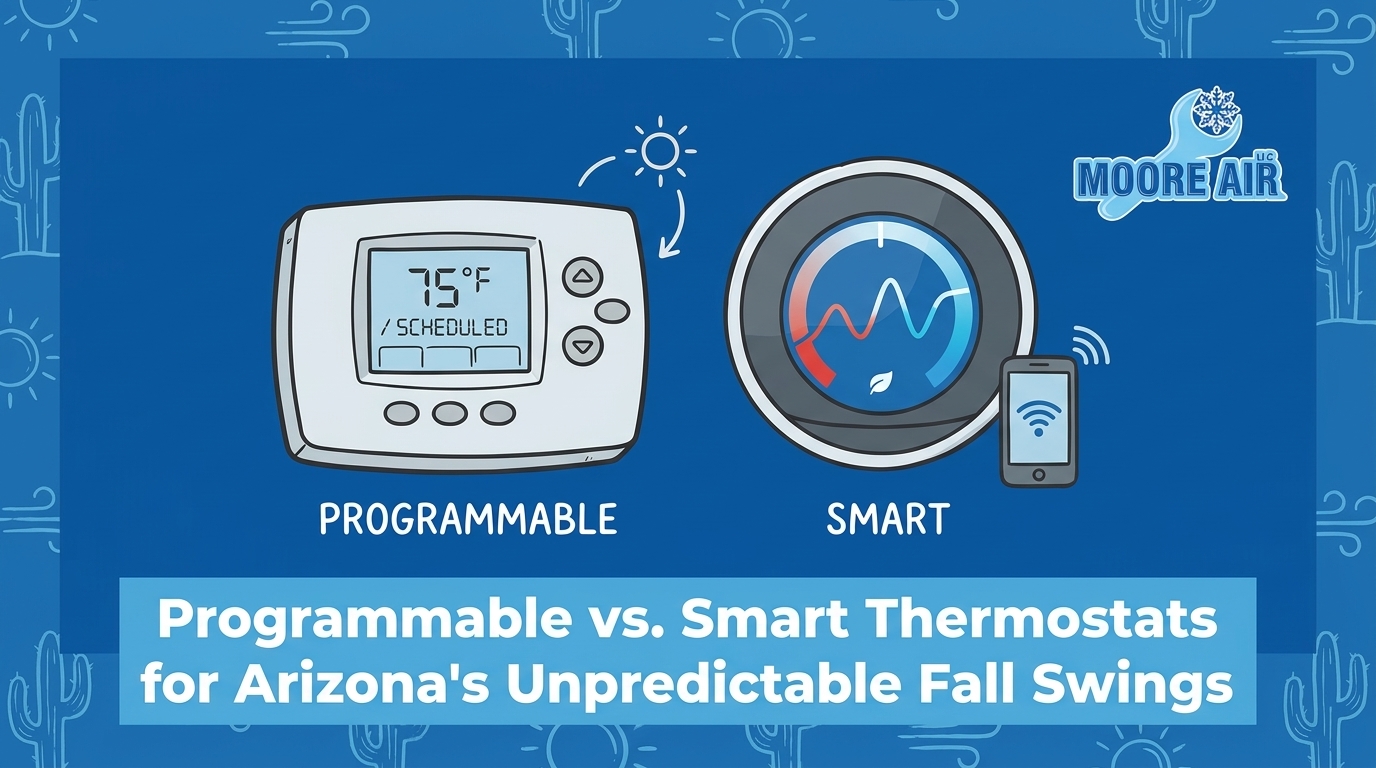
Programmable vs. Smart Thermostats for Arizona’s Unpredictable Fall Swings
Tired of Babysitting Your Thermostat During the Fall Transition?
Are you constantly waking up to a freezing house, only to return from work to a sweltering living room? Deciding between programmable vs. smart thermostats for Arizona’s unpredictable fall swings is one of the most common dilemmas we hear from Litchfield Park homeowners as summer fades. At Moore Air, our team knows firsthand how the September transition with 30-degree daily shifts creates a frustrating cycle. You set the dial for a chilly 60-degree morning, but by the time you get home, the afternoon sun has pushed indoor temperatures to uncomfortable extremes. Instead of enjoying the changing season, you find yourself manually overriding your system twice a day just to stay comfortable.
To end this constant dial-turning, you need a comprehensive approach to your home’s climate management. Whether you need an upgrade to your controls or broader HVAC services, finding the right strategy makes all the difference.
The core decision point comes down to technology. Is a standard programmable schedule enough to handle the desert’s rapid weather changes, or is an algorithmic smart thermostat a necessary upgrade? To answer that, we have to look closely at what your heating and cooling equipment actually goes through during the early autumn weeks.
The West Valley’s 30-Degree Daily Temperature Shift
To understand why keeping your home comfortable in early autumn is so difficult, you have to look at the unique climate of Litchfield Park and the surrounding West Valley. Unlike other parts of the country where seasonal changes happen gradually over weeks, the desert experiences extreme diurnal temperature variation. Because our environment has very low humidity, there is little moisture in the air to trap heat after the sun goes down. This specific atmospheric condition causes rapid cooling at night and intense heating during the day.
In our years of servicing HVAC systems across the desert, we’ve seen how this dramatic daily shift takes a heavy physical toll on your home’s thermal envelope and your heating and cooling equipment. A standard September day typically forces your system through three distinct phases:
- The Early Morning Chill: Just before sunrise, temperatures often drop into the low 60s or even upper 50s. Your home loses heat quickly overnight, meaning you rely heavily on your heating system to take the edge off when you wake up.
- The Midday Climb: As the sun rises, the lack of cloud cover and low humidity allow solar radiation to heat your roof and walls rapidly. The outdoor temperature can spike by 20 degrees in just a few hours, completely reversing your home’s thermal needs.
- The Afternoon Peak: By 3:00 PM or 4:00 PM, temperatures can easily surge back into the 90s. The heating cycle you needed at breakfast is now entirely useless, and your air conditioner must take over to combat the intense afternoon heat.
This 24-hour cycle demands reliable dual-mode operation. You absolutely need your heating equipment working flawlessly in the AM and your cooling equipment performing at its peak in the PM. If your system struggles to keep up with the morning chill, scheduling professional furnace service ensures your equipment is prepared for these rapid daily transitions.
Why Traditional Programmable Schedules Struggle in Autumn
The Problem: A standard programmable thermostat operates on fixed time blocks. Most use a 5-2 schedule (one routine for weekdays, another for weekends) or a 7-day schedule (a specific routine for every day of the week). You tell the device to turn the heat on at 6:00 AM and switch to cooling at 2:00 PM. The problem arises because these rigid schedules assume that seasonal changes are predictable and gradual. In the West Valley, a September transition with 30-degree daily shifts does not follow a predictable pattern.
The Cause: Rigid scheduling fails when unpredictable weather patterns hit. For example, if a mild cold front moves through, the morning warm-up might be delayed by several hours. Your programmable thermostat, blindly following its fixed time block, might shut off the heat and switch to a cooling schedule at 10:00 AM—even though the house is still chilly. Because the device cannot sense the actual outdoor weather conditions or adjust its internal logic, it executes the wrong command at the wrong time.
The Solution: This rigidity forces homeowners into a frustrating routine of manual overrides. You walk past the thermostat, notice the house feels wrong, and manually bump the temperature up or down. If you do this frequently, you completely defeat the energy-saving purpose of having a programmed schedule in the first place. You are essentially operating the system manually, which wastes energy and puts unnecessary wear on your equipment. Moving away from rigid time blocks toward adaptable technology is the only way to solve this operational flaw.
How Algorithmic Learning Adapts to the Desert
The core difference between a standard programmable unit and a smart thermostat is algorithmic learning versus rigid time-based execution. Algorithmic learning thermostats (e.g., Nest, Ecobee) do not just follow a clock; they actively study your behavior and the environment to build a dynamic, flexible comfort profile.
Occupancy and Adjustment Tracking: During the first few days after installation, an algorithmic thermostat monitors every manual adjustment you make. It notes what time you wake up, when you leave the house, and what temperatures you prefer during those specific times. Using built-in motion sensors, it also learns when the house is empty. Instead of forcing you to program time blocks, it builds a custom schedule in the background based on your actual lifestyle.
Weather Integration via Wi-Fi: One of the most powerful features for desert living is Wi-Fi connectivity. Smart thermostats constantly pull local weather data from the internet. If the forecast predicts an unseasonably hot afternoon, the thermostat preemptively adjusts. It knows that the afternoon peak will hit harder than usual, so it may start cooling the house slightly earlier to stay ahead of the thermal load. This level of proactive management is a crucial part of a comprehensive thermostat strategy for changing seasons.
Hands-Off Comfort: Ultimately, this algorithmic learning eliminates the need for daily micromanagement. You no longer have to worry about whether a cold front will ruin your morning routine or if a sudden heat wave will leave your house sweltering. The device adapts to the September transition with 30-degree daily shifts automatically, ensuring your home remains comfortable without any input from you.
Auto-Changeover: The Secret Weapon for Arizona Homes
When dealing with extreme diurnal temperature variation, one technical feature stands out above the rest: auto-changeover. While some advanced programmable thermostats offer a basic version of this, algorithmic learning thermostats (e.g., Nest, Ecobee) perfect the process, making it a vital tool for maintaining comfort during the extreme midday temperature climb.
Defining Auto-Changeover: Auto-changeover is the ability of the thermostat to switch seamlessly from heating mode to cooling mode without you ever touching a button. Instead of setting the system to “Heat” in the morning and manually switching it to “Cool” in the afternoon, you simply set a desired temperature range. The thermostat monitors the indoor climate and decides which piece of equipment needs to run to maintain that range.
The Importance of the Deadband: To make auto-changeover work without damaging your equipment, these devices utilize a “deadband.” A deadband is a buffer zone—typically 3 to 5 degrees—between your heating setpoint and your cooling setpoint. For example, you might set the heat to kick on if the house drops below 68°F, and the AC to kick on if the house rises above 74°F. The space between 68°F and 74°F is the deadband.
Preventing Equipment Stress: This buffer zone is critical because it prevents the system from rapidly cycling back and forth between the furnace and the air conditioner. Without a deadband, a slight breeze or a momentary sunbeam hitting the thermostat could cause the system to short-cycle, turning the heat on for two minutes, then immediately switching to cooling. Short-cycling causes massive wear and tear on your compressor and heat exchanger. By maintaining a proper deadband, auto-changeover ensures your equipment runs efficiently. If your system is currently struggling to transition smoothly, professional air conditioner service can verify that your control wiring and relays are functioning correctly.
Head-to-Head: Programmable vs. Smart in the Desert
To make the best choice for your Litchfield Park home, it helps to see exactly how these two technologies stack up against each other when facing extreme daily temperature swings. The table below breaks down the critical operational differences.
| Feature / Capability | Standard Programmable Thermostat | Algorithmic Smart Thermostat |
|---|---|---|
| Auto-Switching (Heat to Cool) | Often requires manual mode switching at the device. | Seamless auto-changeover with built-in deadband protection. |
| Schedule Adjustments | Rigid time blocks; requires manual reprogramming for weather shifts. | Dynamic adjustments; pulls local weather data to adapt preemptively. |
| Manual Overrides | High frequency during the unpredictable early autumn weeks. | Virtually zero overrides required once the initial profile is learned. |
| Energy Efficiency Integration | Basic scheduling only; overrides defeat energy-saving goals. | Tracks usage, senses occupancy, and optimizes run times automatically. |
Programmable Limitations
Standard programmable models are highly reliable for predictable climates, but they show their limitations in the desert. They rely heavily on manual mode switching (Heat/Cool/Off). When the weather shifts unexpectedly, you have to manually reprogram the time blocks to match the new reality. This leads to a high override frequency during September, making the system feel more like a chore than a convenience.
Smart Advantages
Algorithmic learning thermostats (e.g., Nest, Ecobee) thrive in unpredictable environments. They offer seamless auto-changeover with deadband protection, ensuring your equipment is never stressed by short-cycling. Because they make dynamic schedule adjustments via algorithmic learning, they provide a truly hands-off experience. Once customized to your lifestyle, they require virtually zero manual overrides, even when the outdoor temperature swings wildly.

Honest ROI: Is an Upgrade Right for Your Home?
Despite the clear technological advantages, our team at Moore Air always provides transparent, honest advice regarding whether an upgrade makes sense for your specific home. Not every household requires a smart thermostat. If your family operates on a highly predictable, unchanging routine, and you do not mind occasionally adjusting the dial when a cold front moves through Litchfield and the surrounding West Valley, a standard programmable unit might serve you perfectly well.
However, if you have an unpredictable schedule, or if the frustration of constant temperature swings is impacting your comfort, algorithmic learning becomes a necessity rather than just a luxury gadget. The return on investment comes from the elimination of daily micromanagement and the optimization of your energy usage. In many cases, upgrading to a qualifying smart thermostat may even make you eligible for local utility incentive programs or energy rebates—we always recommend checking with your utility provider for current opportunities.
Our commitment to honest, quality work means we advise homeowners on true ROI rather than pushing unnecessary tech upgrades. We look at the holistic health of your system. A great example of this philosophy in action happened recently during one of our service calls in the West Valley. A homeowner was dealing with a 31-year-old air conditioner that had required repeated repairs over a decade. Instead of immediately pushing an expensive, unnecessary system replacement or high-end tech upgrade, our technician arrived quickly, diagnosed the core issue, and expediently got the unit running normally. That honest approach kept the old unit running for another ten years without an upsell.
When you do choose to upgrade your thermostat, professional installation ensures that complex features like auto-changeover and deadbands are wired correctly and configured to protect your specific HVAC equipment.
Get Expert Guidance on Your Home’s Climate Control
Surviving the September transition with 30-degree daily shifts doesn’t have to mean constantly babysitting your thermostat dial. By understanding the differences between rigid schedules and algorithmic learning, you can choose the right technology to keep your home comfortable automatically.
You don’t have to figure out the technical details on your own. The experts at Moore Air can evaluate your current system compatibility, check your wiring, and recommend the best control strategy for your lifestyle. If you are ready to stop manually overriding your system and want to improve your home’s overall thermal management, reach out for professional energy efficiency services today. We are here to provide honest advice and ensure your home stays perfectly comfortable, no matter what the desert weather brings.
Frequently Asked Questions
What is the difference between a programmable and smart thermostat?
The primary difference is how they execute commands. A programmable thermostat follows a rigid, time-based schedule that you must input manually. A smart thermostat uses algorithmic learning and Wi-Fi weather data to adapt its schedule automatically based on your habits and the outdoor climate.
Can a smart thermostat automatically switch from heat to cool?
Yes, most smart thermostats feature auto-changeover capabilities. You set a desired temperature range, and the device automatically determines whether to activate the furnace or the air conditioner to maintain that comfort level. This is especially useful during days with extreme temperature fluctuations.
Is a smart thermostat worth it in Arizona?
For many homeowners, the investment is absolutely worth it due to the extreme diurnal temperature variation in the desert. Because temperatures can swing 30 degrees from morning to afternoon, a smart thermostat’s ability to adjust preemptively saves you from constantly manually overriding the system.
How do you manage a thermostat during fall weather changes?
If you have a standard programmable unit, you will likely need to adjust your schedule frequently or use manual overrides as cold fronts move in. If you have a smart thermostat, you simply set your preferred temperature range and allow the algorithmic learning to manage the daily swings automatically.
How do smart thermostats handle extreme temperature changes?
Smart thermostats handle extreme changes by pulling local weather data via Wi-Fi and adjusting their run times preemptively. If a sudden heat wave is predicted for the afternoon, the device will begin cooling the house earlier to stay ahead of the thermal load, ensuring consistent comfort.
What is a deadband setting on an auto-changeover thermostat?
A deadband is a temperature buffer zone—usually 3 to 5 degrees—between your heating and cooling setpoints. This buffer prevents the HVAC system from rapidly short-cycling back and forth between the furnace and the AC, which protects your equipment from unnecessary wear and tear.