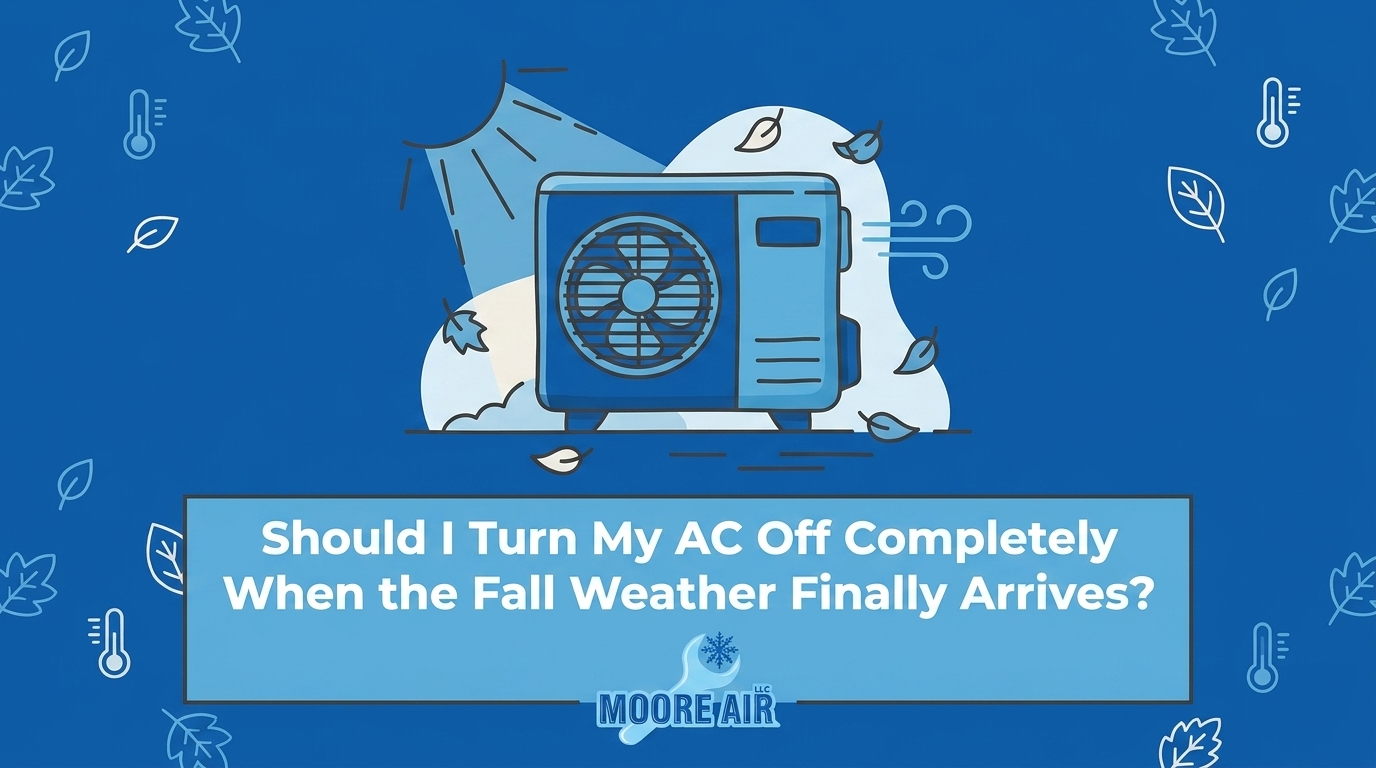
Should I Turn My AC Off Completely When the Fall Weather Finally Arrives?
Why the First Cool Morning Doesn’t Mean Your Cooling Season is Over
Is your thermostat tempting you with the “Off” switch now that mornings are finally cooling down? The question, “Should I Turn My AC Off Completely When the Fall Weather Finally Arrives?” is one of the most common things homeowners ask as summer breaks. You step outside, feel that brisk air, and immediately think about giving your system a much-needed rest. After months of hearing the compressor run around the clock, the idea of silent, open windows and lower energy bills is incredibly appealing.
But wait before you flip that switch. The short answer is: No, you should not turn your AC completely off during early fall in Arizona. Instead, adjusting your thermostat setpoints higher is much safer than a hard shut-off due to the lingering daytime heat that inevitably returns by mid-afternoon.
If you need expert air conditioning services or are ready to schedule your air conditioner maintenance, our team at Moore Air is here to help.
The reality of desert living: In our years of keeping Litchfield Park AZ comfortable, we’ve learned that the transition into autumn is rarely a straight line. We experience a prolonged period where the mornings feel like November, but the afternoons still feel like August. When you turn your cooling system completely off based on the morning temperature, you are setting your home up for a massive thermal shock later in the day.
The comfort compromise: Many homeowners believe that shutting the system down is the ultimate energy-saving hack. Unfortunately, this strategy often backfires. A house that is allowed to heat up entirely requires significantly more energy to cool back down than a house maintained at a reasonable, slightly elevated temperature. By keeping the system on but adjusting the setpoint, you protect your equipment, manage indoor humidity, and keep your living space comfortable without the extreme energy spikes associated with a hard reboot.
Understanding the ‘False Fall’ Phenomenon
To understand why a hard shut-off is premature, you have to look closely at the specific climate patterns of the September transition season. Meteorologists and our own seasoned HVAC technicians often refer to this period as the “false fall.” It is a deceptive stretch of weather where the daily temperature swings can be extreme, often shifting by 30 degrees or more within a single 24-hour period.
During September and October, Litchfield Park frequently sees morning lows drop comfortably into the 60s or 70s, tricking you into thinking the heat has finally broken. However, by 3:00 PM, the intense desert sun pushes those temperatures right back into the 90s. Here is exactly how this daily cycle impacts your home and why our team strongly recommends keeping your HVAC system active:
- The Morning Chill (6:00 AM – 9:00 AM): The outside air is crisp and comfortable. If you open your windows, the indoor air temperature drops quickly, making the house feel wonderfully cool. The temptation to turn the thermostat to “Off” peaks here.
- The Thermal Mass Trap (10:00 AM – 2:00 PM): Desert homes are built with high thermal mass materials like stucco, tile roofs, and thick insulation. While these materials are great at slowing down heat transfer, they also absorb and store the sun’s radiant energy throughout the morning and early afternoon.
- The Afternoon Spike (3:00 PM – 6:00 PM): As the outside temperature climbs back into the 90s, the heat stored in your home’s exterior walls begins transferring indoors. If the air conditioner has been turned off all day, the indoor temperature will rapidly rise, often surpassing the outdoor temperature because the house traps the heat inside.
- The Short Cycle Reality: Because the system is still needed, but only for a fraction of the day, you will start experiencing shorter cooling cycles. Understanding and preparing your AC for shorter cooling cycles is a much better strategy than turning the unit off entirely.
When an air conditioner has been completely shut down, it loses its grip on the home’s baseline temperature. The walls, floors, and furniture all absorb heat. When you finally cave and turn the system back on at 4:00 PM, the unit isn’t just cooling the air—it has to remove the deep, baked-in heat from every solid object in the house. This takes hours of continuous, high-stress operation.
The Hidden Role of Your AC in Managing Late Monsoon Humidity
Temperature is only half of the comfort equation. The other half—often ignored until it becomes a problem—is indoor humidity. Air conditioners do not just blow cold air; they actively condition the space by removing excess moisture. During the early fall, this dehumidification function is more critical than ever.
Doesn’t my AC just cool the air?
While cooling is the primary function, the process of refrigeration naturally extracts moisture from the air. Warm indoor air is blown over the freezing-cold evaporator coil. As the air cools, it loses its ability to hold water vapor. That moisture condenses on the coil and drains away outside, leaving the air returning to your vents cooler and drier.
Why is humidity still an issue in early fall?
As a local HVAC company serving Litchfield Park AZ and across the West Valley, we constantly remind homeowners that the end of summer does not immediately mean dry air. Lingering late-monsoon moisture often gets trapped in the region throughout September. Even if the outside temperature is a mild 82 degrees, a high dew point can make the air feel heavy, sticky, and deeply uncomfortable.
What happens to indoor air quality when the system is off?
When you turn the thermostat completely off, the air inside your home stops circulating. Without the evaporator coil extracting moisture, the humidity from cooking, showering, breathing, and the lingering outdoor monsoon moisture begins to build up. High indoor humidity makes the air feel warmer than it actually is, promotes the growth of allergens, and creates a stagnant, stuffy environment that degrades your overall indoor air quality.
How does a higher setpoint solve this?
By leaving the system on but raising the setpoint (for example, to 78 or 80 degrees), the air conditioner will still cycle on periodically during the warmest parts of the day. These brief cycles are enough to pull the excess moisture out of the air. You maintain a dry, comfortable indoor environment without forcing the system to run constantly, striking the perfect balance between energy savings and indoor air quality.
The Cost of Catch-Up Cooling: System Strain vs. Energy Savings
The most persistent myth about fall HVAC management is that turning the system completely off saves a massive amount of money. While you might save a few kilowatt-hours during the morning, you pay for it dearly when the afternoon heat forces your system into “catch-up” mode.
Our technicians frequently respond to emergency calls during the September transition season from homeowners whose systems failed entirely during an afternoon heat spike. In one memorable case, a customer had been attempting to save energy by turning the system off completely for days at a time, which resulted in an extreme crisis requiring a full installation. Our team provided fair pricing and installed a new air conditioner, leaving the customer pleased with the outcome—but the situation highlighted the severe strain catch-up cooling places on aging equipment.
When you ask an air conditioner to drop the indoor temperature by 10 or 15 degrees all at once, you are placing extreme mechanical strain on the compressor. The compressor is the heart of your system, and forcing it to run continuously at maximum capacity to fight against a heat-soaked house drastically reduces its lifespan.
| Thermostat Strategy | Energy Usage Pattern | System Strain Level | Indoor Comfort Result |
|---|---|---|---|
| Turning AC Completely OFF | Zero in morning, massive spike in afternoon | Extreme (Compressor runs continuously for hours) | Poor (High humidity, stuffy air, hot afternoons) |
| Adjusting Setpoints UP (78-80°F) | Moderate, controlled cycles | Low (Normal operation, short cycles) | Excellent (Controlled humidity, consistent temps) |
The long-term math: Protecting your equipment ultimately saves more money than a few days of zero AC usage. A compressor failure or a premature system replacement costs thousands of dollars. By maintaining a moderate temperature, you avoid the extreme strain that causes unexpected breakdowns, extending the life of your unit and keeping your long-term ownership costs low.

Smart Thermostat Strategies for the Transition Zone
Navigating the hot-and-cold swing weeks of early fall requires a bit of strategy. Rather than manually fighting with your thermostat twice a day, you can use smart programming to handle the transition seamlessly. At Moore Air, providing transparent, practical advice that treats the customer’s wallet like our own—rather than pushing unnecessary services—is exactly how we operate, and optimizing your thermostat is a great place to start.
Widening the deadband: If you have a smart or programmable thermostat, the best approach for Litchfield Park AZ in the fall is to widen the temperature deadband. This is the range between your heating setpoint and your cooling setpoint. Instead of switching the system to “Off,” set your cooling target to 78 or 80 degrees, and your heating target to 65 degrees. This ensures the system only activates when the house gets uncomfortably warm in the afternoon, completely ignoring the mild morning temperatures.
Avoid the manual flip-flop: One pattern we see often on our service calls is homeowners manually switching their system from “Heat” in the morning to “Cool” in the afternoon. This rapid cycling is terrible for the reversing valve (if you have a heat pump) and the control board. Let the thermostat’s automatic settings do the work. If your home is well-insulated, the natural morning coolness will carry you well into the afternoon before the AC needs to kick on.
Optimize your fan settings: Leave your thermostat fan setting on “Auto” rather than “On.” When the fan runs continuously while the AC is not actively cooling, it can actually pull moisture off the wet evaporator coil and blow it right back into your home, increasing indoor humidity. “Auto” ensures the fan only runs when the system is actively conditioning the air.
If you are struggling to keep your utility bills predictable during these swing months, exploring professional energy efficiency services can help you identify insulation gaps, duct leaks, and programming errors that are costing you money.
Why the Fall Transition is the Perfect Time for a System Tune-Up
Once you have your daily thermostat management under control, it is time to pivot toward seasonal readiness. The September transition season provides a brief window where your HVAC system is experiencing a lighter workload. This makes early fall the absolute perfect time to inspect, clean, and tune up the equipment before the winter heating season officially begins.
Just last fall, our dispatch team received a frantic call from a customer with a sudden AC problem when they tried to turn their system back on after a cool spell. They needed same-day service to handle the rising afternoon heat. One of our lead technicians arrived that same day, diagnosed the issue, and completed the repair at a reasonable price. This kind of unexpected breakdown is exactly what proactive maintenance helps prevent.
Addressing summer wear-and-tear: We know firsthand that your air conditioner just survived one of the most brutal summer environments in the country. Capacitors have been stressed by heat, contactors have pitted from thousands of cycles, and the condenser coils are likely caked with monsoon dust. Addressing this minor wear-and-tear now prevents those small issues from turning into catastrophic failures next spring.
Preparing for the heating season: A fall tune-up isn’t just about the AC; it is about ensuring your heating components are safe and ready to operate. Whether you have a heat pump or a gas furnace, having a professional verify that the reversing valves, heat exchangers, and safety switches are functioning properly gives you peace of mind.
Enrolling in a comprehensive HVAC maintenance plan ensures that these quick, affordable tune-ups happen automatically every fall and spring. It keeps your system running efficiently, validates your manufacturer warranties, and ensures your equipment is ready for whatever weather comes next.
Frequently Asked Questions About Fall AC Management
Is it better to leave the AC on or turn it off when it cools down in the fall?
It is generally better to leave the AC on but adjust the temperature setting higher. Turning the system completely off allows humidity to build up indoors and forces the unit to work significantly harder when afternoon temperatures inevitably rise again. A higher setpoint keeps the air circulating and dehumidified without wasting energy.
How do I manage my thermostat during fall temperature swings?
The best strategy is to widen the temperature range on your programmable thermostat. Set your cooling to activate only if the house reaches 78 or 80 degrees, and set the heat to activate only if it drops below 65 degrees. This prevents the system from running unnecessarily during mild mornings while still protecting you from afternoon heat spikes.
Does turning the AC off save money if it gets hot again?
No, turning the AC off completely often costs more if a heat spike follows. When the house absorbs heat into the walls and furniture, the air conditioner has to run continuously for hours to remove that thermal mass, which draws massive amounts of electricity and puts severe strain on the compressor.
At what temperature should you turn off your AC in the fall?
You can safely switch your AC off when the outdoor high temperatures consistently remain below 75 degrees for several consecutive days. Until the afternoon highs stop spiking into the 80s and 90s, it is safer to leave the system on “Auto” with a higher setpoint to manage humidity and thermal load.
Should I leave my AC fan on in the fall?
You should leave your thermostat fan setting on “Auto” rather than “On” during the fall. Running the fan continuously when the AC is not cooling can pull moisture back off the evaporator coil and blow it into your home, making the indoor air feel muggy and uncomfortable.
What happens if I turn the AC off and on repeatedly during the transition season?
Repeatedly turning the system completely off and on manually places unnecessary stress on the electrical components, particularly the capacitors and the compressor. It is much healthier for the equipment to rely on the thermostat’s internal sensors to cycle the system naturally based on a slightly elevated setpoint.
Stay Comfortable Through the Fall Transition
So, should I turn my AC off completely when the fall weather finally arrives? As our team at Moore Air has covered, keeping the system active with adjusted setpoints is the smartest way to protect your equipment and maintain comfortable indoor humidity. By managing your thermostat wisely during these unpredictable hot-and-cold swing weeks, you can enjoy the crisp mornings without suffering through the afternoon heat. If you need help getting your system ready for the season, schedule a tune-up to ensure everything runs smoothly all year long.