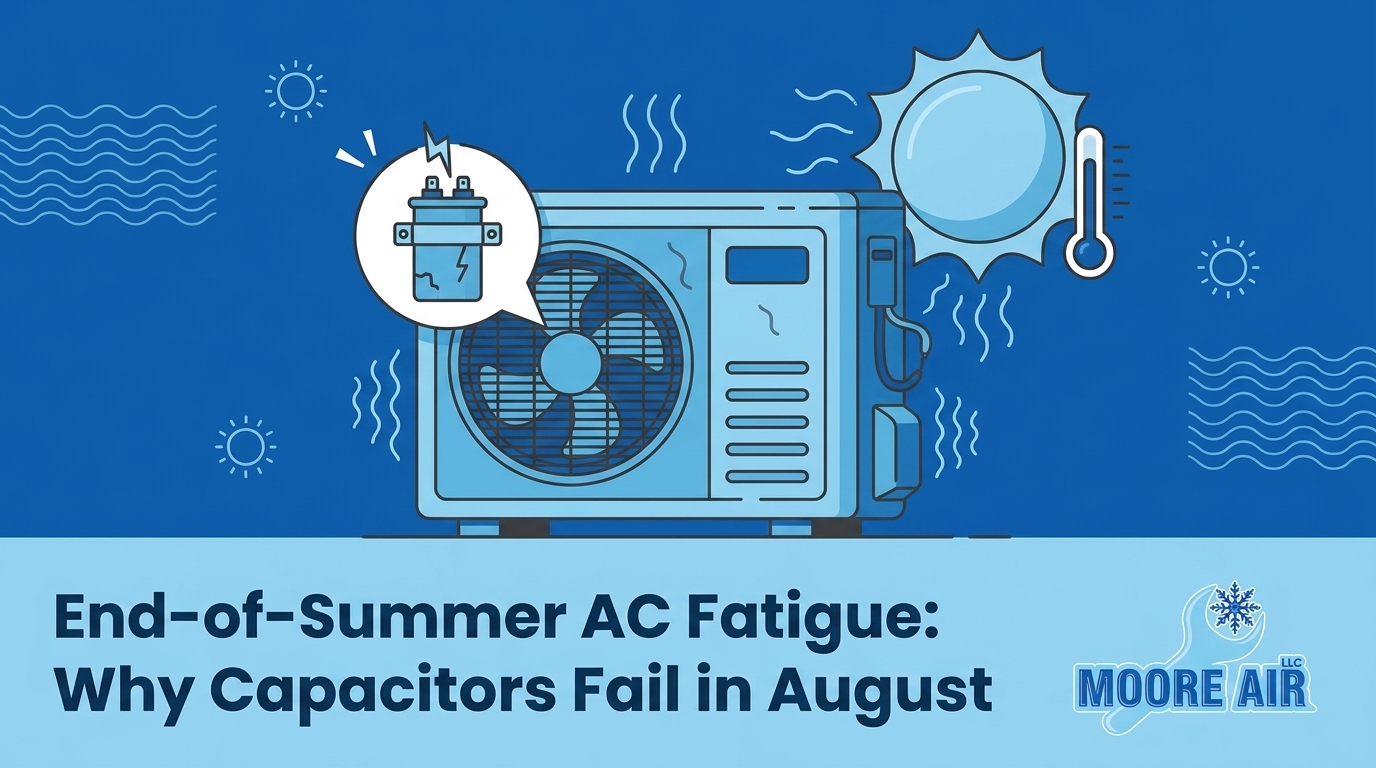
End-of-Summer AC Fatigue: Why Capacitors Fail in August
The August Wall: When End-of-Summer AC Fatigue Strikes
Summer in the Valley is winding down on the calendar and the back-to-school transition is underway, but the brutal heat is still punishing your home’s cooling system. If your air conditioner suddenly starts struggling to keep up or stops blowing cold air entirely right now, you are likely experiencing End-of-Summer AC Fatigue: Why Capacitors Fail in August. At Moore Air, we know it is incredibly frustrating to deal with a sudden breakdown when the 100+ degree days feel endless, but our technicians will tell you these late-season failures are rarely random. Instead, they are the predictable result of months of continuous operation under extreme environmental stress.
If you are dealing with a sudden late-summer breakdown, reaching out for professional air conditioning services is the safest way to restore your comfort quickly.
In our experience, your air conditioning system does not just magically break because it is August. It breaks because it has hit a wall known as cumulative thermal fatigue. Every time your system cycles on during those scorching afternoons, the internal electrical components endure immense heat. Over time, this constant baking degrades the sensitive parts inside your outdoor condenser unit. Recognizing the early signs of this fatigue is a critical decision point for any homeowner. Catching a weakening component early can mean the difference between a simple, routine fix and a catastrophic failure that destroys your entire compressor.
The Timeline of Thermal Fatigue: From May to August
To understand why late summer is so brutal on your system, you have to understand the role of the run capacitor. Think of the capacitor as a heavy-duty jump-starter for your air conditioner. Your compressor and fan motors require a massive jolt of electricity to start spinning—much more power than your home’s standard electrical wiring can provide all at once. The capacitor stores energy and releases it in a powerful burst to get the motors moving.
Inside this small, cylindrical component is a special substance called dielectric fluid, which acts as an insulator and helps the capacitor hold its electrical charge. However, this fluid is highly sensitive to prolonged extreme temperatures. When our team maps out the lifespan of a capacitor over a typical cooling season, the timeline of thermal fatigue becomes clear. If your system is struggling right now, timely air conditioner repair can replace this vital part before it causes further damage.
- May and June (The Warm-Up): The cooling season begins. Your capacitor is healthy, the dielectric fluid is intact, and the component easily stores and releases the required electrical charge. The system handles the early 100+ degree days without breaking a sweat.
- July (The Degradation Phase): The heat becomes relentless. As the outdoor unit runs for hours on end, the internal temperature of the capacitor skyrockets. The dielectric fluid begins to slowly break down and lose its insulating properties. The capacitor has to work harder and longer to store the same amount of energy.
- August (The Breaking Point): By late summer, the thermal fatigue peaks. The dielectric fluid is severely degraded, and the internal components may even begin to bulge or leak. The capacitor struggles to hold a charge, leading to delayed starts, loud humming, or a complete failure to jump-start the compressor.

Why the Local Climate Accelerates Electrical Wear
In our years of servicing cooling systems across Litchfield Park AZ, we’ve seen firsthand how our specific climate realities dramatically accelerate the timeline of thermal fatigue. In many parts of the country, air conditioners get a break overnight. The sun goes down, ambient temperatures drop into the sixties, and the metal components inside the outdoor condenser have a chance to cool off completely. That is simply not the reality in the desert.
Here, the lack of significant nighttime temperature drops means your outdoor unit never truly recovers. The metal condenser cabinet sits baking in the direct sun all afternoon, absorbing radiant heat. When the sun finally sets, the ambient air often remains incredibly warm. Because the system is still cycling on to keep your home comfortable overnight, that trapped heat never dissipates.
This continuous heat retention means your capacitor’s internal temperature remains dangerously high 24 hours a day, 7 days a week. It is subjected to a relentless cycle of electrical heat from within and environmental heat from without. This constant, unyielding thermal stress is exactly why we see electrical components in our region suffer a significantly reduced lifespan compared to those in milder climates. By the time late summer arrives, the cumulative damage of this 24/7 baking process simply becomes too much for the part to handle.
Early Warning Signs Your AC Capacitor is Losing its Charge
Because a blown capacitor is the result of cumulative wear over months of 100+ degree days, our technicians find that it rarely fails without warning. If you know what to look and listen for, you can often catch a failing capacitor before it leaves you stranded in a hot house. Paying attention to these early warning signs can save you from a much larger repair bill.
- A distinct humming or clicking sound: If you step outside and hear your condenser unit buzzing, humming loudly, or clicking repeatedly without the fan spinning, the capacitor is likely trying—and failing—to send the necessary voltage to the motors.
- Delayed or sluggish startups: Pay attention to how quickly your system kicks on when the thermostat calls for cooling. If there is a noticeable hesitation, or if the system sounds like it is straining to start, the capacitor is losing its ability to deliver a full charge.
- The fan is not spinning: If you hear the compressor running but the top fan blade is stationary, the fan side of your dual-run capacitor has likely failed.
- Blowing warm air: If you notice warm air coming from your vents, it often means the indoor blower is working, but the outdoor compressor hasn’t started because the capacitor is dead. This is a pattern we see often and a common reason why your AC runs non-stop during summer afternoons without actually cooling your home.
The Danger of the “Stick Trick”
If you search online for solutions to a fan that won’t spin, you will inevitably find videos suggesting you push the fan blade with a stick to jump-start it. We strongly advise against doing this. While manually spinning the blade might occasionally force the motor to start, it is a dangerous, temporary band-aid that completely ignores the root electrical issue. Forcing a motor to run without the proper starting voltage causes it to overheat rapidly. You are actively damaging a very expensive fan motor to avoid replacing a very affordable capacitor, while also risking serious physical injury.
The Domino Effect: Protecting Your Compressor from Electrical Stress
Our team frequently responds to late-summer service calls where ignoring a weak or failing capacitor has triggered a dangerous mechanical domino effect inside the air conditioner. The compressor is the heart of your cooling system, and it relies entirely on the capacitor to provide the correct starting voltage. When the capacitor degrades over the late summer months, the compressor is forced to work much harder to turn on.
Because the capacitor is no longer providing that massive jump-start, the compressor has to pull significantly higher electrical amperage directly from your home’s power supply to force itself to start. This excessive electrical draw generates massive amounts of internal heat. If this continues cycle after cycle, the compressor will begin to overheat, tripping its internal thermal overload switch. Eventually, this repeated stress will melt the electrical windings inside the compressor, causing it to burn out completely.
| The Problem | The Cause | The Impact on Your System | The Solution |
|---|---|---|---|
| Weak Capacitor | Cumulative thermal fatigue from 100+ degree days. | System struggles to start; minor electrical inefficiency. | Routine, fast replacement of a standard electrical part. |
| Overheating Compressor | Operating with a weak capacitor forces high amperage draw. | System repeatedly shuts down; internal wear accelerates. | Immediate diagnostic needed to prevent permanent damage. |
| Burned-Out Compressor | Ignoring warning signs until the internal windings melt. | Catastrophic system failure; no cooling capability. | Major, system-threatening expense; often requires full replacement. |
The difference between these outcomes is critical. Replacing a capacitor is a routine, manageable fix that takes one of our professionals only a short time to complete. Replacing a ruined compressor, on the other hand, is a major expense that often forces homeowners to consider replacing their entire air conditioning unit.
Fast, Honest Solutions: Why Professional Diagnosis is Non-Negotiable
When you suspect a capacitor issue in late summer, attempting a DIY repair is never worth the risk. Capacitors are essentially high-capacity batteries. Even when you have completely shut off the power to your air conditioning unit at the breaker panel, the capacitor still stores lethal amounts of electrical energy. Touching the wrong terminals can result in a severe, potentially fatal electrical shock.
Professional diagnosis is non-negotiable for both safety and accuracy. A trained Moore Air technician knows how to safely discharge the stored energy before touching the component. We also use specialized multimeters to test the exact microfarad readings of the capacitor under load. This precise testing confirms whether the part has actually failed or if there is a deeper electrical issue within the system.
Just recently, our team helped a local Litchfield Park family facing an extreme cooling crisis during a late-summer heatwave. After receiving poor troubleshooting and high-pressure quotes for a massive replacement from another company, they reached out to us for a second opinion. One of our technicians arrived promptly, accurately diagnosed the specific capacitor issue, and provided a professional solution at a fair price, resolving the crisis without unnecessary upselling.
Moore Air operates on a simple philosophy: Honest Quality Work Fair Prices. This means that a trustworthy technician will simply replace the bad part efficiently. A blown capacitor is a standard August repair, not an automatic excuse to pressure you into buying a brand-new AC system. Ensuring your system gets proper air conditioner maintenance from an honest professional extends the life of your equipment and protects your wallet.
Frequently Asked Questions About Summer Capacitor Failures
Why do AC capacitors fail in extreme heat?
Extreme heat causes the dielectric fluid inside the capacitor to break down over time. This fluid acts as an insulator, and as it degrades from cumulative thermal fatigue, the capacitor loses its ability to store and release the electrical charge needed to start your AC motors. By the time late summer arrives, months of heat exposure finally push the component past its breaking point.
Can heat alone cause an AC capacitor to go bad?
Yes, ambient environmental heat is a primary cause of capacitor failure. Even if your air conditioner is well-maintained, the constant exposure to 100+ degree days combined with the internal electrical heat generated during operation causes unavoidable wear and tear on the component’s internal materials.
What does a failing AC capacitor sound like?
A failing capacitor often produces a distinct, loud humming or buzzing sound coming from the outdoor condenser unit. You may also hear a repeated clicking noise as the system tries and fails to engage the compressor. If you hear these sounds but the fan is not spinning, shut the system off immediately to prevent further damage.
Can a bad capacitor ruin an AC compressor?
Absolutely. When a capacitor is weak, it forces the compressor to pull a much higher electrical current to start. This excessive amperage causes the compressor to overheat rapidly. If left unaddressed, this repeated stress will eventually melt the internal windings, leading to a catastrophic and expensive compressor failure.
How long does an AC capacitor typically last in Arizona?
In our daily service calls across the extreme climate of the Litchfield Park AZ area, we find that a capacitor typically lasts between 3 to 5 years. The lack of nighttime cooling and the sheer number of hours the system runs from May through October significantly reduces the lifespan of these electrical components compared to milder regions.
Is it safe to replace an AC capacitor myself?
No, replacing a capacitor is highly dangerous for an untrained homeowner. Capacitors store lethal amounts of high-voltage electricity, which remains present even after you have turned off the power at the breaker panel. Only a licensed professional who knows how to safely discharge and test the component should handle this repair.
Don’t Let an August Breakdown Ruin Your Comfort
Dealing with a hot house at the end of the season is stressful, but it is important to remember that August capacitor failures are a highly predictable result of cumulative extreme heat, not necessarily a sign that your entire system is doomed. Months of relentless 100+ degree days take a heavy toll on electrical parts, and thermal fatigue is simply a reality of living in our climate.
The key is to act quickly. If you notice a humming condenser, a delayed startup, or warm air coming from your vents, do not ignore it. Addressing these symptoms early prevents a minor electrical issue from destroying your expensive compressor. Schedule a professional diagnostic with Moore Air today to safely resolve your End-of-Summer AC Fatigue: Why Capacitors Fail in August, and get your home back to a comfortable temperature without the stress of unnecessary upsells.