Navigating AC Replacements in Older Litchfield Park Homes
When a Standard AC Swap Isn’t Enough for Your Older Home
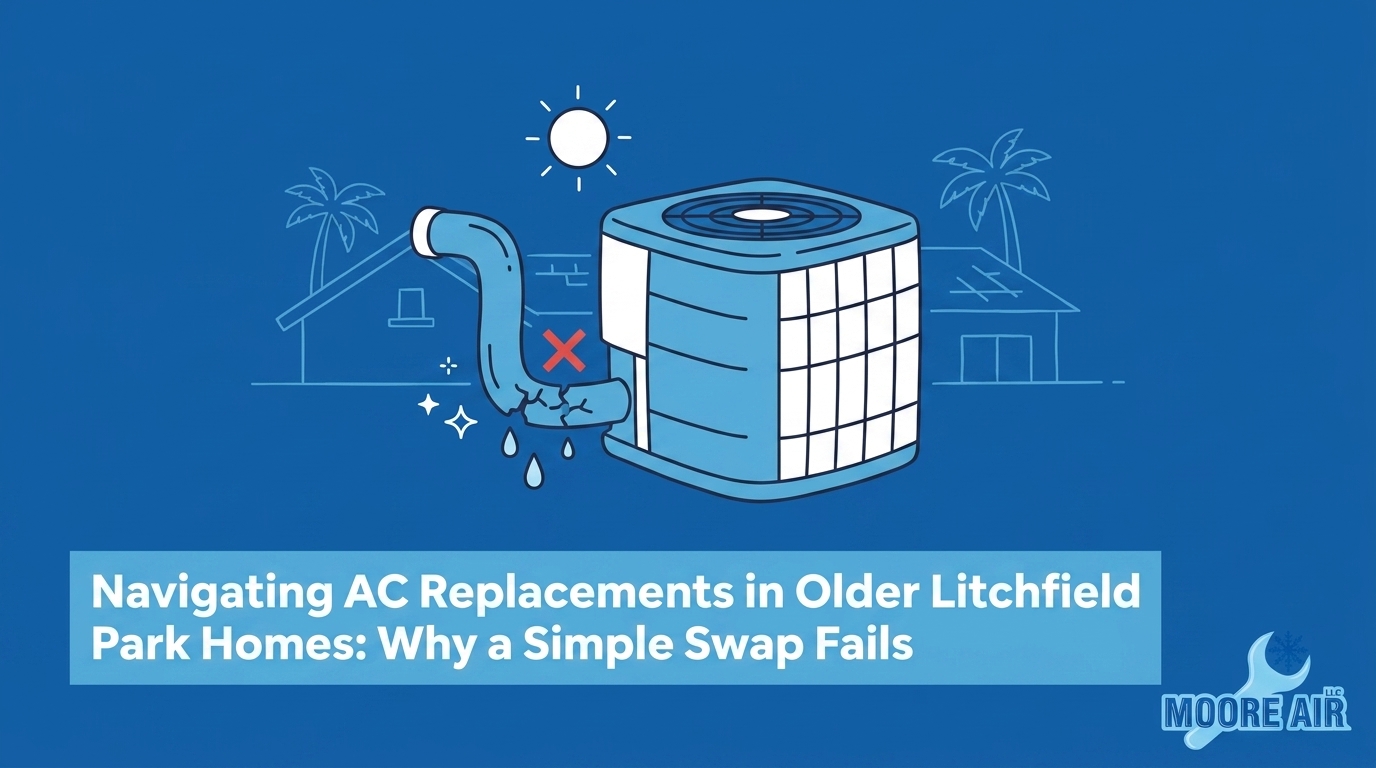
When your air conditioner gives out just as the kids are heading back to school, navigating AC replacements in older Litchfield Park homes is never as simple as buying a new box. At Moore Air, we see this scenario constantly. If you live in one of the area’s classic mid-century properties, that sudden mechanical failure usually brings an uncomfortable realization: modern cooling technology has outgrown the original footprint of your house. Late August end-of-season cooling failures are incredibly common, as aging systems finally collapse under the relentless strain of the desert summer. When that happens, the instinct is to simply pull out the old condenser and drop a new one in its place.
Here is the reality our technicians face every day: modern cooling systems require specific physical space, electrical support, and airflow infrastructure that older homes were simply never built to provide. Decades ago, air conditioners were smaller, less efficient, and drew different power loads. In our experience servicing Litchfield Park’s historic homes, attempting to force a highly advanced, modern high-efficiency AC system onto a house built in the 1960s without making the necessary structural and electrical adjustments is a recipe for immediate system failure. You cannot put a sports car engine into a vintage chassis without upgrading the transmission and exhaust.
Whether you need comprehensive air conditioning services to diagnose the failure or a complete AC installation in Litchfield Park, understanding the unique needs of your property is the first step. A successful upgrade requires a holistic approach—evaluating electrical panels, inspecting ductwork, and measuring physical alcoves—to ensure your new system operates safely and effectively.
The Physical Limitations of Historic Architecture
One of the most immediate hurdles we help homeowners navigate when updating Litchfield Park historic and mid-century builds is a sheer lack of physical space. When these homes were originally constructed, utility closets, attic spaces, and side-yard clearances were designed around much smaller equipment. Today’s air conditioners are physically massive compared to their predecessors. This size difference is not a design flaw; it is a direct result of federal efficiency mandates designed to lower energy consumption.
Forcing a large modern unit into an undersized space restricts vital airflow around the equipment. When an air handler or condenser cannot breathe, the compressor overworks, the coils freeze, and the system suffers premature wear. Modifying these physical spaces—whether by expanding a utility closet, relocating the air handler to a more accommodating space, or adjusting the outdoor pad—is a mandatory step in the retrofit process.
SEER2 Standards and Equipment Footprints
The Department of Energy recently updated its efficiency requirements with the SEER2 (Seasonal Energy Efficiency Ratio 2) standards. To achieve these higher efficiency ratings, manufacturers had to increase the surface area of the evaporator coils and condensers. More surface area allows the system to transfer heat more effectively without consuming excess electricity. However, this means the physical footprint of the equipment has grown significantly.
| Equipment Feature | Mid-Century AC Units | Modern SEER2 AC Units |
|---|---|---|
| Physical Footprint | Compact, designed for tight utility closets | Up to 30-50% larger to house expanded coils |
| Airflow Requirements | Lower volume, single-speed operation | High volume, variable-speed operation |
| Clearance Needs | Minimal clearance required | Strict clearance mandates for proper ventilation |
If you are exploring sizing your AC unit for extreme heat, it is critical to understand that the physical dimensions of the unit must align with the architectural realities of your home. A professional Moore Air installer will measure your existing space and factor in the necessary modifications long before the new equipment arrives.

Electrical Infrastructure: Why 100-Amp Panels Fall Short
Beyond physical space, the most critical bottleneck we encounter in Litchfield Park historic and mid-century builds is the electrical panel. Many older properties were originally constructed with 100-amp electrical service. Decades ago, this was more than enough power to run a basic air conditioner, a refrigerator, and standard household lighting. Today, our homes are filled with high-draw appliances, home offices, and advanced entertainment systems. When you add modern high-efficiency AC systems to a 100-amp panel, you are asking for trouble.
Attempting to run a powerful new cooling system on an outdated electrical panel is not just inefficient; it is dangerous. The immediate symptoms include constantly tripping breakers and flickering lights when the AC kicks on. Over time, this excessive strain can lead to overheated wiring and significant fire hazards. Upgrading to a 200-amp panel is typically a mandatory step when retrofitting an older home for modern cooling.
Recognizing Outdated Wiring and Breakers
Assessing the electrical panel should be the very first step in any retrofit planning. This is not an area for DIY guesswork; professional diagnosis by a licensed electrician or certified HVAC technician is required to ensure compliance with the National Electrical Code (NEC). Older wiring often lacks the proper grounding or gauge required to carry the electrical load of a modern compressor.
During a recent late-summer installation of a modern split system, our Moore Air team discovered a homeowner’s existing setup required careful wiring corrections. Because we performed a thorough assessment upfront, our installation team was able to correct the wiring and make the final adjustments to safely support the new modern high-efficiency AC system without adding surprise charges to the final bill. Proper electrical preparation ensures your new system runs smoothly from day one.
Addressing Undersized and Aging Air Distribution Systems
Your air conditioner is only as effective as the ductwork that delivers the cold air throughout your home. In older properties, original ductwork is frequently undersized, uninsulated, or rapidly deteriorating after decades of continuous use in the hot attic. Original R-4 insulated ducts or bare sheet metal configurations simply cannot handle the intense airflow demands of modern equipment.
Modern variable-speed blowers require precise static pressure to function correctly. Static pressure is essentially the resistance the air faces as it moves through the ducts. When a powerful modern blower tries to push a massive volume of air through small, old, restrictive ducts, the system chokes. The blower motor has to work twice as hard, consuming excess energy and drastically shortening the lifespan of the equipment.
The Airflow Bottleneck
Evaluating your existing air handlers and ductwork is critical to determine if resizing, sealing, or complete replacement is necessary. Ignoring the ductwork during a major upgrade is a costly mistake. If you connect a highly efficient air conditioner to leaky, undersized ducts, you will never experience the comfort or the energy savings you paid for.
Replacing an air handler and addressing distribution issues is a massive job, especially during the extreme late-summer heat, as one local homeowner recently experienced. Our Moore Air crew had to completely remove the aging equipment and overhaul the distribution setup to ensure the new system could breathe properly. If you suspect your home is suffering from an airflow bottleneck, professional ductwork services are essential to clear the path for your new AC.
Signs your older ductwork needs an upgrade:
- Hot and cold spots: Uneven temperatures across different rooms indicate poor airflow distribution.
- Excessive dust: Leaky ducts pull dust and debris from the attic and blow it into your living spaces.
- Loud whistling noises: High static pressure forcing air through tight spaces creates noticeable noise at the vents.
- High utility bills: If cooled air is leaking into the attic before reaching your rooms, your system runs longer to compensate.
The Impact of Extreme Late-Summer Heat on Retrofits
The local climate plays a massive role in how unforgiving AC installations can be. When we experience consecutive 110-degree days, there is absolutely zero margin for error in HVAC sizing and infrastructure support. Prolonged periods of extreme heat push cooling systems to their absolute limits, running compressors almost continuously to maintain indoor comfort.
If a new unit is installed without addressing the underlying ductwork or electrical bottlenecks, this extreme heat will immediately expose those weak links. A system fighting against undersized ducts will freeze up. A system drawing too much power from an old panel will trip the breaker right when you need cooling the most. Late August end-of-season cooling demands are particularly brutal because the equipment has already been running hard for months.
Holistic upgrades ensure your system can maintain indoor comfort even when outdoor temperatures remain elevated for weeks on end. Proper retrofitting protects your investment from the premature wear caused by continuous high-load operation. Investing in comprehensive energy efficiency upgrades alongside your new AC ensures the entire home works together to reject heat and retain conditioned air.
Avoiding Surprises with Transparent Retrofit Scopes
Upgrading the cooling in an older home is a complex project, and it requires absolute transparency from your contractor. Unfortunately, a pattern we see often in the industry is for contractors to quote an artificially low price for a basic unit swap, knowing full well the home requires extensive modifications. Midway through the job, they suddenly “discover” that the electrical panel needs an upgrade or the ductwork must be replaced, resulting in massive, unexpected fees.
A thorough, upfront assessment of a historic home will identify all necessary modifications before any work begins. At Moore Air, our commitment to Honest Quality Work Fair Prices means evaluating the electrical load, measuring the utility closets, and testing the static pressure of the ductwork during the initial consultation.
Transparent, honest evaluations build trust and allow you to budget accurately for the full scope of the work. Quality workmanship involves doing the hard retrofitting tasks right the first time, rather than taking shortcuts that leave you stranded with a broken system in the middle of a heatwave.
Financial Considerations and Modern Efficiency Standards
Retrofitting older architecture undoubtedly requires a larger initial investment than a simple equipment swap in a newer build. However, the long-term return on investment (ROI) is substantial. Modern high-efficiency AC systems use significantly less electricity to produce the same amount of cooling, which translates directly to lower monthly utility consumption.
When you pair a high-efficiency unit with properly sized ductwork and a stable electrical supply, the system operates exactly as the manufacturer intended. It runs shorter cycles, requires fewer repairs, and lasts years longer than a unit struggling against architectural bottlenecks.
Additionally, upgrading to highly efficient technology often qualifies homeowners for various incentives. General federal tax credits may apply to qualifying high-efficiency heat pump or air conditioning installations, and local utility providers frequently offer rebate programs for energy-saving home improvements. We always advise consulting with a tax professional or your local utility provider to verify current incentive programs and eligibility requirements.
Frequently Asked Questions About Historic Home AC Replacements
Do I need to replace ductwork with a new AC?
Not always, but it is highly likely in older homes. Original ductwork is often undersized or deteriorating, which restricts the airflow required by modern variable-speed systems. Our team will test your static pressure to determine if your existing ducts can handle the new equipment or if resizing and sealing are necessary.
Does a new AC require a new electrical panel?
If your home still has its original 100-amp electrical panel, an upgrade is almost certainly required. Modern air conditioners and household appliances draw significant power, and connecting a new high-efficiency system to an outdated panel can cause tripped breakers and serious fire hazards.
Can you put central air in a historic home?
Yes, central air can be installed in historic properties, but it requires careful planning and retrofitting. The process often involves upgrading the electrical service, creatively routing new ductwork, and modifying utility spaces to accommodate the larger physical footprint of modern SEER2 equipment.
Why is my AC struggling at the end of summer?
Late August end-of-season cooling failures occur because the system has been running under maximum load for months. In older homes, this prolonged strain exacerbates existing issues like restricted airflow and electrical fatigue, pushing aging components past their breaking point.
Why can’t I just swap my old AC unit?
A simple “box swap” fails in older homes because modern units are physically larger and require different airflow and electrical support. Forcing new equipment into an old infrastructure leads to poor performance, high utility bills, and premature mechanical failure.
How do SEER2 regulations affect replacements in mid-century homes?
SEER2 regulations mandate higher efficiency, which requires manufacturers to build units with larger evaporator coils and enhanced airflow capabilities. These larger units often do not fit into the compact utility closets of mid-century homes without structural modifications.
Partner with Local Experts for Your Retrofit Needs
Successfully upgrading the cooling system in an older property requires specialized knowledge of regional architecture and a deep understanding of modern HVAC demands. Litchfield Park historic and mid-century builds possess unique charm, but their outdated infrastructure demands a careful, holistic approach to climate control.
While the prospect of electrical upgrades and ductwork modifications can seem daunting, complex retrofits are entirely manageable with the right professional guidance. You do not have to settle for poor airflow, tripped breakers, or a system that fails when you need it most. By addressing the structural realities of your home upfront, you can enjoy the full benefits of modern, high-efficiency cooling.
Take the guesswork out of your next HVAC project. Schedule a comprehensive assessment with our Moore Air team today to understand your home’s specific requirements, and let us provide a clear, honest roadmap for your retrofit.