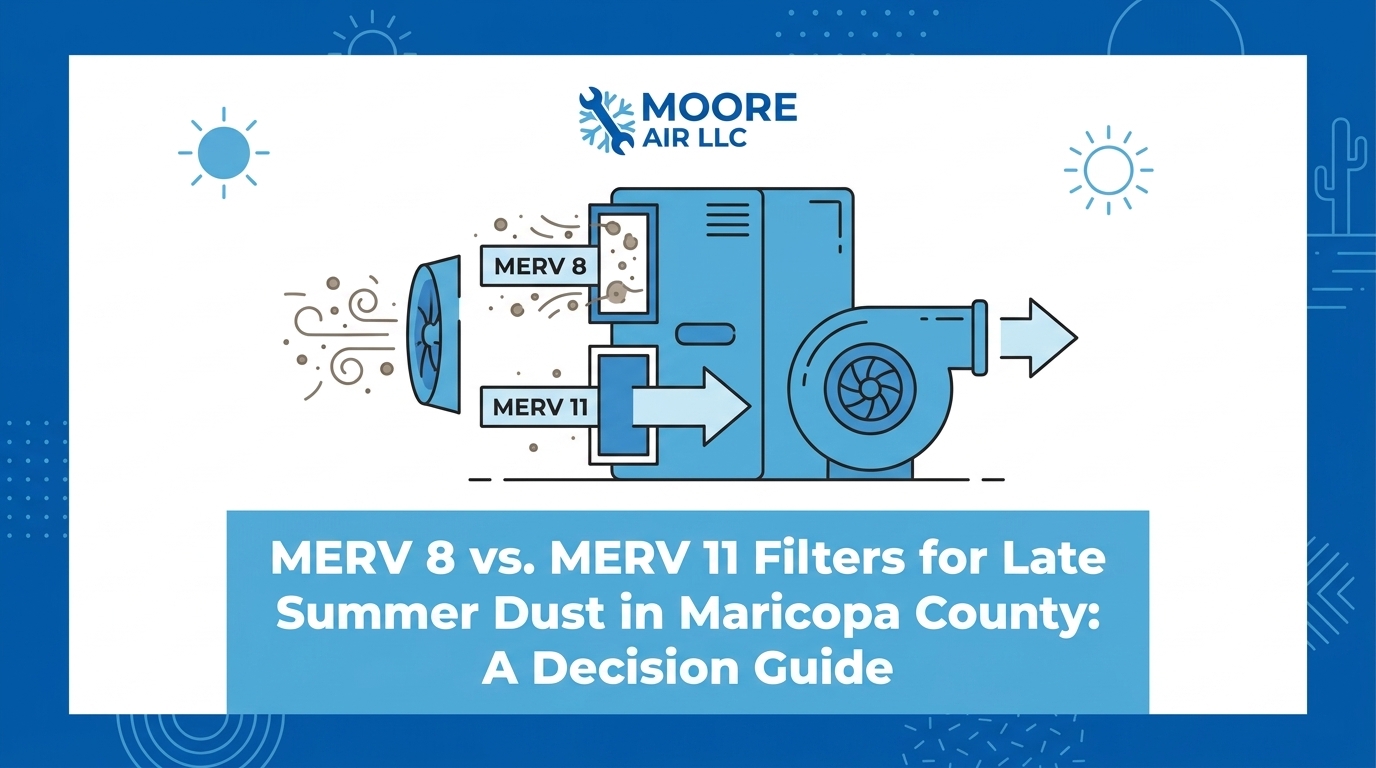
MERV 8 vs. MERV 11 Filters for Late Summer Dust in Maricopa County
The High-MERV Myth: Why More Filtration Isn’t Always Better for Your AC
Buying the highest-rated air filter on the hardware store shelf doesn’t automatically mean you get cleaner air—sometimes, it just guarantees a broken air conditioner. When comparing MERV 8 vs. MERV 11 Filters for Late Summer Dust in Maricopa County, many homeowners mistakenly assume that a higher number is always the superior choice. The logic seems sound on the surface: a denser filter traps more particles, which should lead to a healthier home environment. However, residential cooling systems are precisely engineered machines that rely on a very specific volume of airflow to function properly. If you are exploring comprehensive indoor air quality services, our team at Moore Air always recommends starting with the fundamentals of how your HVAC system breathes.
The airflow balancing act: Your air conditioner’s blower motor has to physically pull air from your home through the return ducts, force it through the air filter, push it across the chilled evaporator coil, and distribute it back into your living spaces. When you install a highly restrictive filter, you are effectively putting a mask over your air conditioner’s intake. The motor has to work significantly harder to pull the same amount of air. During peak heat, when an AC unit might run for 15 or more hours a day, this constant airflow restriction becomes a critical threat to the system’s survival.
The core decision point: The choice between MERV 8 and MERV 11 ultimately comes down to a trade-off between indoor air quality and mechanical longevity. You have to balance the pressing need to block heavy outdoor particulate matter against the risk of choking your HVAC blower motor. For homeowners in Litchfield Park and surrounding Maricopa County, our technicians have seen firsthand how making the wrong choice during the hottest part of the year can lead to expensive breakdowns and uncomfortable days without cooling.
How August Haboobs Challenge Your HVAC System
To understand why filter selection matters so much, you have to look at the severe environmental baseline of the region. The sudden influx of airborne particulate matter (PM10) generated by late summer monsoon storms creates an extreme stress test for any residential cooling system. When a massive wall of dust rolls through the valley, that particulate matter inevitably finds its way inside your home, where your HVAC system acts as a giant vacuum cleaner.
The rapid caking effect: Standard filters can handle normal household dust for months, but the August monsoon and haboob dust season changes the rules entirely. During a severe storm, a breathable filter can become caked with fine, silty dust in a matter of days. This transforms the filter media from a porous screen into a solid, impenetrable wall. When you compound this extreme dust load with the intense ambient heat of late summer, your air conditioner is forced into a dangerous cycle. The system must run continuously to maintain your thermostat setting, all while trying to pull air through a rapidly clogging barrier. If you want to understand how dust storms impact your AC condenser outside, you also have to recognize the immense strain happening inside your air handler.
The Threat of Static Pressure
Static pressure is the resistance to airflow within your ductwork and air handler. Think of it like blood pressure for your HVAC system. When dust accumulation spikes, static pressure rises dramatically. The blower motor is forced to draw more electrical current (amps) to overcome this resistance, leading to overheating and potential motor failure.
Furthermore, when airflow drops below critical thresholds due to high static pressure, there isn’t enough warm air moving over the indoor evaporator coil. Without that warm air, the refrigerant inside the coil drops below freezing, causing the condensation on the coil to turn into a solid block of ice. A frozen coil completely stops the cooling process and can cause severe liquid damage to the compressor outside.
MERV 8 Filters: The Safe Choice for Airflow and Aging Systems
For the vast majority of residential systems in Litchfield Park and surrounding Maricopa County, MERV 8 filters represent the mechanical sweet spot. A MERV 8 rating means the filter is designed to capture particles between 3.0 and 10.0 microns in size. This range effectively traps standard household dust, pollen, lint, and larger particulate matter without putting a stranglehold on your system’s airflow.
Protecting the blower motor: The primary advantage of a MERV 8 filter is that it keeps static pressure low. Because the synthetic media is less dense, the blower motor can easily pull air through it, reducing mechanical strain and electrical consumption. While it does allow more ultra-fine particles through than higher-rated options, it serves its primary purpose: keeping the internal components of your air handler clean while allowing the system to breathe freely.
Ideal for older units: This balance is especially important for aging HVAC systems. Our team at Moore Air regularly sees this exact scenario. Recently, a local homeowner reached out during a sweltering late-summer weekend when their older air conditioner suddenly stopped working right as the kids were heading back to school. One of our technicians arrived quickly and had the unit repaired in half an hour, saving the back-to-school transition. Often, sudden weekend breakdowns in older systems trace back to components that have been overworked by chronic airflow restrictions. If your air conditioner is more than a decade old, its blower motor likely does not have the strength to push through high-resistance media. A MERV 8 filter is the go-to choice for extending the life of these fragile units, ensuring they don’t overheat while trying to keep your home cool.
MERV 11 Filters: Superior Dust Capture with a Catch
If a MERV 8 filter captures the big stuff, a MERV 11 filter is designed to catch the fine, irritating particulates that slip through. MERV 11 media is tightly woven to capture particles ranging from 1.0 to 3.0 microns. This includes the ultra-fine silty dust brought in by the August monsoon and haboob dust season, as well as pet dander, smog, and certain types of smoke.
The indoor air quality benefit: For households dealing with severe allergies, asthma, or other respiratory sensitivities, the jump to MERV 11 can make a noticeable difference in daily comfort. The air coming out of the vents is objectively cleaner, and there will likely be less fine dust settling on your furniture after a storm.
The static pressure catch: The significant drawback to this superior filtration is the immediate increase in airflow restriction. The denser filter media raises the static pressure in your ductwork right out of the box, even when the filter is brand new. Once a MERV 11 filter begins collecting heavy dust from a late-summer storm, that airflow restriction multiplies rapidly. A MERV 11 filter that is only moderately dirty can choke a residential AC system just as badly as a completely neglected MERV 8 filter. If your system was not specifically designed or modified to handle high-static-pressure filters, using a MERV 11 during peak cooling season is a significant mechanical risk.
Side-by-Side Comparison: Static Pressure vs. Dust Capture
To make the best choice for your home, you need to weigh the specific trade-offs between these two filter types. The comparison below outlines how each rating impacts your air quality and your equipment during the heavy dust loads of the August monsoon and haboob dust season.
| Feature | MERV 8 Filters | MERV 11 Filters |
|---|---|---|
| Particle Capture Range | 3.0 to 10.0 microns (standard dust, pollen, lint) | 1.0 to 3.0 microns (fine dust, smog, pet dander) |
| Baseline Airflow Restriction | Low. Allows older and standard motors to breathe easily. | Moderate to High. Requires a strong blower motor. |
| Impact on Blower Motor | Minimal strain, lower wattage draw. | Increased strain, higher wattage draw, risk of overheating. |
| Risk of Frozen Coils | Low (unless left in place for months). | High (especially if not changed immediately after a storm). |
| Best Application | Older systems, standard setups, prioritizing system lifespan. | Newer systems, households with severe respiratory sensitivities. |
The summary recommendation: If your absolute priority is keeping an older AC unit alive through the intense summer heat, our team recommends sticking with MERV 8. If you have a newer system with a variable-speed blower motor and you desperately need allergy relief, MERV 11 can work—provided you are vigilant about replacement.

Prioritizing System Health Over Premium Upsells
One of the most common issues our technicians at Moore Air see in Litchfield Park and surrounding Maricopa County is the mechanical strain placed on older blowers when homeowners switch to MERV 11 without evaluating their system’s capacity. Often, homeowners are pushed toward expensive, high-MERV filters under the guise of “better air quality,” without being warned about the potential damage to their equipment.
Honest advice for older systems: Pushing a premium, restrictive filter on an aging unit is often a disservice to the homeowner. We believe in providing honest, transparent advice that prioritizes long-term system health over upselling expensive filters that could choke older AC units. For example, our team at Moore Air was contacted by a local homeowner regarding an aging air conditioner that was already 21 years old when we first serviced it. Our technician arrived quickly, got the unit running normally, and provided straightforward guidance that helped keep that exact same unit operating for another 10 years without unnecessary upselling. That kind of longevity is only possible when you prioritize airflow and reduce mechanical strain.
A safer alternative strategy: If you want cleaner air but have an older HVAC system, the most effective strategy is often to decouple your air purification from your air conditioning. Pairing a free-flowing MERV 8 filter in your central ductwork with standalone HEPA room air purifiers in your bedrooms and living spaces gives you the best of both worlds. The room purifiers scrub the fine dust out of the air you breathe, while the MERV 8 filter ensures your central AC unit isn’t suffocated in the process.
Adjusting Filter Replacement Schedules for Monsoon Season
The standard advice printed on most air filter packaging is to “change every 90 days.” While this might be true for a mild spring in a different climate, following that rule during the late summer in Arizona is a recipe for disaster. Haboob dust loads require a completely different maintenance approach to prevent catastrophic airflow drops.
Steps for monsoon filter maintenance:
- Shorten your timeline: During the August monsoon and haboob dust season, you should plan to change your filters every 2 to 3 weeks, regardless of the MERV rating.
- Perform visual inspections: Do not rely strictly on the calendar. After every major dust storm rolls through the valley, pull your filter out and hold it up to a light source. If you cannot see light shining through the media, the filter is clogged and must be replaced immediately.
- Stock up in advance: Keep a stack of 4 to 6 filters in your garage or closet before the storms hit. If you have to drive to the store every time you need a filter, you are much more likely to put off the chore, leaving your system vulnerable.
- Schedule professional check-ups: Even with diligent filter changes, fine silt can still bypass the filter housing over time. Routine professional maintenance from our experienced technicians ensures the blower motor hasn’t sustained hidden damage from restricted airflow and keeps the internal coil clean. A comprehensive HVAC maintenance plan is the best way to catch these minor airflow issues before they escalate into major mechanical failures.
Protect Your Indoor Air Quality and Your AC Unit
Ultimately, the right filter choice balances clean air with a healthy, breathable AC system. While MERV 11 filters offer excellent particulate capture, their dense media can create dangerous levels of static pressure. For most homes in Litchfield Park and surrounding Maricopa County, especially those with older equipment, a MERV 8 filter changed frequently is the safest route to maintaining comfort without risking a breakdown.
Protecting your blower motor is absolutely vital during peak late-summer heat. If you are unsure about your system’s static pressure capacity, or if you’ve noticed your unit struggling to keep up after recent dust storms, do not wait for the system to fail. Reach out to our team at Moore Air to evaluate your ductwork and ensure your system is breathing properly. Take the next step toward reliable comfort by scheduling your air conditioner maintenance today.
Frequently Asked Questions
Is MERV 11 too restrictive for my AC?
It depends entirely on the age and design of your HVAC system. Newer systems with variable-speed blower motors can often handle the increased static pressure of a MERV 11 filter without issue. However, if your air conditioner is older or has undersized return ducts, a MERV 11 filter can severely restrict airflow and cause the motor to overheat.
Does MERV 11 restrict airflow more than MERV 8?
Yes, a MERV 11 filter creates significantly more airflow restriction than a MERV 8 filter. The media in a MERV 11 filter is woven much tighter to capture smaller particles, which inherently makes it harder for the blower motor to pull air through it. As the filter collects dust, this restriction multiplies much faster than it would with a less dense filter.
Can I use MERV 11 in an older HVAC unit?
Using a MERV 11 filter in an older HVAC unit is generally not recommended by our team. Aging blower motors often lack the strength to overcome the high static pressure created by dense filter media. Forcing an older motor to work that hard can lead to premature mechanical failure, elevated energy bills, and frozen evaporator coils.
How often should I change my AC filter during Arizona dust storms?
During heavy dust storm activity, you should inspect and likely replace your AC filter every 2 to 3 weeks. The sheer volume of airborne particulate matter can completely clog a standard filter in a matter of days. Relying on the standard “90-day” rule during monsoon season will almost certainly lead to severe airflow restriction.
Why did my AC coil freeze after changing the filter?
If your AC coil froze shortly after installing a new filter, the new filter is likely too restrictive for your system’s airflow capacity. When a dense filter (like a MERV 11 or higher) prevents enough warm indoor air from blowing across the evaporator coil, the refrigerant inside drops below freezing. Swapping back to a less restrictive MERV 8 filter usually resolves the airflow issue.
Will a MERV 8 filter catch haboob dust effectively?
A MERV 8 filter will effectively capture the larger, heavier particles associated with haboob dust, protecting your HVAC equipment’s internal components. While it will not catch the ultra-fine silt as efficiently as a MERV 11, it provides a much safer balance of filtration and airflow. For the best results, use a MERV 8 filter to protect the AC unit and run standalone room purifiers to capture the finest dust particles.